Written by: Doug Camplejohn, CEO & Co-Founder, Coffee
For small to mid-sized businesses (SMBs), finding a CRM that aligns with unique workflows can feel like an uphill battle. Many traditional systems, built for larger enterprises, often fall short with rigid structures, time-consuming manual tasks, and features that don’t quite fit the needs of smaller teams. As the market evolves, a new wave of AI-first CRMs is addressing these gaps by prioritizing flexibility and automation. These platforms enable SMBs to tailor their tools to specific goals, driving efficiency and growth without requiring extensive resources. This article explores seven vital customization options in AI-first CRMs, using Coffee as a leading example of how adaptable technology can support SMB success in a competitive landscape.
Why Customization Matters for SMBs Using AI-First CRM
SMBs operate in a challenging space, needing advanced tools to compete with bigger players while managing limited budgets and staff. Traditional CRMs, often designed for complex enterprise environments, can burden smaller teams with cumbersome processes or features that don’t align with their operations.
Data highlights the issue clearly. Sales reps spend about 71% of their time on non-selling tasks like data entry, leaving only a small portion of their day for actual customer engagement. This inefficiency often ties back to systems that lack the adaptability to streamline repetitive work.
AI-first CRMs stand out because they are built on modern frameworks that handle diverse data types and automate intricate processes. Their design supports quick adjustments to changing business needs, a critical advantage for SMBs in fast-moving markets. Customization in these platforms allows companies to shape tools around their specific sales strategies and customer interactions, rather than forcing a standardized approach.
Coffee: A Leader in Customizable AI-First CRM
Coffee exemplifies the shift toward AI-first CRM solutions, focusing on automation and adaptability from the ground up. Its design integrates intelligent features to match the unique needs of each business, setting it apart in a crowded field of legacy systems.
Key customization options with Coffee include:
- AI-assisted workflow tools that manage tasks like meeting prep and follow-up notes, customized to your sales cycle.
- Pipeline tracking features that show changes over time, helping spot trends with minimal effort.
- Automatic data syncing with Google Workspace and Microsoft 365 to keep contact information current without manual updates.
- Support for sales frameworks such as BANT, MEDDIC, or SPICED, standardizing how deals are qualified across teams.
- Prospect list creation using natural language searches, refining outbound efforts with precision.
Discover how Coffee can adapt to your needs. Request access today.
7 Customization Options in AI-First CRM That SMBs Need
1. Streamline Operations with AI Workflow Automation
Automation in modern CRMs must do more than set reminders. Platforms like Coffee use AI to take over repetitive tasks, such as preparing for meetings or drafting follow-up messages, directly addressing time constraints faced by growing teams.
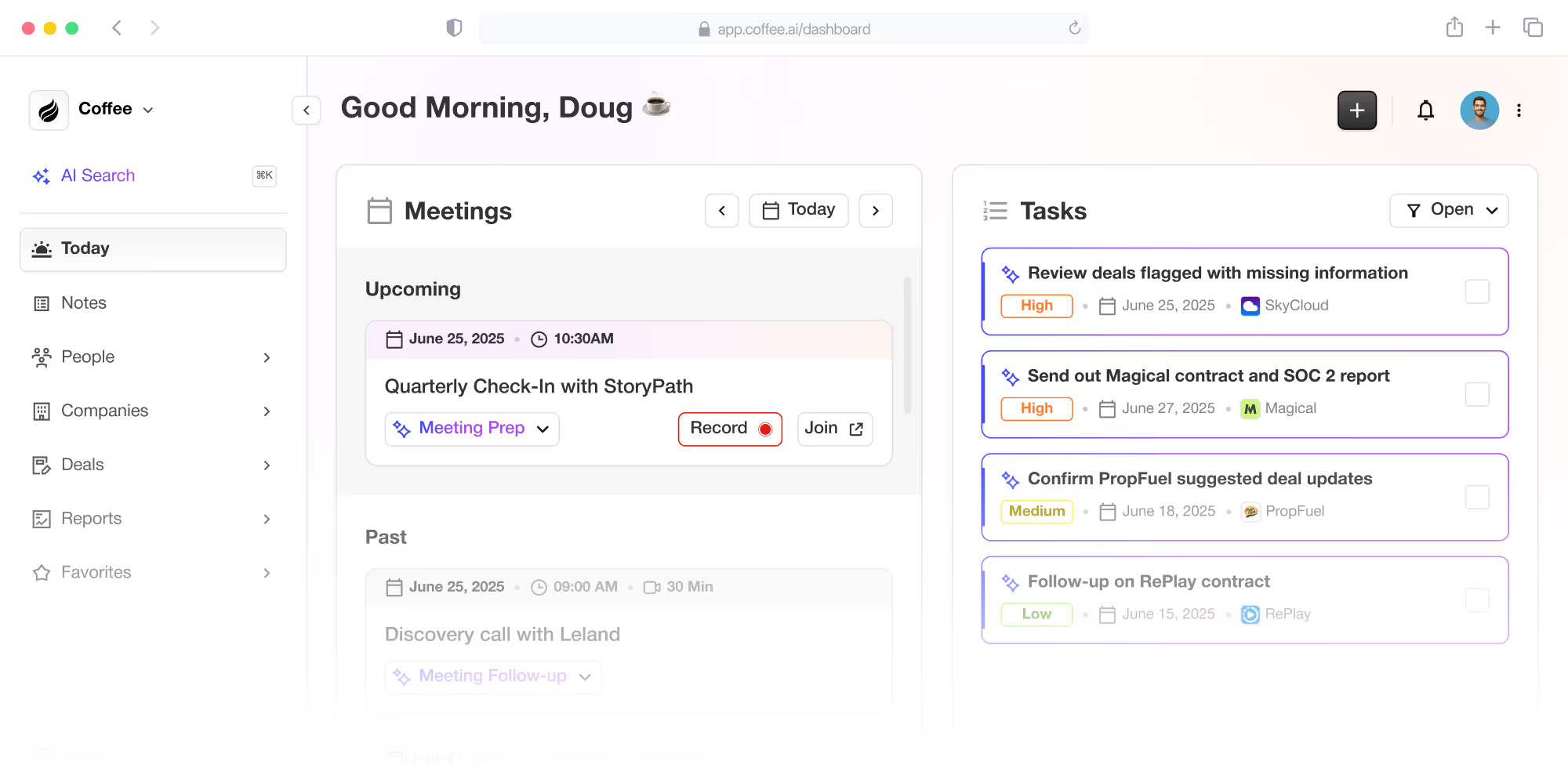
This can save sales reps an estimated 8 to 12 hours weekly by handling pre- and post-meeting logistics. Coffee offers a daily overview page with call details, attendee backgrounds, and interaction histories, ensuring reps are well-prepared without extra effort.
2. Consolidate Data for a Complete Customer Picture
Scattered customer data across multiple tools often clouds decision-making for SMBs. Coffee tackles this by syncing with Google Workspace and Microsoft 365 to automatically update and enrich contact details, creating a unified view of interactions.
With all relevant information in one place, reps can personalize outreach more effectively. This approach removes the need for separate data tools, keeping information accurate and accessible as it evolves.
3. Gain Insights with Real-Time Pipeline Tracking
Standard reports often fail to deliver timely insights for SMB sales cycles. Coffee’s pipeline comparison tool shows week-over-week changes instantly, bypassing the need for manual data pulls common in older systems.
This feature helps teams monitor deal progress, spot delays, and strategize during reviews. Historical data storage within the platform also provides a clear picture of performance trends over time.
4. Align Processes with Sales Methodology Frameworks
Sales teams rely on specific methods to qualify leads, and effective CRMs should support these practices. Coffee allows structuring meeting notes and deal assessments using frameworks like BANT, MEDDIC, or SPICED, maintaining consistency across the board.
Teams can select the framework that fits their market, whether focusing on enterprise deals with MEDDIC or customer challenges with SPICED, ensuring follow-ups reflect strategic priorities.
5. Enhance Adoption with User-Friendly Design
A CRM’s value depends on whether teams actually use it. Coffee prioritizes a design that eliminates manual data entry, making it a helpful tool rather than a burden for sales reps.
This focus on usability means the system molds to team workflows, boosting engagement and data accuracy. Higher adoption rates often lead to stronger sales outcomes through consistent interaction with the platform.
6. Refine Outreach with Targeted Prospect Lists
Building focused prospect lists is essential for SMBs, yet it can consume significant time. Coffee’s list-building tool uses natural language inputs to search for specific roles or company profiles, simplifying the process.
By tapping into enriched data, this feature ensures outreach targets the right leads, increasing efficiency and potential conversions without needing extra software.
7. Adapt to Your Setup with Flexible Integration
SMBs vary widely in their technology use, and Coffee accommodates this with two options: a standalone CRM for a full modern solution, or a companion app that enhances existing systems.
This flexibility ensures businesses can leverage AI and automation features regardless of their current tools, aligning new capabilities with established processes for a smooth transition.
Ready to shape a CRM around your business needs? Request access to explore Coffee’s tailored options.
How Coffee Compares to Traditional CRM Limitations
When looking at AI-first CRMs like Coffee alongside some older systems, the differences in adaptability and efficiency are evident:
|
Feature |
Coffee (AI-First CRM) |
Some Older CRMs |
SMB Impact |
|
Workflow Automation |
AI handles meeting prep and follow-ups |
Often relies on manual input or setup |
Saves 8-12 hours weekly per rep |
|
Data Integration |
Automatic syncing and enrichment |
Can struggle with unified data views |
Reduces need for additional tools |
|
Pipeline Tracking |
Instant week-over-week comparisons |
Limited real-time analysis options |
Supports quicker decisions |
|
Sales Frameworks |
Custom summaries for BANT, MEDDIC |
Less adaptable to specific methods |
Ensures uniform qualification |
This comparison shows why many SMBs are shifting to AI-first platforms. Coffee’s built-in flexibility and automation offer practical benefits that can be more challenging to achieve with some traditional setups.
Conclusion: Empower Growth with a Tailored AI-First CRM
The days of settling for inflexible CRM systems are fading. SMBs now have access to AI-first solutions that balance powerful features with ease of use. Coffee stands as a prime example, showing how automation and customization can work together to meet the needs of growing businesses.
The seven customization options discussed, from automated workflows to precise prospecting, provide a foundation for systems that adapt to a company’s unique challenges. They directly tackle issues like time wasted on data entry and fragmented customer insights.
Adopting an AI-first CRM equips SMBs with capabilities once reserved for large corporations, driving efficiency, enhancing customer connections, and building a sharper competitive edge. Coffee’s focus on intelligent design positions it as a valuable choice for businesses ready to evolve.
Interested in a CRM that fits your exact needs? Request access to see Coffee’s customization features firsthand.
Frequently Asked Questions (FAQ)
Can AI Features Be Customized in an AI-First CRM?
Yes, platforms like Coffee are designed for flexibility. AI tools can be configured to automate tasks, such as creating meeting summaries based on sales frameworks like BANT or MEDDIC, matching your specific processes.
How Does Customization Differ Between AI-First and Traditional CRMs?
In AI-first CRMs like Coffee, customization focuses on adjusting AI-driven tasks and data handling to fit your operations. Many older systems may require significant technical effort for similar changes, while Coffee offers user-friendly setup of automated features.
Is Advanced Customization Too Complex for SMBs?
Not with an intuitive AI-first CRM. Coffee emphasizes ease of use, allowing non-technical users to implement impactful automation through simple interfaces, scaling features as business needs grow.
What Specific Customization Benefits Does Coffee Offer Sales Teams?
Coffee aids sales teams by automating meeting workflows, aligning summaries with sales methods like BANT or MEDDIC, providing pipeline insights through comparison tools, and supporting targeted outreach with natural language searches, creating a personalized system.
What Returns Can SMBs Expect from a Customized AI-First CRM?
Implementing Coffee’s tailored features often yields significant time savings, with reps gaining 8 to 12 extra hours weekly through automation. Improved data accuracy and real-time insights enhance decisions, while consolidating tools can also reduce costs for many businesses.