Written by: Doug Camplejohn, CEO & Co-Founder, Coffee
In today’s competitive sales landscape, the ability to turn raw data into actionable insights is a game-changer for revenue growth. Sales teams face mounting pressure to deliver results, yet many struggle with fragmented data, manual processes, and outdated systems that hinder efficiency. As businesses navigate digital transformation, the demand for smarter tools that unify customer information and provide real-time intelligence has never been higher. Market trends show a clear shift toward AI-driven solutions, with spending on AI in sales expected to grow significantly in the coming years as companies seek to address these persistent challenges.
This growing need reflects a broader industry evolution. Traditional Customer Relationship Management (CRM) systems, once the backbone of sales operations, often fall short in handling modern demands for speed, automation, and predictive analytics. Meanwhile, new AI-first platforms are emerging to tackle these issues head-on, offering built-in intelligence and data unification. At the same time, augmentation tools aim to enhance existing legacy systems without requiring a full overhaul. This article dives into the details of these approaches, exploring their benefits and trade-offs to help you make an informed decision about the best path for your sales organization.
Why Sales Teams Struggle with Data-Driven Insights
Sales teams often fail to leverage data effectively due to fragmented tools and manual workflows. Many reps juggle multiple platforms like HubSpot for CRM, ZoomInfo for data enrichment, and SalesLoft for outreach. This creates silos, where customer information is scattered, obscuring a full view of interactions and buying signals. As a result, reps waste time piecing together data instead of focusing on selling.
Manual data entry adds another layer of frustration. Studies indicate that 71% of sales reps spend excessive time logging notes and updating CRM fields, leaving only about 35% of their week for actual sales activities. Errors creep in, data quality suffers, and many reps abandon official systems for personal tools like spreadsheets or Notion, further fragmenting information.
Older CRM architectures also pose challenges. Systems like Salesforce, built over two decades ago, weren’t originally designed for real-time AI demands or unstructured data like email content. HubSpot, while newer, started as a marketing tool, and its CRM features may not fully support complex sales needs. These limitations can hinder deep insights without additional customization or tools.
What Defines Effective Data-Driven Insights for Sales
Effective insights for sales go beyond static reports and dashboards. Modern teams need predictive AI that forecasts customer behavior, flags at-risk deals, and recommends next steps. This requires processing both structured data, such as deal stages, and unstructured data, like call transcripts, to deliver tailored guidance.
High-quality, unified data is the foundation of reliable AI. Without it, even advanced algorithms produce flawed results. Automating data collection and enrichment ensures accuracy and frees reps from tedious updates, enabling AI to provide meaningful, actionable intelligence.
How Coffee Delivers AI-First Sales Insights
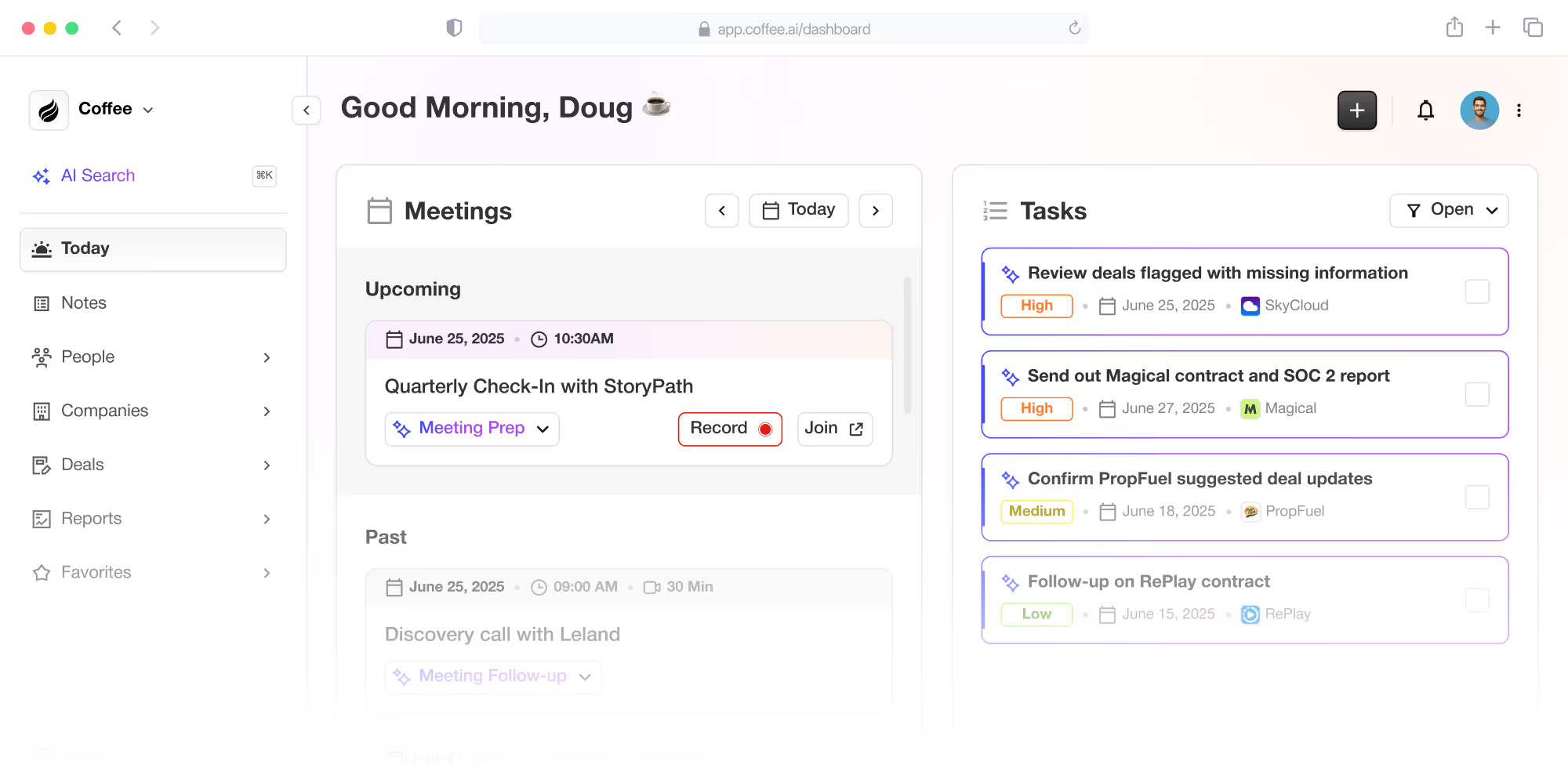
Coffee stands out as an example of the AI-first trend, focusing on native automation to ensure data quality. By connecting to Google Workspace or Microsoft 365, it scans emails and calendars to auto-create contacts and companies. Activity logging happens in real time, pulling ‘last activity’ and ‘next activity’ details without manual input. Coffee also enriches data with details like job titles and company information from licensed partners.
This automation saves sales reps an estimated 8-12 hours weekly on administrative tasks. Every interaction, from emails to meetings, ties to the right records, building a complete history. Coffee’s AI further analyzes this data for pre-meeting briefings with attendee details and past interaction summaries, ensuring reps are prepared.
During calls on Google Meet, Microsoft Teams, or Zoom, Coffee’s AI bot records and transcribes conversations. Post-meeting, it summarizes key points, identifies action items, and drafts follow-up emails for quick review and sending. Pipeline intelligence features, like the ‘Compare’ tool, show week-over-week changes in deal progress, new opportunities, and stalled prospects, all from a built-in data warehouse that stores historical snapshots.
Coffee also consolidates tools typically spread across separate vendors, combining CRM, data enrichment, call recording, and forecasting into one platform. This unified setup avoids data sync issues, reduces vendor management, and enables deeper AI insights across all customer touchpoints.
Comparing Sales Solutions: AI-First CRM vs. Legacy Augmentation
Option 1: Standalone AI-First CRM for Modern Needs
Standalone AI-first CRMs, like Coffee, are built from the ground up for today’s sales demands. Their architecture supports seamless data flow, extensive automation, and advanced analytics without legacy limitations. This setup suits small teams of 1-20 employees, startups, or founders moving beyond basic tools like spreadsheets. It offers a streamlined user experience and reduces the need for multiple vendors.
Option 2: Companion Apps to Enhance Existing CRMs
For teams committed to Salesforce or HubSpot, companion apps like Coffee’s add AI capabilities without replacing the core system. They sync data via simple authentication, improving data quality and automating tasks while maintaining existing workflows. This approach fits small to mid-sized companies or RevOps leaders aiming to boost CRM adoption and address specific pain points like manual entry.
Side-by-Side Look at Key Features
| Feature / Aspect | Standalone AI-First CRM | Legacy CRM + Companion App | Traditional Legacy CRM |
| Data Unification Depth | Built-in, comprehensive consolidation | Unified overlay on existing systems | Limited, often manual effort needed |
| Real-time AI Insights | Fully integrated across processes | Focused AI enhancements | Basic, minimal AI support |
| Automation Scope | Extensive, covers most workflows | Targeted to key pain points | Limited, manual tasks dominate |
| User Experience | Modern, adoption-friendly design | Improves legacy system usability | Often complex, low adoption |
Key Differences in Delivering Sales Insights
Data Unification and Quality
Standalone AI-first platforms like Coffee excel by natively consolidating data. Every feature uses the same high-quality information, avoiding silos common in older systems. Companion apps improve unification by overlaying intelligence on legacy CRMs, enhancing accessibility, though they may not fully overcome underlying constraints. Traditional CRMs often struggle here, relying on manual updates and integrations that can fragment data.
Depth of AI and Personalization
AI-first CRMs embed intelligence across all functions, offering tools like Coffee’s meeting briefings and pipeline analysis from historical data. Companion apps add targeted AI to existing systems, focusing on specific needs like data enrichment. Traditional setups lack this depth, often providing only basic reporting without advanced personalization.
Impact on Productivity and Automation
Coffee’s standalone platform saves reps significant time by automating data entry, meeting follow-ups, and pipeline tracking. Companion apps focus automation on high-impact areas, with savings varying by integration. Traditional CRMs, burdened by manual tasks, often reduce productivity, with reps spending excessive time on administration.
Ease of Setup and Long-Term Value
Standalone AI-first CRMs need moderate setup but deliver immediate automation benefits and simpler maintenance. Companion apps integrate quickly, though optimizing data sync may take extra effort. Scalability is stronger with AI-first systems due to modern design, while total value depends on balancing productivity gains against preserving existing investments.
Which Path Fits Your Sales Team?
Starting Fresh or Scaling a Small Team
If you’re building a sales operation from scratch or scaling a small team, Coffee’s standalone AI-first CRM offers flexibility and automation without legacy baggage. It works well for companies with 1-20 employees or founders outgrowing basic tools, especially if modern user experience and high adoption are priorities.
Enhancing an Existing Salesforce or HubSpot Setup
For teams invested in Salesforce or HubSpot, Coffee’s companion app adds AI-driven value without disrupting current systems. It suits sales leaders looking to improve data quality and adoption incrementally, especially if manual tasks or poor integration are pain points.
Consolidating Tools for Maximum Intelligence
If reducing tech stack complexity is the goal, evaluate both Coffee options. The standalone replaces multiple tools with one platform, cutting overhead. The companion app offers partial consolidation, enhancing core CRMs while potentially phasing out extra tools. Both provide robust pipeline analysis compared to traditional setups.
Common Questions About Data-Driven Sales Solutions
How Coffee Maintains High Data Quality
Coffee prioritizes data quality by automatically pulling information from emails, calendars, and calls, avoiding manual entry errors. It enriches records with external data and uses a warehouse system to store historical versions, supporting accurate pipeline analysis over time.
Reducing Manual Data Entry for Sales Reps
Coffee cuts down manual work by auto-creating contacts and logging activities from connected systems. Its AI handles meeting summaries and follow-up drafts, letting reps focus on selling while ensuring data stays current and complete for better insights.
Pipeline Intelligence Compared to Add-Ons
Coffee’s built-in ‘Compare’ feature offers one-click pipeline analysis, tracking changes without external tools. Unlike add-ons for legacy CRMs, which may require complex setups, Coffee’s unified data foundation provides seamless, context-rich insights.
Adding AI to Existing CRMs vs. Using Coffee
Customizing legacy CRMs for AI can be challenging due to older designs less suited for handling unstructured data. Coffee’s companion app overlays AI intelligence on Salesforce or HubSpot, automating tasks and unifying data without requiring a full system switch.
AI-First Platforms vs. CRMs with Added AI
AI-first platforms like Coffee integrate intelligence into every feature, ensuring seamless automation and insights. Traditional CRMs with added AI often face limitations from older structures, making their enhancements less comprehensive compared to native designs.
Shape the Future of Your Sales with Data-Driven Tools
Adopting data-driven sales strategies is now essential for staying competitive. Sticking with manual processes or fragmented systems puts organizations at a disadvantage against those using AI-powered intelligence. The decision between a standalone AI-first CRM or a legacy augmentation reflects your commitment to modernizing sales operations.
Coffee offers effective solutions for both routes. Its standalone CRM drives full modernization, while the companion app enhances existing systems with automation and insights. Explore how Coffee can elevate your sales by requesting access today at Coffee’s platform.