Written by: Doug Camplejohn, CEO & Co-Founder, Coffee | Last updated: September 4, 2026
Day.ai vs. Coffee: Quick Takeaways for Startup Teams
- Day.ai automates CRM data capture from email, calendar, and Slack, which suits 2–5 person founder-led teams that hate manual entry.
- Pipeline forecasting, integrations, and pricing transparency start to limit Day.ai once teams reach seed stage or beyond.
- Day.ai works best as a context layer rather than a full system of record, so many customers eventually add a separate CRM like HubSpot or Salesforce.
- Seed-stage and Series A teams need structured pipeline visibility, admin controls, and predictable pricing that Day.ai does not yet deliver.
For startups that want to scale without migration headaches, see Coffee’s pricing and plans and compare it to your current stack.
Where Day.ai Shines for Tiny Teams: The Zero-Data-Entry Promise
Day.ai launched in May 2023 in Boston, founded by Christopher O’Donnell and Michael Pici, the former HubSpot Chief Product Officer and VP of Sales who built HubSpot’s original CRM and Sales Hub. O’Donnell also co-founded ProfitWell, which sold to Paddle for $200M in 2022. The company has raised $24 million in total venture funding, including a $4 million seed round and a $20 million Series A led by Sequoia Capital, with Pat Grady joining the board.
The core product ingests Gmail, calendar, Zoom, and Slack, then uses an LLM to create and update CRM records automatically. Users report that Day.ai eliminates the administrative grind, acting as a digital Chief of Staff that structures customer context in real time. For a two-person founding team that lives in the inbox and dreads manual data entry, that promise feels tangible.

For a deeper look at Day.ai’s full feature set, see our Day.ai CRM Review 2026.
Where Day.ai Hits a Ceiling as You Grow
Day.ai’s limitations appear quickly as a team scales beyond a few people. Day.ai’s pricing is per deployed AI agent per month, not per human seat, with tiers ranging from Free ($0) to Executive ($200) and a 20% annual discount arranged via sales rather than a self-serve toggle. That structure makes budgeting unpredictable for growing teams.
Most teams land in the $50–$100 per user per month range with usage costs on top, yet no public list rates confirm that figure before signing. This opacity complicates planning for seed and Series A companies that track runway closely.
Day.ai’s integration footprint covers Gmail, Outlook, calendars, Slack, Notion, and video conferencing. That coverage still trails HubSpot’s 1,500+ app marketplace. Pipeline forecasting sits behind the Professional tier, which limits advanced reporting for smaller plans. These constraints become critical as teams scale, which is why Day.ai’s own blog notes that its fastest-growing customers “graduated off Day AI as their CRM” as they scaled, keeping it as a context layer alongside tools like HubSpot and Gong.
On Reddit’s r/CRM and in startup forums, founders express skepticism about AI-native CRMs, raising concerns about data accuracy and whether they can replace a structured system of record. Day.ai reached general availability in February 2026 with roughly 120 customers and no independent review base, so its scalability for growing teams remains unproven beyond an early-adopter cohort.
Explore Coffee’s pricing if you want a proactive CRM agent that scales from founder-led to Series A.
How Your Stage Shapes CRM Fit in 2026
The right CRM depends heavily on your current stage. Use this breakdown to match tools to where your company is today.
Pre-Product (No Sales Yet)
A CRM usually adds more overhead than value at this stage. A shared spreadsheet or Notion database is enough for tracking early conversations. Investing in CRM infrastructure before you have a repeatable sales motion creates process work without clear return.
Founder-Led (1–5 Employees)
Day.ai fits reasonably well here. It automates capture of early customer conversations without requiring manual logging. For call-heavy teams that hate data entry, Day.ai’s ingestion-first architecture keeps records current without human effort.
Coffee offers the same zero-entry automation and adds Lead Finder and Visitor ID. These features turn anonymous website traffic into named prospects and start building a pipeline from day one. Day.ai does not currently match those prospecting capabilities.

Seed Stage (5–20 Employees)
Seed-stage teams need structured pipeline management and week-over-week forecasting to run board reviews and manage a growing sales team. Day.ai struggles to meet those needs. Coffee’s Pipeline Compare feature visualizes deal progression, stalled opportunities, and new additions automatically. That view replaces manual CSV exports and extra tooling.
This stage highlights Coffee’s “good data in, good data out” philosophy. The agent keeps records accurate, which makes pipeline reports and forecasts more reliable.
Series A (20+ Employees)
Series A teams require robust admin controls, broad integrations, and deep customization. These areas are still maturing in Day.ai. The product was not designed to handle Salesforce or HubSpot complexity with quotas, forecasting, and required fields.
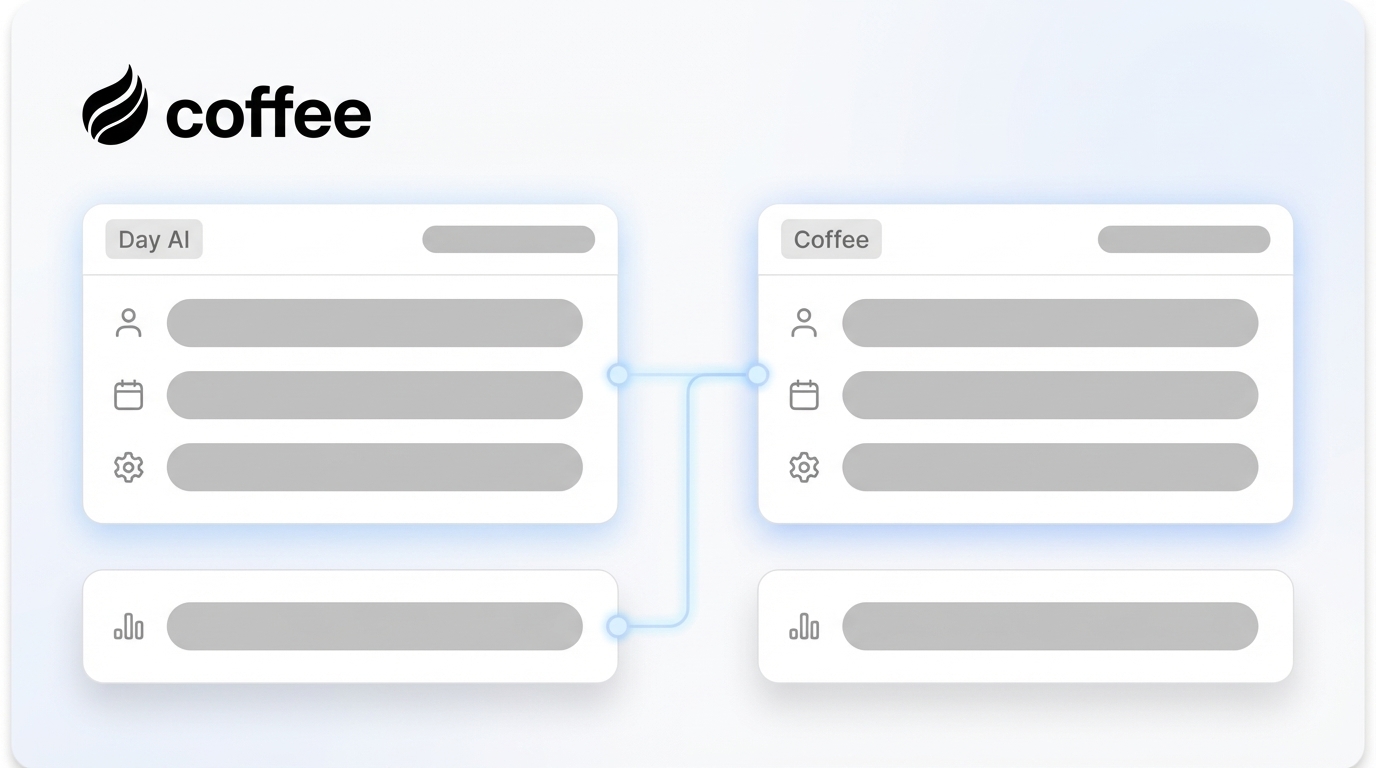
Coffee’s dual-model architecture supports this transition. You can run Coffee as a standalone CRM or as a Companion App on top of Salesforce or HubSpot. That approach preserves data integrity as headcount and deal volume grow.
Day.ai vs. Coffee vs. Attio vs. HubSpot: Direct Comparison for Startups
This section compares the main tools on data entry, pipeline management, scalability, and pricing so you can see where each one fits.
| Tool | Data entry model | Pipeline & forecasting | Scalability | Pricing style |
|---|---|---|---|---|
| Day.ai | Ingestion-first AI builds records from email, calendar, and calls. | Forecasting behind higher tiers, limited structure on lower plans. | Works well as a context layer for small teams, less proven at scale. | Per AI assistant with usage-based elements and limited public transparency. |
| Attio | Humans own records, AI is assistive and keeps structure flexible. | Strong manual pipeline tools, no automatic freshness if reps stop typing. | Great for technical teams under 20 reps that want model control. | Per-seat pricing from $29 to $69 per user per month. |
| HubSpot | Passive database with auto-logging via plug-ins and meeting tools. | Mature reporting and forecasting with extensive integrations. | Scales well but requires admin time and rep discipline. | Tiered per-seat pricing with many paid add-ons. |
| Coffee | Proactive agent automates structured and unstructured data entry. | Built-in pipeline intelligence, including week-over-week change views. | Runs as system of record for SMBs or as a layer on Salesforce/HubSpot. | Straightforward seat-based pricing with AI labor included. |
Day.ai suits call-heavy teams that hate typing and want automatic capture, yet it lacks the breadth of a complete revenue operations platform. Attio favors teams that value control and clean structure over automation. HubSpot remains the safe legacy choice for marketing-led organizations that can support admin overhead. Coffee combines Day.ai’s zero-entry automation with the pipeline intelligence of a legacy system, while avoiding manual work and painful migrations.
Try Coffee’s proactive agent for your pipeline and see how it handles your deals from day one.
For a detailed breakdown of how Day.ai and Attio compare on data architecture, see our Day.ai vs Attio comparison.
The 2–4 Week Pilot: How to Test Day.ai in Your Own Workflow
If you are still considering Day.ai, run this structured pilot before committing.
- Week 1 — Setup & Capture: Connect email and calendar. Check whether contacts and activities are auto-logged accurately. Confirm that the data stays current and correct.
- Week 2 — Pipeline & Forecasting: Create a pipeline report. Assess whether it delivers the forecasting your stage requires and shows week-over-week changes without manual exports.
- Week 3 — Integrations & Ecosystem: Test integrations with your existing tools. If you use Salesforce or HubSpot, verify that Day.ai syncs cleanly and does not duplicate or lose data.
- Week 4 — The Stop-Typing Test: Stop all manual data entry for one week. See whether the CRM stays current. A proactive agent like Coffee will keep records fresh, while a passive or ingestion-only system will fall behind.
Real User Sentiment: Trust vs. Freshness
The core trade-off is data reliability versus freshness. Day.ai’s records are current but unverified, while Attio’s are trustworthy but stale. That framing matches the central anxiety founders express in CRM evaluation forums. An AI-written record that is always up to date only helps if you trust what the AI wrote.
A Gartner survey of 645 B2B buyers conducted in May 2026 found that 69% route AI-generated insights through a human before acting on them. This skepticism is widespread, which explains why Coffee’s transparent data model and human override capabilities matter. Reps adopt tools they trust, and trust requires visibility into how data was generated and the ability to correct it durably.
Day.ai addresses this architecturally. Human corrections outrank LLM inferences in its reconciliation layer, so a user’s fix is durable and not overwritten by subsequent ingestion passes. The small customer base mentioned earlier and lack of independent reviews mean real-world evidence for that design at scale still looks thin.
Final Verdict: When Day.ai Fits and When Coffee Wins
Choose Day.ai if you are a 2–5 person, founder-led team that is call-heavy, hates data entry, and has no legacy CRM. You feel comfortable piloting it against live deal flow and auditing what the AI wrote against what actually happened.
Skip Day.ai if you are at seed stage or beyond, need reliable pipeline forecasting, require deep integrations with your existing stack, or want a proactive agent that handles both structured and unstructured data while also managing pipeline as the system of record.
Early-stage startups that want an agent to handle data entry, meeting prep, and pipeline intelligence without Day.ai’s limitations tend to see a better fit with Coffee. It scales from founder-led to Series A without a painful migration, and its seat-based pricing means you pay for humans rather than for AI usage.
Ready to automate CRM admin and get accurate pipeline intelligence? See how Coffee scales with your startup.
Frequently Asked Questions
Is Day.ai a full CRM or just a meeting assistant?
Day.ai markets itself as a unified solution combining a meeting assistant, CRM, and knowledge base. In practice, it behaves more like a customer memory layer than a full system of record. Its own blog notes that its fastest-growing customers keep Day.ai as a context layer while using a separate CRM like HubSpot or Salesforce for pipeline management.

Pipeline management features also sit behind the Professional tier. Free and Turbo users do not receive structured deal tracking, which limits how far they can push the product.
How does Day.ai’s pricing actually work for a small startup?
Day.ai charges per deployed AI assistant rather than per human seat. Teammates without an assigned assistant can use basic features for free. Published tiers range from Free ($0) to Executive ($200 per assistant per month), with a 20% annual discount available through sales.
For a 10-person team with two deployed Professional assistants, the monthly cost would be approximately $120. Usage-based costs on top of that figure are not publicly listed, which makes budget forecasting difficult. Coffee uses straightforward seat-based pricing where the agent’s labor is included without metering AI usage separately.
What does Coffee do that Day.ai does not?
Coffee operates as a proactive agent across the full revenue workflow, including data capture, prospecting, and pipeline intelligence.

Key capabilities that Day.ai does not currently offer include:
- Visitor ID: turns anonymous website traffic into named, qualified prospects.
- Lead Finder: builds targeted prospect lists from a built-in database using natural language.
- Campaigns: runs multi-step AI-generated email sequences natively from the rep’s own mailbox.
- Pipeline Compare: visualizes week-over-week deal changes automatically without CSV exports.
Coffee also operates as either a standalone CRM or a Companion App on top of Salesforce or HubSpot. It has deep integration knowledge of quotas, forecasting, and required fields, which newer AI-native tools have not yet matched.
At what stage should a startup switch from Day.ai to a more robust CRM?
The inflection point usually arrives when a team reaches five or more people and begins running structured pipeline reviews, managing multiple concurrent deals, or hiring dedicated sales reps. At that stage, the absence of reliable forecasting, limited integration breadth, and opaque pricing in Day.ai create friction that compounds as the team grows.
Seed-stage teams in particular need week-over-week pipeline visibility and the ability to forecast for board meetings. Those needs call for a system of record with a built-in data warehouse rather than a separate memory layer.
Can Coffee work alongside an existing Salesforce or HubSpot instance?
Yes. Coffee offers a Companion App model specifically for teams already committed to Salesforce or HubSpot. The Coffee Agent connects via authentication, then handles the data-in process, auto-creating contacts, logging activities, enriching records, and generating meeting summaries while writing valuable insights back to the primary CRM.
This setup keeps the system of record accurate without human effort and preserves the existing investment in Salesforce or HubSpot. Coffee recommends this path for Series A teams and beyond that need deep integration support without migrating their entire data infrastructure.