
Sales professionals today face a crowded market landscape where technology, while meant to simplify work, often adds complexity. The CRM industry, valued at over $50 billion globally, continues to grow as businesses seek tools to manage customer relationships and drive revenue. Yet, many sales teams find themselves stuck in a cycle of administrative overload. Traditional CRM systems, initially designed to organize data and streamline processes, frequently demand time-consuming manual updates, pulling focus away from core selling activities. This tension reflects a broader challenge in the sales tech space: balancing operational needs with the human element of building client connections.
Amid this, AI-driven solutions are gaining traction, offering a way to handle repetitive tasks while allowing sales reps to prioritize relationships. Tools like Coffee represent a shift toward intelligent automation, helping teams navigate the complexities of modern sales environments. In this guide, we’ll walk through a practical four-step framework to delegate non-sales responsibilities using AI CRM technology. You’ll learn how to pinpoint tasks to offload, set up automation, and track results, with the goal of freeing up time for what matters most, closing deals.
Why Delegating Non-Sales Tasks Is Critical for Sales Teams
Sales reps often spend only a small portion of their day on actual selling. Data shows that only about 35% of their time goes to direct sales activities, with the rest consumed by administrative duties like data entry and reporting. This imbalance not only slows down individual performance but also impacts overall revenue when top performers are bogged down by routine work.
Common barriers to delegation include concerns about losing control over tasks, distrust in automated systems, or uncertainty about which responsibilities can be handed off. However, failing to address these issues can lead to burnout and missed opportunities. Let’s look at the key non-sales tasks that often take up valuable time:
- Data entry and CRM updates, which involve logging contacts and deal progress manually.
- Reporting and documentation, including compiling sales reports for management.
- Scheduling and logistics, such as arranging meetings or travel for outside sales reps.
- Pre- and post-meeting follow-ups, which include routine client communications.
Addressing these time drains through delegation, especially with AI tools, can shift focus back to selling. If you’re looking to improve your team’s efficiency, explore how AI CRM can support this process by visiting Coffee’s access page.
Step 1: Pinpoint Non-Sales Tasks for Delegation
To delegate effectively, start by understanding where your team’s time goes. Many sales leaders are surprised to find out how much effort is spent on non-selling activities once they dig into the details.
Begin with a time audit. Have your team track their activities in 30-minute blocks for a week, labeling each as either direct selling, like client calls, or administrative, like CRM updates. Use basic tools like spreadsheets for this. You’ll likely uncover that selling time is far less than expected, often closer to half the day or less.
Next, group tasks by their potential for delegation or automation. Focus on routine duties like data entry, which AI can handle, or logistics like scheduling, which support staff might manage. The aim isn’t to remove the human touch from sales but to free up space for meaningful interactions while automating the repetitive parts.
Step 2: Choose the Right Resource for Delegation
Delegation today isn’t just about assigning tasks to people. It includes leveraging AI tools alongside human support to boost efficiency without sacrificing quality.
For complex issues or sensitive client matters, human support like sales operations staff is still vital. They can handle nuanced problems or detailed research that requires judgment. However, adding more staff comes with costs and scalability limits, which is where AI steps in.
AI CRM systems work around the clock, managing high-volume, repetitive tasks with consistency. Platforms like Coffee act as a virtual assistant, learning from user behavior to automate routine work. This allows your team to focus on strategic priorities while AI handles the background operations.
Step 3: Automate Delegation with AI CRM Tools Like Coffee
Coffee stands out in the AI CRM space by focusing on automating specific non-sales tasks, letting sales reps concentrate on client relationships. As an example of the broader trend toward AI-driven sales tools, Coffee integrates with existing systems to simplify workflows.
One key feature is automatic data entry. By linking to your email and calendar, Coffee pulls in contact details and updates CRM records without manual effort. It also enriches data with job titles, company info, and location details, keeping everything current.
Meeting management is another area where Coffee adds value. It offers pre-meeting briefings with attendee and company details, transcribes calls during sessions, and drafts follow-up emails afterward. This cuts down on administrative follow-up time significantly.
For pipeline tracking, Coffee’s Compare tool shows week-over-week changes instantly, removing the need for manual data analysis. Its List Builder also simplifies prospecting by creating targeted lists from natural language queries, saving time on research.
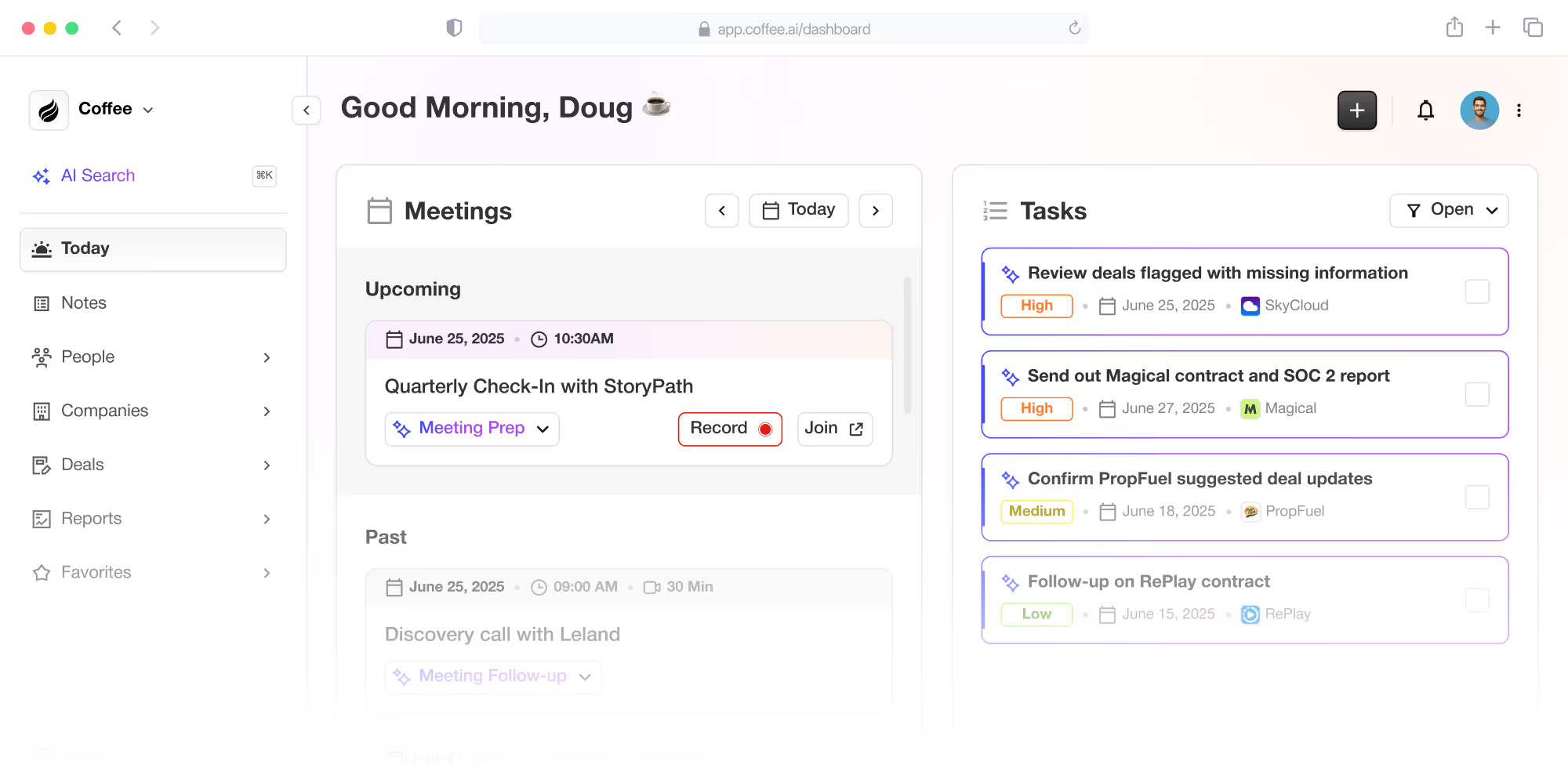
To see how Coffee can fit into your workflow, check out more details at Coffee’s request access page.
Step 4: Track and Improve Your Delegation Strategy
Delegation isn’t a one-time fix. It requires ongoing attention to ensure time savings and maintain quality. Start by setting up integrations with tools like Coffee, which connects easily to email, calendar, and existing CRM systems like Salesforce or HubSpot.
Measure success by comparing baseline data, such as hours spent on admin tasks, to post-delegation numbers. Look at metrics like follow-up speed or CRM data accuracy. Regular feedback from your team also helps refine the process, identifying where automation works well or needs adjustment.
Keep optimizing over time. Review performance data and expand automation to new areas as your team adapts. This continuous approach ensures delegation delivers lasting value.
Comparing AI CRM to Traditional Task Management Methods
AI CRM offers distinct advantages over older systems or manual processes, but it’s worth weighing the trade-offs to make an informed choice.
|
Feature/Aspect |
Coffee AI CRM |
Legacy CRM |
Manual Process |
|
Data Entry & Enrichment |
Automatically updates and enriches contacts from email and calendar data. |
Often requires manual input, risking incomplete records. |
Time-consuming, prone to errors, fully manual effort. |
|
Meeting Summaries |
AI creates summaries and action items, tailored to sales methods. |
Relies on manual note-taking and follow-up work. |
Inconsistent notes, no structure, high time cost. |
|
Pipeline Reporting |
Instant snapshots of changes, no manual analysis needed. |
Requires exporting data, often into spreadsheets. |
Delayed insights, heavy reliance on manual updates. |
|
Lead Prospecting |
Builds lists via natural language searches, automates research. |
Depends on manual searches or external tools. |
Slow, manual compilation from multiple sources. |
AI tools like Coffee reduce errors and save time compared to legacy CRMs, which often need more manual oversight. Manual processes, while flexible, can’t match the speed or consistency of automation. On the downside, AI systems may require setup time and occasional monitoring to handle edge cases. Traditional methods, though familiar, often lead to inefficiencies that hinder scalability.
Conclusion: Let Your Sales Team Focus on Selling
Delegating non-sales tasks with AI CRM can significantly improve how sales teams operate. By following a structured approach, from auditing time to automating routine work with tools like Coffee, you can boost efficiency and let reps focus on building relationships.
As part of the growing trend of AI in sales, Coffee offers a practical solution to common pain points, automating tasks while integrating with existing platforms. This shift not only saves time but also positions companies to stay competitive in fast-moving markets.
Ready to see the difference for your team? Visit Coffee’s access page to explore how AI CRM can streamline your workflow.
Common Questions About AI CRM Delegation
What tasks can AI CRM automate for sales teams?
AI CRM handles repetitive tasks like contact updates, activity logging, meeting summaries, follow-up drafting, and pipeline analysis. Coffee, for instance, automates data entry and prospecting list creation, reducing manual workload.
How does Coffee maintain data accuracy compared to older CRMs?
Coffee pulls data directly from emails and calendars, minimizing errors from manual input. Unlike traditional CRMs, where data quality often suffers over time, Coffee keeps records consistent with automated updates.
Does delegating to AI mean losing control over sales processes?
No, AI delegation enhances control. Coffee provides full visibility into automated actions, offers pre-meeting insights, and lets reps customize settings, ensuring they stay focused on high-value work.
How soon can teams see results from AI CRM delegation?
Many teams notice time savings within a week of using Coffee, with broader productivity gains within a month. Early benefits include automated data entry and meeting follow-ups as the system adapts to user needs.
Can Coffee work with our current sales tools?
Yes, Coffee integrates with Google Workspace, Microsoft 365, Salesforce, and HubSpot. It also supports Zapier for additional connections and offers an API for custom setups, fitting into existing workflows.