
For small to mid-market businesses, Salesforce remains a critical tool for managing sales processes, yet many struggle with data fragmentation and manual tasks that slow down growth. The CRM market has evolved significantly, with a growing demand for tools that integrate smoothly and reduce administrative burdens. Research indicates that sales teams lose substantial time on non-selling activities, often spending less than 40% of their hours engaging with prospects due to inefficiencies in data handling and system integration (Salesforce sales productivity statistics). This landscape reflects a broader trend toward automation and AI-driven solutions that address these pain points directly. In this context, companion apps like Coffee stand out as part of a wave of innovation, offering practical ways to enhance Salesforce functionality. This article explores seven leading sales apps designed for straightforward integration with Salesforce, helping sales leaders and teams improve data accuracy, streamline workflows, and focus on closing deals.
Why Easy Salesforce Integration Matters for SMBs
Small to mid-market businesses rely on Salesforce to drive sales, but poor integration can turn a powerful tool into a productivity drain. Without seamless connections between systems, sales operations face significant hurdles that impact efficiency and revenue.
- Data silos create gaps in customer information as tools like lead enrichment or call recording operate separately, leaving sales reps with incomplete views of prospects.
- Manual data entry consumes hours, pulling focus from selling, with many reps spending excessive time updating records instead of engaging clients.
- Technical barriers, such as API limits, lead to sync delays or failures, especially for teams without dedicated IT support to troubleshoot issues.
- High costs of traditional integration middleware add financial strain, often requiring custom work or ongoing maintenance that SMBs can’t sustain.
Finding apps that integrate effortlessly with Salesforce can eliminate these challenges, turning your CRM into a reliable, efficient system. Modern solutions focus on automation and simplicity to deliver value without complexity. Curious about how this can work for your team? Request access to explore tools that simplify your workflow.
Top Salesforce Sales Apps for Simple Integration
1. Coffee: Automate Data Entry and Enhance Salesforce Records
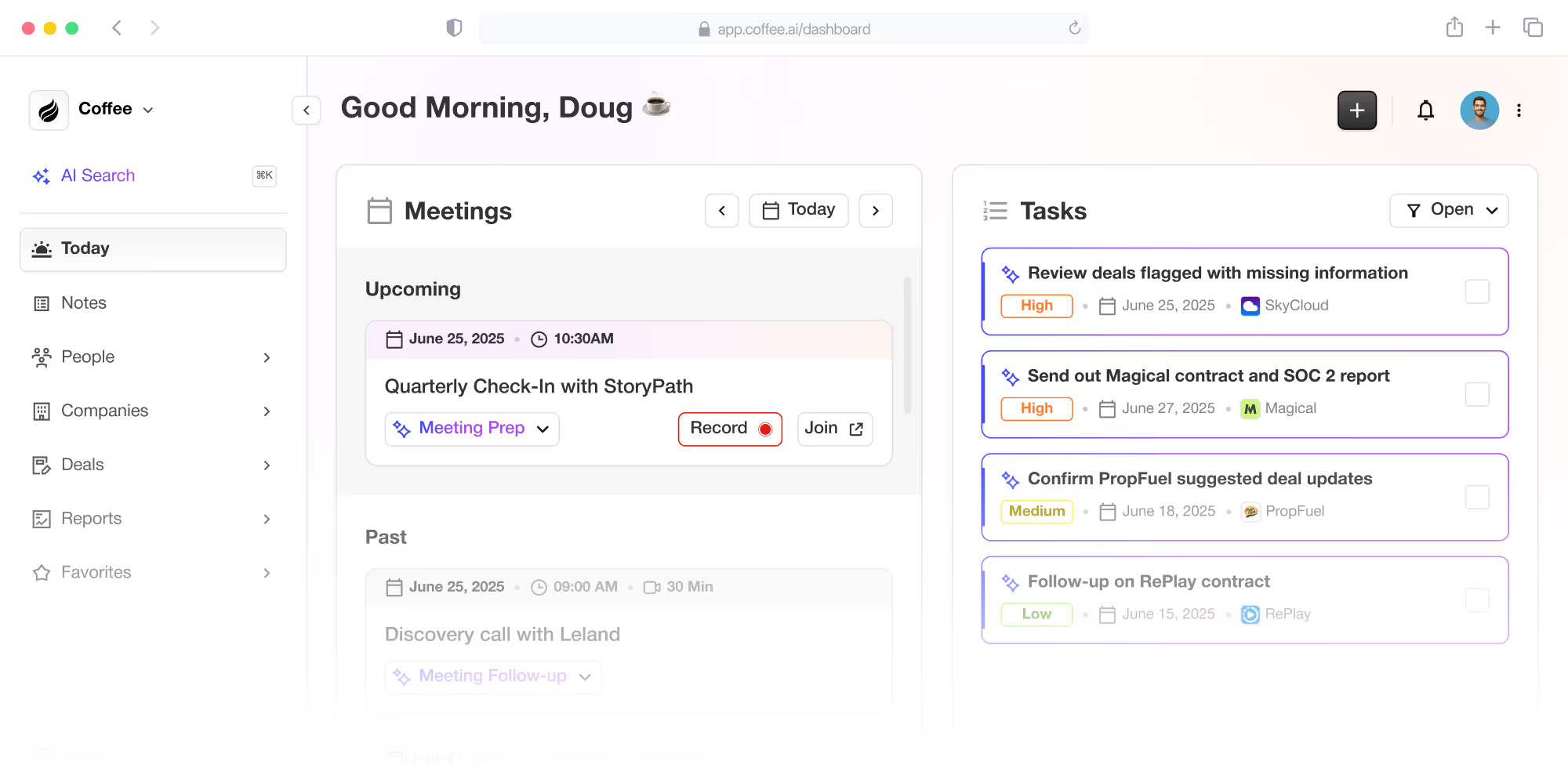
Coffee offers a practical solution to one of the biggest Salesforce challenges: manual data entry. By automatically capturing and organizing customer interactions, this app syncs both structured data, like contacts and deals, and unstructured data, such as emails or meeting notes, directly into Salesforce. Sales reps save an estimated 8 to 12 hours weekly, freeing them to focus on client relationships instead of administrative tasks.
The setup process is user-friendly, relying on a basic authentication step to connect with Salesforce. Coffee uses AI to create and enrich records from email and calendar activity, ensuring your CRM stays current without extra effort. This tackles data fragmentation head-on by consolidating information in one place. Additionally, its pipeline intelligence feature provides week-over-week comparisons of deal progress, helping managers spot stalled opportunities or growth trends without manual exports. As part of the trend toward AI-first tools, Coffee exemplifies how automation can elevate Salesforce into a proactive sales resource.
2. Outreach: Simplify Sales Engagement with Salesforce Sync
Outreach helps sales teams manage engagement through email sequences and call tracking, integrating directly with Salesforce. A quick OAuth setup enables two-way data sync, automatically logging activities like emails or calls to CRM records. This reduces manual updates and keeps data consistent across platforms.
Designed to handle Salesforce’s API constraints, Outreach uses batch processing to maintain reliable syncs even during high activity. Its straightforward field mapping cuts down on configuration time, making it accessible for teams with limited technical resources.
3. ZoomInfo: Improve Lead Data Within Salesforce
ZoomInfo enhances Salesforce by delivering real-time contact and company details directly in the CRM. Sales reps can access enriched data without switching tools, streamlining outreach efforts. Installation is simple through the Salesforce AppExchange, with an easy-to-use interface for mapping fields, though setup duration may depend on specific needs.
The app’s design ensures efficient data updates, working within Salesforce limits to avoid sync issues. This focus on usability makes ZoomInfo a practical choice for teams needing better lead intelligence.
4. Gong: Gain Insights from Sales Conversations
Gong captures and analyzes sales calls and meetings, syncing insights like competitor mentions or next steps to Salesforce deal records. Setup uses standard Salesforce integration methods, allowing quick configuration for automatic call logging and analytics. This connection ensures managers and reps see deal progress without extra data entry.
Using webhook technology, Gong updates Salesforce in real time while managing API usage effectively. Only key insights are synced, preventing data overload while still covering essential interaction details.
5. HubSpot Sales Hub: Connect Marketing and Sales Data
For teams using HubSpot alongside Salesforce, Sales Hub offers automation with a focus on data consistency. Its two-way sync and automated deduplication keep records aligned across platforms. Recent updates have simplified setup for SMBs, reducing onboarding time and minimizing data silos through better field mapping.
The integration uses algorithms to prevent data conflicts, cutting down on manual oversight. This makes it a solid option for businesses balancing multiple systems without deep technical expertise.
6. Salesforce Einstein: Access Built-In AI Insights
As a native Salesforce feature, Einstein delivers AI-driven predictions like lead scoring and deal closure likelihood without external setup hassles. It uses existing CRM data to provide insights on follow-up timing and opportunity health, improving decision-making for sales teams.
Being built into Salesforce, Einstein avoids many API sync issues, though complex use may still require additional configuration or licensing. Its direct integration offers a reliable way to add intelligence to your CRM.
7. Clari: Streamline Revenue Operations with Salesforce
Clari focuses on revenue intelligence, syncing pipeline data with Salesforce to improve forecasting accuracy. Its integration allows sales leaders to track deal health and identify risks directly within the CRM. Setup is designed to be efficient, leveraging pre-built connectors for quick deployment.
Clari manages data updates to stay within Salesforce constraints, ensuring consistent performance. This makes it a useful tool for teams prioritizing pipeline visibility and operational alignment.
Want to see how automation can redefine your Salesforce experience? Request access to learn more about tailored companion apps.
How to Pick the Right Salesforce Companion App
Choosing a sales app for Salesforce involves weighing factors that impact both immediate setup and long-term value. Sales leaders and admins should focus on practical criteria to ensure the tool fits their team’s needs.
- Data consistency hinges on clear field mapping and governance. Apps with automated cleansing and deduplication reduce errors and save time.
- API handling is critical for real-time syncs. Look for tools with efficient batching and alerts for when limits are neared.
- Security must meet industry standards like SOC 2 or GDPR. Check encryption practices and access controls to protect your data.
- Integration type, whether native or through platforms like Zapier, affects performance. Native connectors often excel for core tasks, while iPaaS suits simpler links.
Comparison Table: Salesforce Integration Features
|
Feature |
Coffee |
Traditional Apps |
Manual Methods |
|
Real-Time Data Sync |
Yes (Two-Way) |
Partial |
Manual/Batch |
|
Automated Data Enrichment |
Yes (Included) |
Paid Add-On |
Manual Research |
|
Pre-Built Connectors |
Yes (Native) |
Limited |
Custom Development |
|
Setup Complexity |
Low (OAuth) |
Moderate |
High (Technical) |
Ready to upgrade your Salesforce with minimal hassle? Request access to see how Coffee can automate data tasks and boost pipeline visibility.
Common Questions About Salesforce Integrations
What Challenges Come with Integrating Apps to Salesforce?
Integrating new apps often involves navigating API limits that can disrupt syncs, handling data duplication from manual inputs, and managing the expense of middleware solutions. Real-time sync failures are especially tricky, as they create inconsistencies requiring time-consuming fixes. Multiple tools for different functions can also trap data in silos, complicating a unified view of customer activity. Security adds another layer, with compliance needs demanding careful attention to data protection and access tracking.
How Can Data Quality Be Maintained with Integrations?
High data quality starts with defined governance, including ownership roles and validation rules to block duplicates. Apps with two-way sync and built-in deduplication help minimize errors from manual entry. AI tools that pull data from emails or calls further improve accuracy by automating updates. Regular audits and user training ensure long-term consistency as your systems scale.
Do iPaaS Tools Cover All Integration Needs?
Platforms like Zapier work well for basic integrations, offering user-friendly connectors at lower costs. However, they fall short for complex workflows or high-volume real-time needs, where delays or feature gaps can arise. For critical processes, native integrations often provide better reliability and depth. A mixed approach, using iPaaS for minor tasks and native tools for essentials, frequently strikes the best balance.
What Security Factors Should Be Reviewed for Integration Apps?
Start by confirming certifications like SOC 2 or ISO 27001 and compliance with regulations such as GDPR. Examine how data is encrypted and stored, and verify access control options. Review vendor policies on data handling and retention to ensure alignment with your standards. Apps should also offer audit logs and alerts to support ongoing security monitoring and risk management.
How Is ROI Measured for Salesforce Integrations?
Track ROI by measuring time saved on manual tasks like data entry or reporting. Improved data quality shows in better lead conversions and forecast precision. Sales productivity gains, such as shorter cycles or higher activity, also reflect value. Factor in both direct cost savings and indirect benefits like enhanced decisions or customer satisfaction. Many teams see returns within months through increased efficiency alone.
Final Thoughts on Enhancing Salesforce with Integrated Apps
Salesforce provides a strong base for sales operations, but companion apps unlock its full capability by cutting out manual work and data silos. For SMBs, the right integration can shift a CRM from a burden to a growth driver. Tools like Coffee highlight a shift toward AI and automation, showing how technology can refocus teams on relationships over admin tasks. By prioritizing simple setup and reliable data sync, these apps help build scalable sales systems. Ready to enhance your CRM with intelligent automation? Request access to Coffee and streamline your Salesforce today.