
In today’s fast-paced business world, companies are grappling with a shifting market landscape where customer expectations demand personalized, timely interactions. Traditional Customer Relationship Management (CRM) systems, once the backbone of sales strategies, now often fall short due to fragmented data and time-consuming manual tasks. This gap has paved the way for AI-first CRM platforms to emerge as vital tools, automating routine work and unifying customer insights to help sales teams focus on building relationships. Among these innovations, Coffee stands out as a practical example, offering a solution that enhances engagement and productivity for businesses of all sizes. Let’s explore how this technology addresses common challenges and drives real results.
Why Traditional CRMs Struggle to Support Customer Engagement
Fragmented Data Limits Customer Understanding
Customer interactions today happen across multiple channels, from emails to social media to phone calls. Traditional CRMs, however, often fail to connect these dots, leaving sales teams with scattered information. Platforms like Salesforce and HubSpot, while widely used, can require manual effort to piece together data from various sources. This creates gaps in understanding customer needs and histories, making it harder to deliver relevant responses. Without a complete picture, sales reps risk missing key opportunities, which can weaken trust and lower engagement levels.
Manual Tasks Drain Time and Focus
Another major hurdle with traditional CRMs is the heavy reliance on manual data entry. Sales reps spend countless hours updating contact details, logging calls, and recording meeting notes. This repetitive work cuts into time that could be spent on high-value tasks like researching prospects or nurturing relationships. As a result, reps may enter conversations unprepared, lacking the context needed to address customer concerns effectively. Errors or outdated data from manual input only add to the problem, further disrupting engagement efforts.
How AI-First CRM Enhances Engagement and Productivity
Unified Data for a Clearer Customer Picture
AI-first CRM platforms tackle data fragmentation head-on by automatically pulling information from various touchpoints, such as emails, calendars, and other tools. This creates a single, up-to-date view of each customer relationship. Sales teams no longer need to jump between systems to gather details. Instead, they have instant access to interaction histories and preferences, allowing for more tailored and effective communication. This approach directly supports stronger customer connections by ensuring reps are always informed.
Automation Frees Time for Relationship Building
By automating repetitive tasks, AI-first CRMs enable sales reps to prioritize meaningful work. Data entry, contact updates, and activity logging happen without manual input. Beyond that, these platforms streamline meeting preparation with detailed briefings and handle post-meeting follow-ups by summarizing discussions and drafting emails. This shift saves hours each week, letting reps invest more energy in understanding customer challenges and closing deals. The result is not just saved time, but also improved interaction quality.
Coffee: A Leading Example of AI-First CRM Benefits
Coffee exemplifies how AI-first CRM can address the shortcomings of traditional systems. Designed as an intelligent assistant for sales teams, Coffee focuses on simplifying workflows and enhancing customer relationships. It offers two options to suit different needs: a standalone CRM for small to mid-sized businesses looking for a modern solution, and a companion app that integrates with existing Salesforce or HubSpot setups to add AI-driven features.
Here are some standout capabilities of Coffee that directly improve engagement and productivity:
- Automatic Data Capture and Enrichment: Coffee populates contact and company details by analyzing emails and calendar events, keeping records current without manual effort.
- AI-Assisted Meeting Support: It provides pre-meeting summaries with attendee details and past interactions, while post-meeting, it creates summaries and follow-up drafts to maintain momentum.
- Pipeline Insights with Comparison Tools: Coffee tracks deal progress over time, highlighting changes and flagging opportunities that need attention for proactive outreach.
- Targeted Prospecting with List Builder: Using natural language queries, Coffee helps build prospect lists for personalized outreach, increasing response chances.
- Integration as a Companion App: For businesses already using Salesforce or HubSpot, Coffee enhances those systems with AI automation, avoiding the need for a full overhaul.
Coffee’s design prioritizes ease of use, encouraging sales reps to adopt it as a helpful tool rather than a burden. By centering on relationship-building features, it redefines CRM as a true partner in sales success.
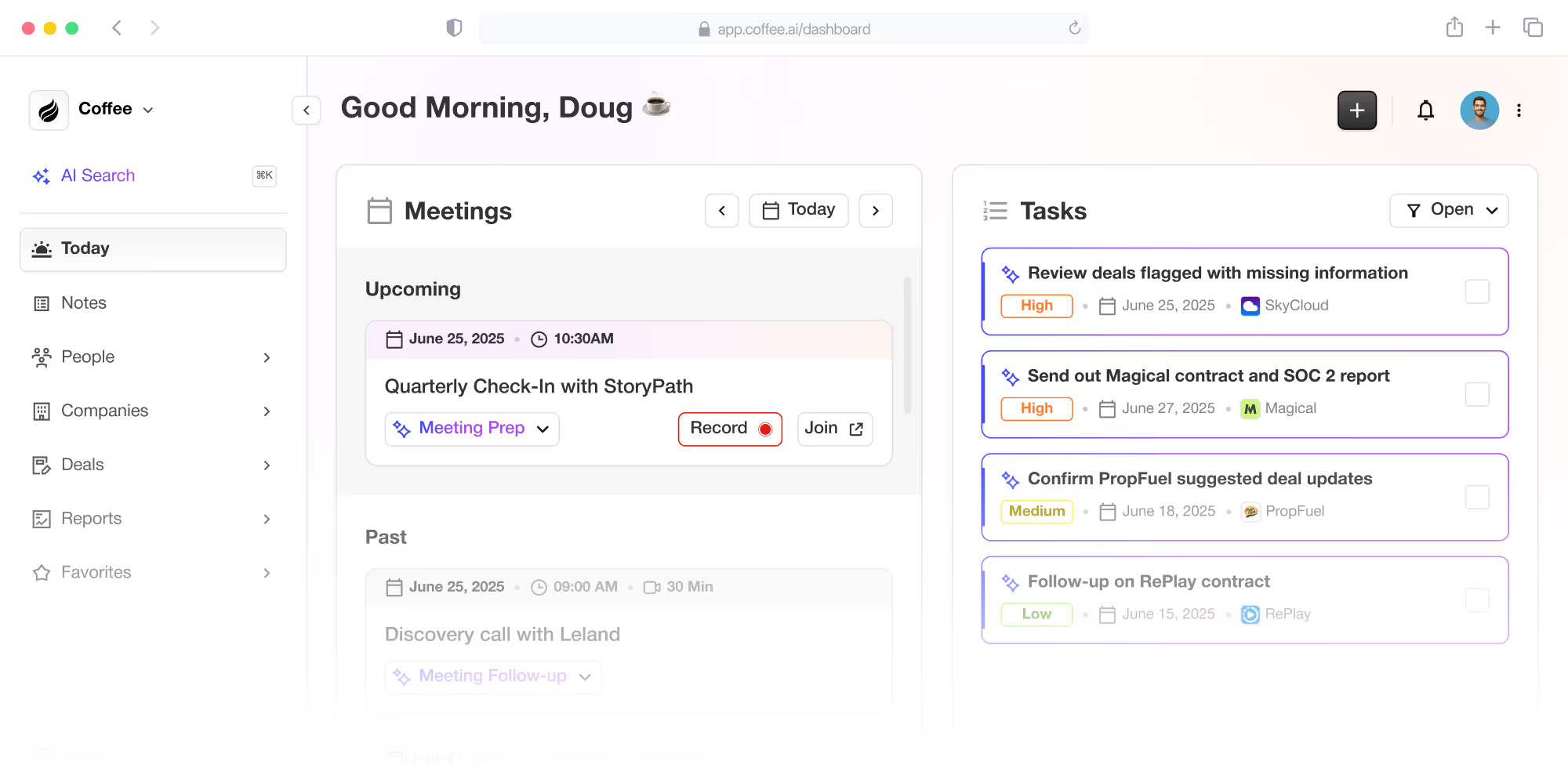
Request access to see how Coffee can improve your sales process.
Comparing AI-First CRM with Traditional Systems
The contrast between AI-first CRMs like Coffee and traditional systems highlights distinct advantages in engagement and efficiency. Below is a breakdown of key differences:
| Feature / Aspect | Coffee (AI-First CRM) | Traditional CRM |
|---|---|---|
| Data Unification | Automatically combines data from multiple sources for a full customer view | Data often remains siloed, requiring manual integration |
| Data Entry | AI handles input and updates, reducing workload | Relies heavily on manual updates, consuming time |
| Sales Productivity | Saves reps 8-12 hours weekly for customer-focused tasks | Significant time spent on administrative work |
| User Experience | Intuitive design supports natural sales workflows | Often seen as complex or burdensome by users |
This comparison shows how AI-first solutions adapt to sales needs with automation, while traditional systems may demand more effort from users to achieve similar outcomes.
Key Questions About AI-First CRM Answered
How Does AI-First CRM Strengthen Customer Connections?
AI-first CRM platforms improve engagement by automating routine tasks, allowing sales reps to focus on relationships. Tools like Coffee gather and update customer data from various sources in real time, equipping reps with the context needed for personalized interactions. This ensures conversations are relevant and build trust with customers.
What Time Savings Can Sales Reps Expect?
Sales reps using AI-first CRM systems like Coffee can save an estimated 8-12 hours per week. Automation handles data entry, meeting prep, follow-up tasks, and pipeline tracking, freeing up time for direct customer engagement and strategic activities that drive results.
Is AI-First CRM Suitable for Smaller Businesses?
AI-first CRM is not just for large companies. Coffee offers a standalone option tailored for small to mid-sized businesses, alongside a companion app for those using existing systems like Salesforce or HubSpot. This flexibility ensures smaller teams can access automation benefits without needing extensive resources.
Conclusion: Improve Sales Outcomes with Coffee’s AI-First CRM
Effective customer engagement is a cornerstone of success in today’s competitive sales environment. Traditional CRMs often create obstacles with disconnected data and manual workloads, limiting a team’s ability to connect with customers. Coffee’s AI-first platform overcomes these issues by automating tasks, unifying data, and delivering actionable insights, enabling sales reps to build stronger relationships and improve efficiency.
With options for standalone use or integration with existing systems, Coffee makes these advantages accessible to businesses of any size. Teams can see immediate improvements in productivity and engagement without disrupting current workflows.