Written by: Doug Camplejohn, CEO & Co-Founder, Coffee | Last updated: July 15, 2026
Key Takeaways for RevOps and Sales Leaders
- An autonomous CRM agent captures, structures, and writes sales data across the full revenue workflow without manual input at each step.
- Gong excels at conversation intelligence and forecasting but leaves non-call data entry manual and lacks visitor identification.
- AI-native CRMs like Lightfield modernize interfaces yet struggle with deep Salesforce and HubSpot integration and existing quota or forecast configurations.
- Coffee uniquely operates as both a standalone CRM and a Companion App layer on Salesforce or HubSpot while adding visitor identification with Suggested Leads.
- Teams ready to eliminate manual data entry and improve pipeline accuracy can get started with Coffee today.
How This Comparison Evaluates Gong, Lightfield, and Coffee
Each option in this comparison is assessed against seven criteria that matter most to RevOps and sales leaders at 30–150 person SaaS companies.
- Data quality and capture method, meaning how structured and unstructured data enters the system
- Salesforce and HubSpot integration depth, including read and write fidelity, field mapping, and quota or forecast compatibility
- Automation of data entry and meeting workflows, or the degree to which human effort is eliminated
- Pipeline intelligence and historical tracking, including week-over-week visibility and deal-change detection
- Visitor identification capabilities, or the ability to convert anonymous web traffic into named, actionable leads
- Pricing model, including seat-based, usage-based, or consumption-based cost structures
- Long-term scalability, covering performance and maintenance burden as headcount and data volume grow
Side-by-Side Comparison of Gong, Lightfield, and Coffee
The comparison below evaluates Gong, Lightfield, and Coffee across these seven criteria and highlights where each option fits mid-market SaaS teams.
| Solution | Core Strength | Primary Gaps |
|---|---|---|
| Gong | Conversation intelligence, call coaching, and forecast validation from call data | Manual non-call data entry, no visitor identification, duplicate spend with separate forecasting tools |
| Lightfield and similar AI-native CRMs | Modern interface, flexible data model, native AI features | Shallow Salesforce and HubSpot integration, migration risk for teams with complex quotas and forecasts |
| Coffee | Autonomous CRM agent for full-funnel data capture, dual deployment modes, visitor identification | Not aimed at very large enterprises with highly customized workflows |
Gong integrates natively with Salesforce, HubSpot, and Microsoft Dynamics 365, automatically updating CRM fields from conversation data. Its forecasting engine delivers 15–30% higher accuracy than CRM-native methods by analyzing actual conversation signals rather than rep-reported probabilities. Gong still leaves non-call activities to manual data entry, does not offer visitor identification, and carries per-seat costs that compound when paired with a separate forecasting tool like Clari.
Lightfield and comparable AI-native CRMs such as Clarify, Day.ai, and Attio modernize the interface and apply post-ChatGPT architecture to contact and deal management. Their core limitation is integration depth. Without a unified execution layer that absorbs SOQL, OAuth, pagination, and field mapping, agents cannot reliably pull deals from Salesforce or create contacts in HubSpot. Teams already committed to Salesforce or HubSpot, with configured quotas, required fields, and forecasting hierarchies, often encounter data-loss or sync-failure issues when adopting these platforms.
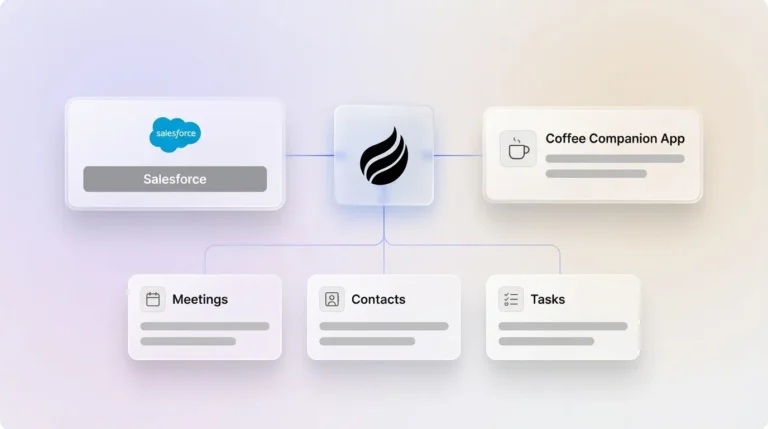
Coffee operates differently from both categories. As a standalone CRM, the Coffee Agent serves as the full system of record. As a Companion App, it deploys as an intelligent layer on top of existing Salesforce or HubSpot instances and handles the “data in” process so the system of record stays accurate without human effort. Coffee is the only solution in this comparison that works in both modes. It also includes visitor identification with Suggested Leads. Where competitors surface company-level data or undifferentiated people lists, Coffee uses your buyer persona to recommend the specific contacts inside a visiting company most worth reaching out to.
See how Coffee’s visitor identification works in your stack
Conversation Intelligence: Where Gong Fits
Gong is the reference point for the conversation intelligence category, capturing, transcribing, and analyzing business conversations. It positions the source of truth about deals in conversations rather than CRM fields. Its strengths include call coaching, deal risk signals, and forecast validation based on actual buyer language rather than rep-entered data.
The limitations are structural. Independent benchmarks show real-world sales-call transcription can have noticeable error rates. AI-generated action items can also hallucinate, which produces errors that become permanent CRM data when written back automatically. Field-level CRM write-back sits behind paid tiers. Teams frequently end up running both Clari and Gong in parallel, incurring duplicate costs, and that consolidation pressure is accelerating in 2026.
Gong fits when call coaching is the primary RevOps gap and a separate forecasting tool already performs well. It does not replace autonomous data capture across email, calendar, and non-call activities.
AI-Native CRMs: Strengths and Migration Risks
AI-native CRMs like Lightfield, Clarify, and Day.ai address the architectural problem of legacy systems that rely on relational databases and lose historical context when fields are updated. These tools also struggle with unstructured data. Their interfaces are cleaner, their data models more flexible, and their AI layers more native than bolted-on.
The integration reality for mid-market teams is more complicated. Most teams deploy their first HubSpot Breeze AI agent in hours because they inherit existing CRM permissions. Salesforce Agentforce often requires weeks to months for initial deployment, depending on the scope and complexity of Einstein, Data Cloud, and Agent Builder configuration. This deployment complexity reflects the depth of integration required to handle quotas, forecasting hierarchies, and required-field enforcement. AI-native CRMs that lack this depth cannot replicate those capabilities.
Without that integration depth, migration becomes costly for teams where those configurations represent years of operational investment. Reports indicate that CRM adoption can fail due to poor data quality driven by manual entry gaps, and a new interface alone does not solve that problem.
Autonomous CRM Agents: Coffee’s Category
Autonomous CRM agents perform pipeline management by detecting stalled deals, drafting re-engagement emails, and updating forecasts, while conversation intelligence platforms typically only log activity without executing proactive workflows. They also automate data hygiene by continuously identifying duplicates, merging records, and enriching missing fields. This work addresses the hidden cost of poor data quality that amplifies unreliable AI outputs.

The write-back challenge remains significant. HubSpot’s official MCP server supports read and write access to CRM data. Gartner predicts that over 40% of agentic AI projects will be canceled by the end of 2027 due to escalating costs, unclear business value, or inadequate risk controls, and a significant portion of those costs stem from integration plumbing. Coffee’s Companion App model addresses this directly by handling Salesforce and HubSpot integration depth, including quotas, forecasting, and required fields, as a core product capability rather than a custom configuration project.
Best-Fit Use Cases by Company Stage
Matching the right solution to company stage reduces both implementation risk and total cost of ownership.
1–20 employees: Teams that have outgrown spreadsheets but find HubSpot or Pipedrive to be expensive manual chores fit Coffee’s Standalone CRM. The agent handles contact creation, activity logging, and meeting workflows from day one without CRM administration overhead.
20–200 employees committed to Salesforce or HubSpot: Coffee’s Companion App is the appropriate layer. It preserves the existing system of record, forecasting configuration, and quota structure while eliminating the manual data entry that degrades CRM quality over time. Gong remains viable as a coaching layer if call analysis is a distinct priority, although the consolidation case for a single agent that handles both is strong.
200+ employees: Large enterprises with complex, custom workflows and multi-year security review requirements sit outside Coffee’s current ICP. Salesforce Agentforce, which has 18,000+ customers and has processed 1.6B–3.8B agentic work units cumulatively or quarterly as of mid-2026, is the more appropriate native option at that scale.
Operational and Long-Term Considerations for Deployment
Simple third-party platform-built autonomous agents can ship in 2–4 weeks and may introduce data residency considerations that trigger Data Processing Agreements and security reviews. Coffee is SOC 2 Type 2 and GDPR compliant, and data is not used to train public models, which addresses the most common security objection at the RevOps evaluation stage.
Agentic CRM integration reduces manual sales administration workloads by 60–80% compared to rep-driven data entry. Coffee’s seat-based pricing model, where the agent’s labor is included without metering on LLM usage or processes, keeps cost predictable as headcount grows. Usage-based models scale unpredictably with workflow volume.
Organizations that designate a dedicated program owner often see improved platform adoption rates. That change management reality applies to any category of tool.
Compare Coffee’s pricing to your current stack
Risks, Limitations, and Common Misconceptions
Several recurring assumptions consistently produce failed deployments across all three categories.
Software alone does not solve process problems. Organizations should invest time and resources in data quality remediation before deploying AI agents on CRMs with accumulated data. Agents amplify both good and bad existing data quality.
Automation is not complete out of the box. Common integration failure modes include CRM field-mapping conflicts that silently corrupt records and agent hallucination that requires human review of personalization during the first 30 days.
Conversation intelligence write-back carries legal exposure. Region-specific recording consent requirements, including 12 US all-party consent states, GDPR balancing tests, and South Africa’s POPIA, must be addressed before activating capture. The Otter.ai class-action lawsuit filed in 2025 illustrates the legal risk of deploying conversation intelligence without a cleared consent posture.
AI-native CRMs are not plug-and-play replacements for Salesforce. Newer platforms lack the integration depth to replicate quota management, forecasting hierarchies, and required-field enforcement that mid-market teams have built into their Salesforce or HubSpot instances over years.
Decision Framework for Your CRM and Agent Strategy
The right choice follows from three core questions about your current operating model.
Your primary gap is call coaching on an otherwise healthy CRM. Gong remains defensible if leadership feels satisfied with the existing forecasting tool and reps are mid-onboarding. The switching cost rarely pays back when coaching is the only gap.
You are starting fresh or willing to migrate your system of record. Coffee’s Standalone CRM suits teams under 20 people that want an agent-managed system of record without legacy overhead.
You are committed to Salesforce or HubSpot with poor data quality and low CRM adoption. Coffee’s Companion App is the only solution that adds an autonomous agent layer without requiring a CRM migration while handling integration complexity such as quotas, forecasting, and required fields that generic AI-native CRMs cannot replicate. It also adds visitor identification with Suggested Leads, which consolidates a capability that would otherwise require a separate point solution.
AI sales agents deliver 300–500% first-year ROI when utilization stays above 75%. The variable that most determines utilization is whether reps trust the agent to handle their busywork, which depends on good data from day one.
Frequently Asked Questions
How long does it take to implement Coffee?
For the Standalone CRM, Coffee is operational within hours of connecting Google Workspace or Microsoft 365. The agent immediately begins scanning emails and calendars to auto-create contacts, companies, and activities. For the Companion App on Salesforce or HubSpot, a simple authentication flow allows the Coffee Agent to begin syncing, enriching, and writing data back to the existing CRM. Teams avoid multi-week configuration of separate data layers or agent builders.

Does Coffee replace Salesforce or HubSpot, or work alongside them?
Coffee operates in both modes described earlier. It can act as a full replacement for teams without an existing CRM or as an intelligent layer for teams committed to Salesforce or HubSpot. In Companion mode, it handles contact creation, activity logging, meeting summaries, and pipeline tracking while the CRM remains the system of record for forecasting, quota management, and reporting. Teams do not need to migrate data or reconfigure their existing Salesforce or HubSpot instance to deploy the Companion App.
How does Coffee handle data quality compared to tools like ZoomInfo or Gong?
Coffee’s agent enriches records with job titles, funding data, and LinkedIn profiles via licensed data partners, providing enrichment roughly on par with dedicated tools for most mid-market use cases. Unlike Gong, which structures data from calls but leaves non-call activities to manual entry, Coffee captures activity across all channels, as described in the earlier comparison. This continuous tracking produces the reliable pipeline and deal history that forecasting and pipeline reviews depend on.
What happens to anonymous website visitors who never fill out a form?
Coffee’s visitor identification feature uses a single tracking pixel to identify anonymous traffic as named individuals and surfaces name, title, email, LinkedIn profile, company, pages visited, time on site, and whether the visit was a first or return. Real-time Slack notifications alert the team to high-fit visitors. The differentiating capability is Suggested Leads. Rather than returning a raw list of everyone at the visiting company, Coffee applies the persona-based filtering described earlier to surface the highest-fit contacts with LinkedIn profiles pre-surfaced for immediate outbound action.

Is Coffee secure enough for a mid-market sales team?
Coffee is SOC 2 Type 2 certified and GDPR compliant. Data processed by the Coffee Agent is not used to train public AI models. For teams evaluating conversation intelligence tools alongside Coffee, recording consent requirements vary by jurisdiction, including all-party consent laws in 12 US states and GDPR balancing tests in Europe. Coffee’s compliance posture is designed to address these requirements rather than expose the organization to the legal risks that have emerged in the broader conversation intelligence category.
Conclusion: Choosing an Autonomous CRM Path Forward
The root problem across all three categories remains consistent. Sales reps spend only 35% of their time selling, according to market data shared by Coffee, with the rest consumed by CRM updates, research, meeting prep, and internal coordination. Conversation intelligence tools surface what happened on calls. AI-native CRMs modernize the interface. Neither category removes the manual data entry burden that degrades CRM quality and produces unreliable forecasts.
An autonomous CRM agent that captures good data from emails, calendars, calls, and web traffic and returns accurate pipeline intelligence offers a structural solution to that problem. Coffee’s dual-mode architecture, detailed in the comparison and FAQ sections, makes it the only option that fits teams at any stage of CRM commitment without requiring a rip-and-replace migration.