Written by: Doug Camplejohn, CEO & Co-Founder, Coffee | Last updated: June 17, 2026
Key Takeaways for Revenue and RevOps Leaders
- Sales reps lose 10–11 hours per week to manual CRM data entry, which consumes 25–30% of their workweek before any customer conversations.
- 32% of reps spend over an hour daily on data logging, which produces inconsistent records where less than half of CRM data is accurate and complete.
- AI agents capture emails, calls, and meetings automatically, so teams eliminate manual entry while keeping data quality high in Salesforce and HubSpot.
- Teams reclaim 8–12 hours per rep weekly and gain clearer pipeline visibility, stronger forecasting, and better revenue performance from real-time CRM updates.
- Get started with Coffee to remove manual CRM data entry and return selling time to your team.
The Problem: Manual CRM Tasks Break Every Sales Day
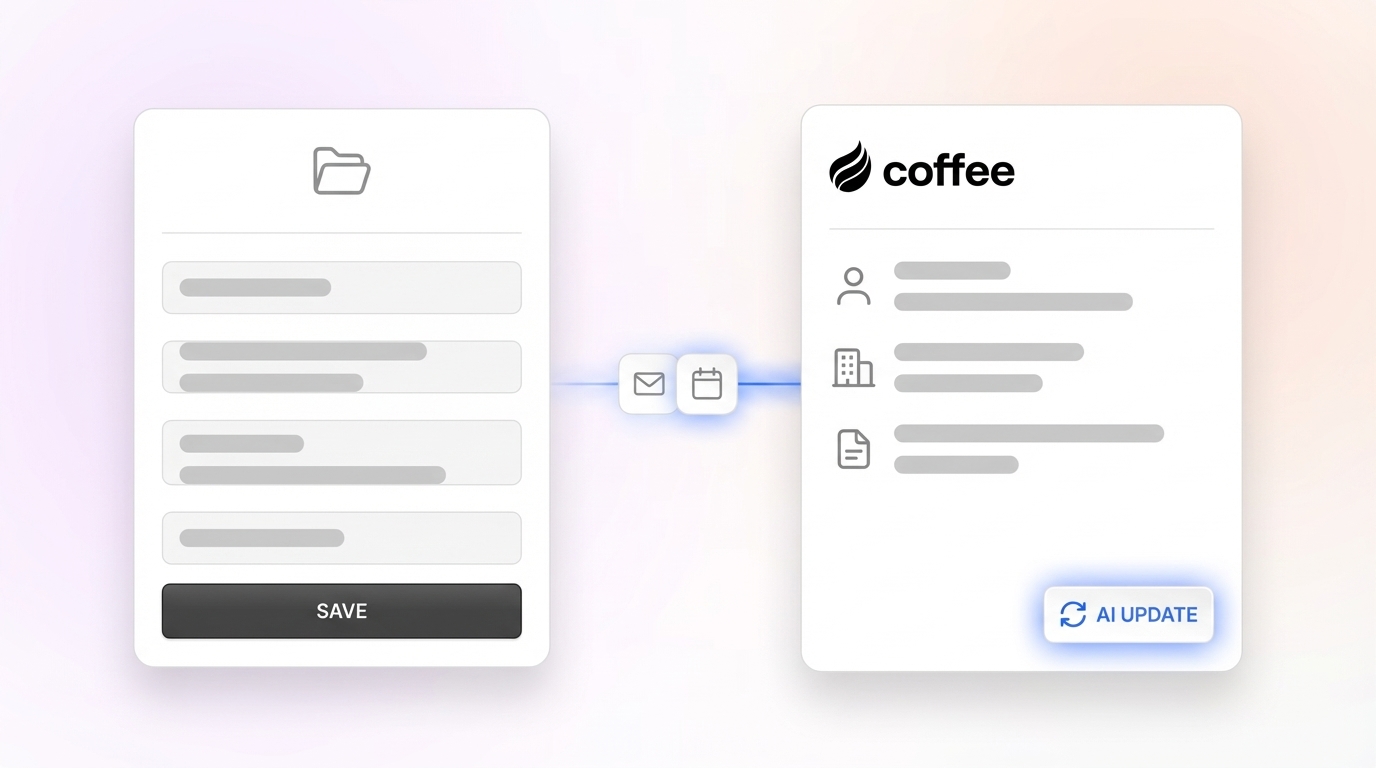
A typical sales rep’s day in 2026 is fragmented across four or five tools before the first meaningful customer interaction. Reps log emails by hand. Calls require post-call notes. Every meeting creates a backlog of field updates, follow-up tasks, and contact edits. Reps with full calendars spend large blocks of time on post-meeting administration, including logging notes, updating fields, and creating follow-up activities.
The downstream effects compound quickly. 32% of sales reps spend more than one hour daily on manual CRM data entry, equating to over 250 hours per year per rep. This volume of manual work produces inconsistent records. 76% of CRM users report that less than half of their organization’s CRM data is accurate and complete. These incomplete records then force reps to reconstruct deal history from email threads and memory, and wasted sales time from incomplete CRM data consumes 20–30% of selling hours through data reconstruction, searching email threads, and manual contact research.
Pipeline reviews suffer directly. Forecasts built on manually entered data reflect what reps remembered to log, not what actually happened. Without accurate CRM data there is no reliable reporting, pipeline visibility, or handoff tracking. Heads of Sales and RevOps leaders are left managing a system of record that is structurally unreliable, and the root cause sits in how these systems were originally designed.
Why Legacy CRMs and Point Tools Cannot Fix the Problem
Legacy CRM architecture rests on a flawed assumption that busy humans will reliably enter data. 71% of sales reps say they spend too much time on data entry, leaving only 35% of their time for actual selling. Operations teams have typically responded by adding point tools such as enrichment platforms, call recording software, and activity tracking add-ons. Each tool introduces its own login, its own data export, and its own manual reconciliation step.
The before-state for a 10-rep team looks like this. Reps toggle between a CRM, an outreach sequencer, a call recorder, and an enrichment tool, then manually stitch outputs into CRM records at the end of each day. Automation collapses this fragmented workflow into a single agent that ingests communication data from email, calendar, and calls automatically, writes structured records without human input, and surfaces pipeline intelligence in real time, which removes every manual handoff in the process. The difference is not marginal. Few field sales teams have fully automated CRM data entry, so the operational gap between leading and lagging teams keeps widening.
See how Coffee replaces your entire point-tool stack with one autonomous agent.
The Solution: AI Agents Take Over CRM Data Entry
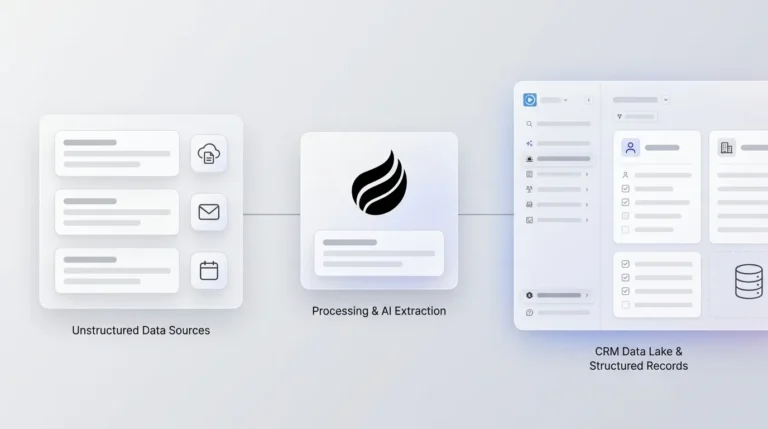
AI agent automation replaces the human data entry loop with a persistent, autonomous process. Instead of waiting for a rep to log an email, an agent reads the email thread, identifies the relevant contact and deal, and writes a structured activity record to the CRM. The same logic applies to calendar events, call transcripts, and inbound messages.
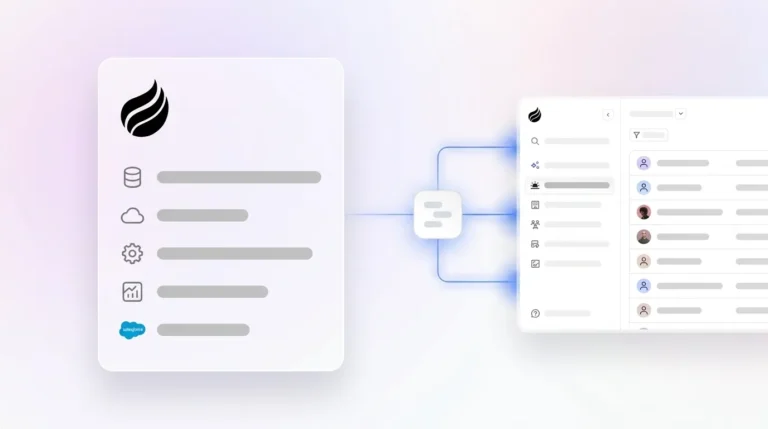
This approach fits two common buyer situations. Teams evaluating a new CRM can deploy an agent-native system of record where the agent manages all data from day one. Teams already committed to Salesforce or HubSpot can layer an agent on top of their existing instance, so the agent handles the data-in process while the existing CRM remains the system of record. Both paths produce the same outcome: accurate, complete CRM data without manual effort.
Email and calendar automation can reduce manual CRM data entry by logging outbound and inbound emails, meeting invites, and full conversation threads automatically. While this handles structured activities, agent-led systems extend the capability further by processing unstructured data such as call transcripts, meeting notes, and email text that legacy relational databases cannot handle.
Quantified Benefits: Time Saved, Better Data, Stronger Pipeline
8–12 Hours Reclaimed Per Rep Every Week
Workflow automation and integrated CRM tools can reclaim 5–10 hours per rep per week currently lost to administrative overload. Agent-led automation that handles both structured and unstructured data pushes that figure to the 8–12 hour range. Teams effectively return one to one and a half full workdays to selling activity every week.
Higher CRM Adoption and Cleaner Data
AI-powered CRM tools reduce manual data entry and automate follow-up task creation, which removes the adoption friction that creates the incomplete records described earlier. As the agent captures more activity automatically, reps stop skipping updates, and data quality improves alongside data volume. AI automation can also cut manual data work and allow sales representatives to reclaim several hours per week that previously went to data entry.
Automatic Pipeline Visibility for Every Deal
When an agent logs every interaction automatically, pipeline reviews shift from data-gathering exercises to strategic discussions. Deal stage, last activity, next step, and close date stay current without rep intervention. Clean data can increase sales revenue by 25% with roughly 30% shorter sales cycles, and some studies show gains up to 66% depending on practices.
Forecasts Grounded in Actual Activity
Poor CRM data quality costs the average B2B company up to $15 million per year. Forecasts generated from agent-captured data reflect ground truth rather than rep memory. RevOps leaders gain projections they can act on with more confidence.
Stack Consolidation and Lower Tool Overhead
An agent that ingests communication data and enrichment in one system replaces separate tools for each function. Teams reduce software cost and remove the manual reconciliation work those tools created.
Start automating your CRM data entry with Coffee today.
How AI Agents Handle CRM Data Entry Day to Day
After connecting to Google Workspace or Microsoft 365, an AI agent scans your team’s email and meeting history to auto-create contact and company records. Every inbound and outbound email is logged as an activity against the correct record without rep action. When a meeting is scheduled, the agent prepares a briefing that covers attendee history, open deal context, and prior interactions.


During the call, the agent joins via meeting bot, records, and transcribes. After the call, it generates a structured summary, identifies next steps, and drafts a follow-up email for rep review. The agent then writes all outputs back to the CRM record automatically. For teams using sales methodologies like BANT or MEDDIC, the agent structures its notes to match the qualification framework, which keeps data consistent regardless of which rep ran the call.


On the pipeline side, the agent tracks week-over-week deal changes such as progressed opportunities, stalled deals, and new additions. It surfaces these changes without manual CSV exports or extra reporting tools.
2026 Evidence and a Simple Lost-Hours Calculator
Recent surveys show that many sales professionals spend significant time each week on manual CRM data entry. Field sales reps lose valuable customer-facing time because they must keep systems updated by hand.
“I spend the last hour of every day just catching up on what I was supposed to log during the day. By then I’ve forgotten half the context.” — anonymous field sales rep, SPOTIO 2026 survey cohort.
“Every time I switch from the call recorder to the CRM to the email tool, I lose the thread. The data that ends up in the system is a summary of a summary.” — anonymous enterprise account executive.
The table below applies the AskElephant 10–11 hours/week figure and $25,000 annual misallocated compensation per rep at $100K OTE across three common mid-market team sizes.
| Team Size | Weekly Hours Lost (Team Total) | Annual Hours Lost (Team Total) | Annual Revenue-at-Risk (at $100K OTE) |
|---|---|---|---|
| 5 Reps | 50–55 hrs | 2,600–2,860 hrs | $125,000 |
| 10 Reps | 100–110 hrs | 5,200–5,720 hrs | $250,000 |
| 20 Reps | 200–220 hrs | 10,400–11,440 hrs | $500,000 |
Checklist for Evaluating CRM Automation Tools
CRM integrations: The tool must write data back to Salesforce or HubSpot natively and respect required fields, validation rules, and forecast categories without custom development work.
Structured and unstructured data handling: Confirm the tool processes email text, call transcripts, and meeting notes, not only form fills and structured field updates.
Data quality versus manual baseline: 44% of organizations report losing over 10% of annual revenue due to low-quality CRM data. Ensure the tool includes enrichment, duplicate detection, and validation so it does not simply automate bad data entry at scale.
Usability and rep adoption: A tool reps ignore produces the same outcome as no tool. Prioritize solutions where the agent works in the background and does not require rep-initiated actions.
Security and compliance: Confirm SOC 2 Type 2 certification and GDPR compliance, and verify that customer data is not used to train shared models.
Implementation complexity: Mid-market teams cannot absorb multi-month implementation projects. Evaluate whether the tool activates through simple authentication or requires dedicated admin resources.
Mid-market fit: Enterprise tools carry enterprise overhead. Confirm the vendor’s ICP aligns with 5–20 rep teams and that pricing scales by seat rather than by usage metrics.
Frequently Asked Questions
How much time does manual CRM data entry actually waste per rep in 2026?
Sales reps lose approximately 10–11 hours per week to manual CRM data entry and related administrative tasks in 2026. This time loss represents roughly 25–30% of a standard 40-hour workweek and remains consistent across many team sizes and industries. For a 10-rep team, that equals 100 hours of lost selling time every week, which mirrors 2.5 full-time sellers focused entirely on data logging instead of revenue generation.
What is the revenue cost of manual CRM data entry for a mid-market sales team?
At a fully loaded rep cost of $100,000 in total compensation, manual CRM data entry results in about $25,000 in misallocated compensation per rep annually. Based on that per-rep cost, a 10-rep team loses $250,000 per year to this single operational inefficiency. Beyond direct labor cost, poor data quality from manual entry degrades forecasting accuracy, slows pipeline reviews, and causes missed follow-ups, which compounds the revenue impact.
Can an AI agent work on top of an existing Salesforce or HubSpot instance?
Yes. Agent-led automation tools like Coffee deploy as a companion layer on top of existing Salesforce or HubSpot installations. The agent connects via authentication, ingests email and calendar activity, processes call transcripts, and writes structured records back to the existing CRM without migration or replacement. Required fields, validation rules, forecast categories, and quota structures in the existing instance are respected, so teams keep their system of record while removing the manual data entry burden that has damaged its data quality.
How does AI agent automation improve CRM data quality compared to manual entry?
Manual entry produces inconsistent records because it depends on rep memory, available time, and individual habits. An AI agent captures every email, calendar event, and call transcript at the moment it occurs, then writes structured data to the correct record automatically. This process removes missed logs, incomplete fields, and duplicate records. The agent also enriches records with external data such as job titles, company funding, and LinkedIn profiles without separate enrichment tools, so the CRM reflects actual deal activity instead of partial updates.
What should a RevOps leader look for when evaluating CRM automation tools?
RevOps leaders should prioritize native integration depth with the existing CRM, the ability to handle both structured data and unstructured data like email text and call transcripts, and built-in enrichment and duplicate detection. SOC 2 Type 2 and GDPR compliance, along with simple activation, also matter. Tools that require multi-month implementations or dedicated admin resources rarely fit mid-market teams. Seat-based pricing models avoid the unpredictable cost that usage-based metering introduces as team activity scales, and vendors should demonstrate experience with Salesforce or HubSpot complexity, including quota management, forecasting hierarchies, and required field configurations.
Conclusion: Turn CRM from Time Drain into Revenue Asset
In 2026, manual CRM data entry consumes roughly a quarter of every sales rep’s workweek, time that belongs in customer conversations rather than data fields. For a 20-rep team, that translates into more than $500,000 in misallocated compensation annually, plus forecasting errors and pipeline blind spots created by incomplete data. The operational cost is clear, and the fix is available now.
AI agent automation removes the manual data entry loop by capturing every customer interaction automatically and writing accurate, structured records to the CRM without human input. Teams on Salesforce or HubSpot do not need to migrate, and teams evaluating a new system can deploy an agent-native CRM from day one. Either path produces the same outcome: complete data, accurate forecasts, and reps who spend their time selling.
Transform your CRM into a revenue asset with Coffee’s AI automation.