
Executive Summary: Navigating Sales in the AI Era
Sales conversations are evolving rapidly as artificial intelligence reshapes customer interactions and shortens business cycles. In today’s competitive market, sales leaders face pressure to adapt to these changes while managing complex technology stacks. Many traditional CRM systems struggle to meet modern demands, often leaving teams juggling multiple tools for data, outreach, and call analysis. This guide offers a framework for executives to understand and adopt AI-driven tools like conversational intelligence and AI-first CRMs. The focus is on practical solutions that streamline processes and boost sales effectiveness, with platforms like Coffee illustrating the potential of these innovations within a broader industry shift.
The current market landscape reveals a growing divide between legacy systems and emerging AI technologies. Companies that cling to outdated tools risk falling behind as competitors leverage automation to gain insights and efficiency. Research indicates that sales reps spend only about 35% of their time actually selling, with much of their day consumed by administrative tasks. This inefficiency, coupled with fragmented data across disconnected platforms, creates a clear need for integrated solutions. AI-first systems aim to address these gaps, unifying data and automating workflows to help teams focus on building relationships and closing deals. As we explore these trends, we’ll highlight specific benefits and trade-offs, positioning tools like Coffee as part of a transformative movement in sales technology.
The Challenge: Why Traditional Sales Tools Struggle
Legacy CRMs: A Fragmented Approach to Modern Sales
Many traditional CRMs fall short in today’s fast-paced sales environment. These systems often require sales teams to manage several tools at once, such as separate platforms for customer data, lead enrichment, outreach, and call recording. This fragmented setup adds complexity, increases costs, and slows down productivity.
Older CRMs were not built with AI or unified data systems in mind. As a result, they often struggle to process diverse data types or integrate newer technologies without custom workarounds. This can lead to inefficiencies, making it harder for teams to access real-time insights or adapt to changing needs.
Missed Insights: Gaps in Sales Conversation Data
Without tools to automatically capture and analyze sales interactions, leaders often lack critical information. Many legacy systems depend on manual data entry, which can result in incomplete or outdated records. This limits the ability to spot buyer behavior patterns or key trends in conversations.
These gaps create uneven performance across teams. Without consistent data collection, best practices remain tied to individual reps rather than becoming standard across the organization. Sales outcomes then depend more on personal skills than on structured, data-driven strategies.
The Real Cost: Time and Revenue Losses
Inefficiencies in sales processes have a measurable impact. Studies reveal that 71% of sales reps spend excessive time on data entry, leaving only a small fraction of their week for selling activities, as noted in this analysis of sales productivity. This time drain lengthens sales cycles, reduces forecast accuracy, and impacts revenue.
Tasks like manual note-taking and post-call updates take hours that could be spent on engaging prospects or advancing deals. Without automated solutions, managers lack the means to simplify workflows, leading to slower onboarding for new reps and inconsistent team results.
Ready to address these challenges? Explore how Coffee’s AI CRM can streamline your sales process by visiting this link to request access.
What Conversational Intelligence Brings to Sales
Defining Conversational Intelligence: Beyond Simple Recording
Conversational intelligence, or CI, moves past basic call recording to analyze customer interactions in depth. These platforms capture data from calls, emails, and video meetings, then use AI to extract meaningful insights. Unlike standard recording tools, CI can transcribe discussions and summarize key points, helping teams focus on what drives results.
By converting unstructured conversation data into actionable information, CI gives sales leaders a clearer picture of customer engagements. This approach provides data directly from interactions, offering a more accurate view than relying solely on rep reports.
How AI Powers Deeper Conversation Insights
AI is central to CI platforms, enabling tools like Coffee to automate call analysis. These systems summarize discussions and pinpoint action items, freeing reps from administrative work. With AI handling these tasks, sales teams can prioritize relationship-building and deal-closing activities over paperwork.
Core Features of CI Platforms
Modern CI tools offer specific capabilities that enhance sales processes:
- Automated transcription and summarization of conversations, saving time on note-taking by identifying key points and next steps.
- Meeting preparation and follow-up support, providing briefings before calls and generating action items or email drafts afterward.
AI-First CRM: A New Standard for Sales Efficiency
Why AI-First CRM Systems Stand Out
Unlike traditional CRMs designed primarily for data storage, AI-first CRMs are built with artificial intelligence at their core. These platforms, such as Coffee, focus on unifying data, automating tasks, and delivering insights from the start. Quality data is essential for effective AI, and systems not designed for it often fall short.
AI-first CRMs handle both structured data, like contact details, and unstructured data, such as emails or call transcripts, within a single system. This integrated approach allows AI to generate practical recommendations and streamline workflows.
Combining CI with AI CRM for Greater Impact
Integrating conversational intelligence with an AI-first CRM creates a powerful toolset. For instance, Coffee automatically captures interaction data and updates customer profiles in real time. This ensures sales teams have a complete, current view of relationships without manual updates, improving decision-making and response times.
Reducing CRM Fatigue for Sales Reps
Many sales reps see traditional CRMs as a burden due to complex interfaces and heavy data entry demands. AI-first platforms like Coffee address this by automating repetitive tasks. Features such as automatic contact creation from emails, meeting summaries, and follow-up drafts turn the CRM into a helpful assistant rather than a chore, letting reps focus on selling.
How Coffee’s AI CRM Enhances Sales Conversations
Automation Throughout the Sales Cycle
Coffee leverages AI to simplify key aspects of the sales process, offering tangible value to teams. It scans emails and calendars to build and update contact records automatically, linking every interaction to the right profiles. This saves reps an estimated 8 to 12 hours weekly on data entry, giving them more time to engage with prospects.
The platform also enriches data with details like job titles, company information, and LinkedIn profiles from trusted sources, reducing the need for separate enrichment tools. Before meetings, Coffee provides detailed briefings with attendee and company backgrounds. Post-meeting, it summarizes discussions using frameworks like BANT or MEDDIC, identifies tasks, and drafts follow-up emails directly from Gmail.
For pipeline management, Coffee offers a “compare” feature that highlights weekly changes in deal status with one click. This eliminates manual spreadsheet work, making pipeline reviews quicker and more data-focused for sales leaders.
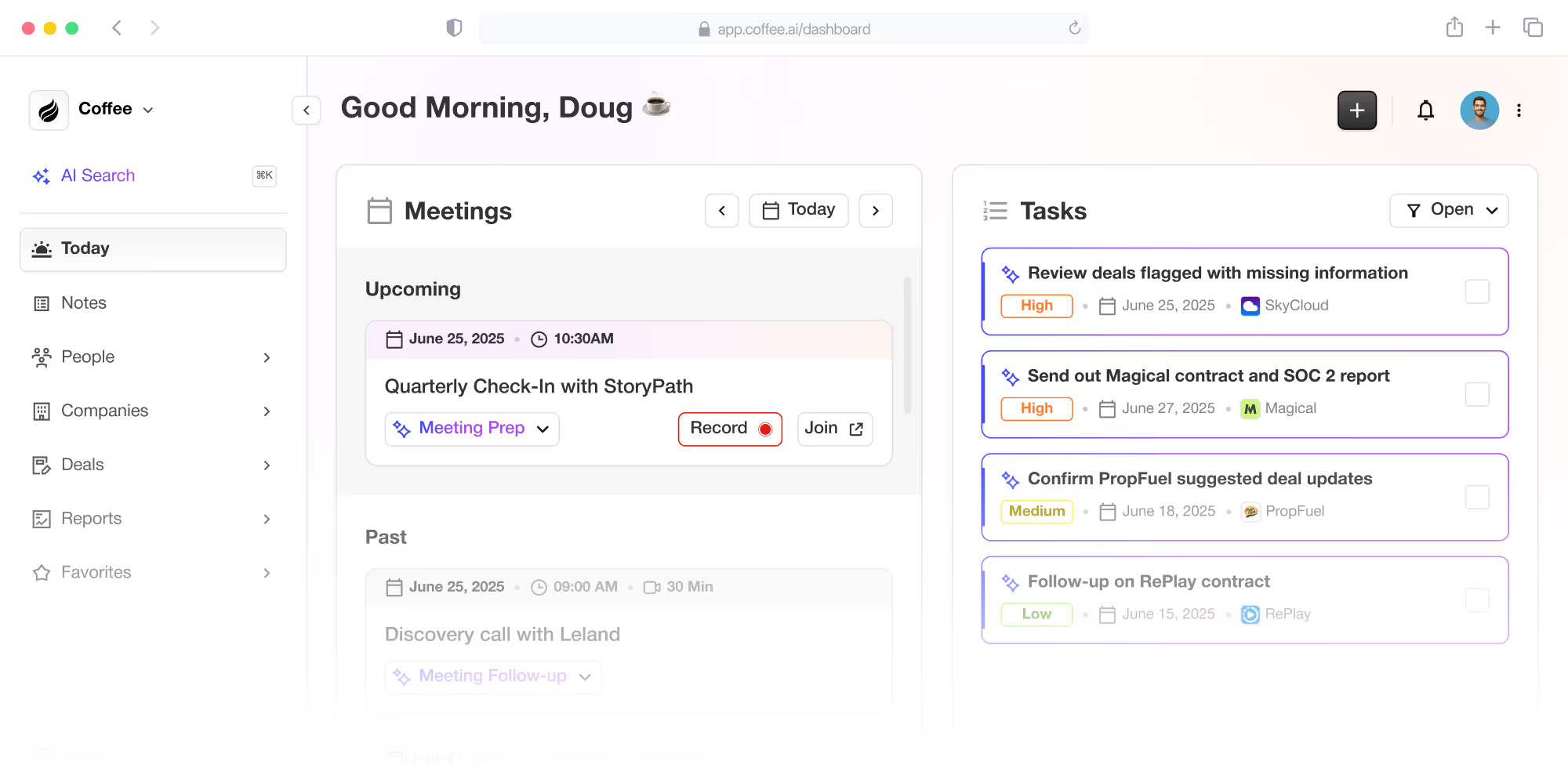
Simplifying Your Sales Tech Stack
Coffee combines the functions of multiple sales tools into one platform, reducing both cost and complexity. Instead of managing separate systems for CRM, data enrichment, and forecasting, teams work from a single interface. This unified setup ensures data consistency and encourages adoption by simplifying workflows.
Flexible Options: Standalone or Companion Use
Coffee offers two ways to implement its platform based on your needs. The standalone CRM suits smaller businesses looking for a modern alternative to spreadsheets or legacy systems. The companion app works with existing CRMs like Salesforce or HubSpot, syncing data to enhance capabilities without disrupting current workflows. This flexibility lets organizations adopt AI benefits at their own pace.
Ready to see the difference? Request access to Coffee’s AI CRM through this link and start automating your sales process today.
Key Steps to Implement AI CRM and Conversational Intelligence
Evaluating Your Team’s Readiness for AI Tools
Before adopting AI CRM, assess your organization’s current setup. Review your tech stack for integration potential and data quality. Teams with fragmented tools or inconsistent data stand to gain the most from AI-first systems like Coffee. Those with stable systems might opt for enhancement through companion apps.
Also, consider your sales process maturity. Teams with defined methods will adopt AI tools faster, while others can use these solutions to standardize practices. Data accuracy is another critical factor, since AI relies on clean input for reliable outputs.
Deciding Between Build, Buy, or Enhance
Choosing the right approach depends on your resources and goals. Buying a standalone AI CRM like Coffee fits organizations seeking a full overhaul, especially if current systems are outdated or minimal. Enhancing existing CRMs with companion apps suits companies with heavy investments in legacy platforms, allowing them to add AI capabilities without starting over.
Managing Change and Encouraging Adoption
Implementing AI tools requires a strong change management plan. Secure leadership support to communicate the value of automation and allocate resources for training. Focus adoption efforts on showing reps how AI saves time on tasks like data entry, proving immediate benefits.
Training should cover practical use cases, helping reps apply automation to daily work. Starting with simple, high-impact features builds confidence and momentum for broader tool usage.
Tracking Success with Clear Metrics
Set specific metrics to measure AI CRM impact. Track productivity gains, such as time saved on administrative tasks and increased selling hours. Monitor business outcomes like improved conversion rates, shorter sales cycles, and better forecast accuracy. These indicators help quantify both short-term efficiency and long-term revenue growth.
Best Practices for AI-Enhanced Sales Conversations
Improving Coaching with Data Insights
AI tools like Coffee support coaching by delivering data on meeting outcomes and follow-ups. Managers can use this to offer specific feedback based on real interactions, helping reps improve skills faster with targeted guidance.
Refining Sales Playbooks with Structure
Platforms like Coffee aid playbook development by summarizing meetings using frameworks like BANT or MEDDIC. This consistency ensures qualification processes align with proven methodologies, strengthening deal strategies.
Delivering Personalized Interactions
Coffee enables tailored engagement by using enriched data and interaction history for meeting prep. Reps receive customized briefings, allowing them to address individual buyer needs effectively, even at scale.
Common Pitfalls to Avoid in AI CRM Adoption
Overlooking Data Quality Needs
Poor data quality can undermine AI tools. Since algorithms depend on accurate inputs, organizations must audit and standardize data before deployment. Neglecting this step risks inconsistent insights and reduced trust in the system.
Viewing AI as an Add-On
Treating AI as a secondary feature rather than a core component limits its value. Platforms like Coffee, designed with AI at the foundation, offer better results than systems retrofitted with AI after the fact.
Skipping User Training and Adoption
Deploying AI tools without a focus on user buy-in often leads to failure. Show reps the direct benefits and provide hands-on training to ensure they see the system as a helpful tool, not an extra task.
Failing to Define Success Metrics
Without clear goals, it’s hard to gauge AI CRM value. Set baseline metrics and specific targets before implementation to track productivity improvements and business results accurately.
Common Questions About AI CRM and CI
How Does Conversational Intelligence Differ from Call Recording?
Call recording captures audio or video for later review, while conversational intelligence, as implemented in Coffee, uses AI to transcribe and summarize interactions. This creates structured insights like action items, reducing manual effort and enhancing sales strategies.
Can Coffee Work with Existing CRMs Like Salesforce or HubSpot?
Yes, Coffee’s companion app integrates with Salesforce and HubSpot through straightforward authentication. This setup syncs data for AI-enhanced insights while maintaining your primary CRM, allowing you to leverage automation without system replacement.
How Does AI Improve Sales Rep Productivity?
AI tools like Coffee save reps an estimated 8 to 12 hours per week by automating data entry and documentation. This shift lets them spend more time on direct selling, improving efficiency and focus on closing deals.
Is Data Safe with an AI CRM Like Coffee?
Data security is a priority for Coffee, which complies with SOC 2 Type 2 and GDPR standards. These certifications ensure high-level protection for data handling and storage, with detailed documentation available for compliance verification.
When Can We Expect Returns from AI CRM Implementation?
Many organizations see productivity gains within the first month of using AI CRM platforms like Coffee. Initial benefits include time saved on administrative tasks, allowing reps to prioritize selling from the start.
Conclusion: Build a Stronger Sales Future with AI
Sales success today hinges on intelligent, data-driven interactions. Tools like Coffee tackle persistent challenges such as poor data quality, administrative overload, and disconnected tech stacks. As part of a wider trend toward AI-first solutions, Coffee unifies automation and insights into a single system, helping teams reach efficiency levels that traditional tools can’t match.
Modern sales requires systems that capture and optimize every customer touchpoint. Coffee exemplifies this shift, balancing advanced technology with the human connections that fuel growth. Don’t let outdated processes limit your potential. Visit this link to request access to Coffee’s AI CRM and take the first step toward smarter, revenue-focused sales conversations.
| Feature/Benefit | Coffee AI CRM + CI | Legacy CRM + Point Solutions |
|---|---|---|
| Data Unification | Native AI-first architecture with unified structured and unstructured data | Fragmented systems requiring manual synchronization |
| Automation Level | Comprehensive automation of notes, follow-ups, and data entry | Low automation with manual task-oriented processes |
| AI Insights | Proactive intelligence with actionable summaries | Reactive basic reporting with limited intelligence |
| Rep Productivity | Significant time savings through automated workflows | Manual data entry burden reducing selling time |