Written by: Doug Camplejohn, CEO & Co-Founder, Coffee | Last updated: June 28, 2026
Key Takeaways for AI-First CRM Buyers
- An AI-first CRM uses autonomous agents to capture, enrich, and unify sales data automatically instead of relying on manual rep input.
- Traditional CRMs like Salesforce and HubSpot require constant human data entry, which creates incomplete records and wastes selling time.
- The agent joins calls, transcribes conversations, drafts follow-ups, and maintains pipeline history without any rep involvement.
- Teams can deploy Coffee as a standalone system of record or as a companion layer that improves existing Salesforce or HubSpot instances.
- Eliminate data-entry drudgery and reclaim selling time, get started with Coffee today.
Traditional CRM vs. AI-First CRM Architecture
The way a CRM is built determines whether your team spends its day feeding forms or actually selling. The comparison below highlights how traditional and AI-first CRMs differ on the dimensions that shape data quality, rep experience, and leadership visibility.
| Dimension | Traditional CRM (e.g., Salesforce, HubSpot) | AI-First CRM (e.g., Coffee) |
|---|---|---|
| Architecture | Passive relational database, stores only structured fields | Active agent layer built on a data warehouse, ingests structured and unstructured data |
| Data entry model | Human-dependent, reps manually log calls, contacts, and activities | Agent-driven, contacts, companies, and activities are created and enriched automatically |
| Historical context | Field updates overwrite prior values, history is lost | Data warehouse preserves full history, week-over-week pipeline changes are tracked automatically |
| Unstructured data | Not natively processed, call transcripts and email text require third-party add-ons | Natively ingested, meeting transcripts, email threads, and summaries are parsed and associated to records |
What an AI-First CRM Like Coffee Actually Does
The core engine of an AI-first CRM is an autonomous agent that acts on behalf of the rep instead of waiting for the rep to act. When a sales professional connects their Google Workspace or Microsoft 365 account, the agent immediately scans emails and calendar events to auto-create contacts, companies, and activity records. As noted earlier, the agent operates autonomously, so no manual input is required.

The agent also joins sales calls via Zoom, Teams, or Google Meet, records and transcribes the conversation, and then generates a structured summary aligned to qualification frameworks such as BANT, MEDDIC, or SPICED. Post-call follow-up emails are drafted automatically and queued for the rep to review and send.

Beyond individual interactions, the agent enriches every record with job titles, funding data, and LinkedIn profiles sourced from licensed data partners. This removes the need for separate enrichment tools. Activity logging, including last-touch and next-step fields, stays current because the agent updates it continuously. The CRM remains accurate at all times, and pipeline reviews shift from interrogating data quality to discussing deal strategy.
Get started with Coffee and reclaim your selling time.
Why Sales Teams Move Off Salesforce and HubSpot
The autonomous agent architecture described above contrasts sharply with how traditional CRMs were built. Salesforce carries roughly 25 years of accumulated architecture decisions. Its data model was designed for an era of structured fields and manual input, and later AI features sit on top of that foundation instead of inside it. The result is a system that can store data but cannot reliably capture it without human effort.
HubSpot started as a marketing automation platform. Its CRM arrived later, so the product never functioned as a single intelligence layer for sales. Both platforms share a common failure mode: they assume reps will consistently enter accurate data, even though the interface forces reps to serve the software instead of the customer.
Low adoption produces a predictable outcome. Reps maintain parallel shadow CRMs in spreadsheets, Notion pages, and personal notes because those tools feel faster than a form-heavy interface. Management then forecasts from a CRM that reflects only a fraction of real pipeline activity. The system becomes a liability instead of an asset, and the cost of enrichment, recording, and forecasting add-ons stacks up without solving the core problem.
How the Coffee Agent Captures and Unifies Sales Data
After authentication, the Coffee Agent starts a continuous ingestion loop that runs in the background. Emails are scanned to identify new contacts and companies, which the system creates automatically. Calendar events trigger pre-meeting briefings that surface attendee history, roles, and prior context. During the meeting, the agent performs the call recording and transcription described earlier.

Post-meeting, the agent parses the transcript against the selected sales methodology, extracts action items, and drafts a follow-up email. The platform then associates the contact record, activity log, transcript, summary, and follow-up with the correct deal record. Enrichment data is appended in the same pass, so the record is complete from the moment it appears.

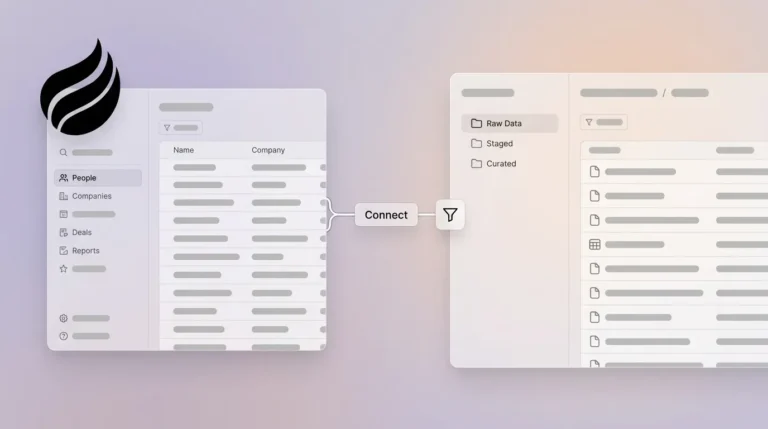
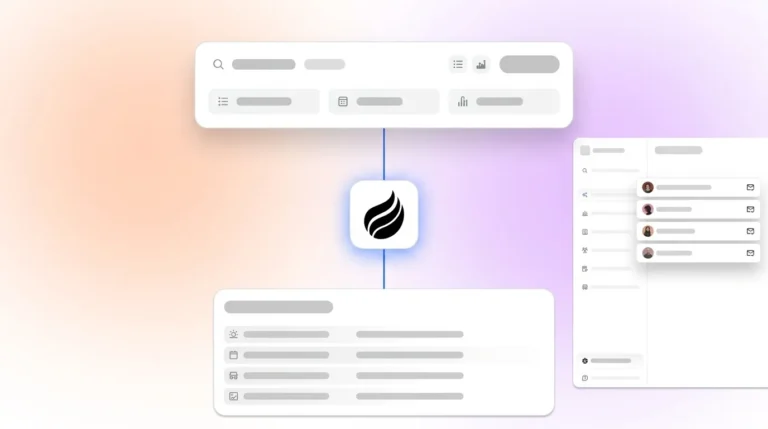
For teams running Salesforce or HubSpot, the agent operates as a companion layer. It authenticates to the existing instance, performs the same ingestion and enrichment work, and writes clean, structured data back to the primary system of record. Because the enriched data flows into the current CRM, teams gain the benefits of Coffee without a disruptive migration.
Pipeline Intelligence Without Manual Spreadsheets
The agent captures every interaction and stores it in a built-in data warehouse, so accurate pipeline analysis appears as a byproduct of normal work. Coffee’s Pipeline Compare feature visualizes week-over-week changes, including deals that progressed, opportunities that stalled, and new additions since the last review period.
This removes the need for manual CSV exports and formula-heavy spreadsheets that RevOps teams usually maintain for forecast calls. Data stays current because the agent logged it, not because a rep rushed to update a field before the Monday meeting.
Choosing Between Standalone and Companion Deployment
Coffee offers two deployment paths that match different stages of company growth. The Standalone CRM fits companies with one to twenty employees that have outgrown spreadsheets but view traditional CRMs as expensive and maintenance-heavy. In this model, the agent serves as the system of record, and no prior CRM infrastructure is required.
The Companion App fits small to mid-market teams that remain committed to an existing Salesforce or HubSpot instance because of contracts, workflows, or organizational preference. The agent authenticates to the existing system and handles the data-in process, which improves data quality without replacing the system of record.
The decision is simple. Teams that want a new system of record choose Standalone. Teams that want to improve an existing one choose Companion.
Deployment Readiness Checklist for Coffee
- Team size: 1–20 employees signals Standalone readiness, while 20–150 employees with an existing CRM signals Companion readiness. This acts as the primary decision criterion, and the remaining factors help confirm fit within that path.
- Current data quality: If pipeline data is unreliable or reps maintain shadow CRMs, the agent addresses the root cause directly, which makes Coffee a strong fit regardless of deployment model.
- Integration needs: Current integrations are available via Zapier, and deeper native integrations are on the roadmap. Teams that depend on niche tools should confirm Zapier coverage before committing.
- Stack complexity: Teams paying separately for enrichment, recording, and forecasting tools are strong candidates for consolidation with a single agent-driven platform.
- Change-management capacity: Coffee requires minimal onboarding, since authentication to Google Workspace or Microsoft 365 is the primary setup step.
- Security requirements: Coffee is SOC 2 Type 2 and GDPR compliant, and data is not used to train public models. This satisfies standard security reviews for most scaling SMBs.
Get started with Coffee and see which deployment model fits your team.
How AI Changes Sales Work, Not Sales Roles
An AI-first CRM automates administrative labor, not sales judgment. The agent handles data entry, enrichment, transcription, and follow-up drafting. The rep still owns relationship-building, negotiation, and deal strategy. Reps spend more time on work that requires human judgment because the agent absorbs the work that does not.
Key Questions to Ask Before You Switch CRMs
- Does the platform ingest unstructured data such as emails and transcripts natively, or does it require manual input?
- Is the agent the system of record, or does it write back to an existing CRM?
- How is historical pipeline data preserved when fields are updated?
- What is the onboarding requirement, such as days, weeks, or a single authentication step?
- Is pricing based on seat count, usage volume, or both?
- What compliance certifications does the platform hold, and is customer data used for model training?
Frequently Asked Questions
Does Coffee integrate with my existing tools?
Coffee currently supports integrations via Zapier, which connects it to a broad range of sales and marketing tools. Deeper native integrations are on the product roadmap. For teams running Salesforce or HubSpot, the Companion App authenticates directly to those systems and writes enriched data back to the existing instance without a separate integration layer.
Is Coffee secure and compliant?
Coffee is SOC 2 Type 2 certified and GDPR compliant, and customer data is not used to train public AI models. For most scaling SMBs, this satisfies standard security review requirements. Organizations in heavily regulated industries such as healthcare or finance with multi-year security review cycles fall outside Coffee’s current ideal customer profile.
How is Coffee priced?
Coffee uses seat-based pricing. You pay for the number of human users on the platform, and the agent’s labor for data capture, enrichment, transcription, and pipeline tracking is included. There are no separate charges for LLM calls or automated workflows.
What happens to my data if I already use Salesforce or HubSpot?
The Companion App deployment model is designed specifically for this situation. The Coffee Agent authenticates to your existing Salesforce or HubSpot instance, performs automatic data capture and enrichment, and writes clean records back to your system of record. Your existing workflows, quotas, required fields, and forecasting configurations remain in place, so no migration is required.
Conclusion: Moving Your Team to an AI-First CRM
The evaluation framework stays simple. If your team spends more time maintaining a CRM than selling, the architecture is the problem, not the reps. An AI-first CRM platform for sales teams fixes this by deploying an agent that handles data capture, enrichment, and pipeline tracking as a continuous background process. The choice between Standalone and Companion deployment depends on whether you need a new system of record or a smarter layer on the one you already have.
Coffee is built for this transition. It operates as both a full system of record for growing teams and an intelligent companion for teams committed to Salesforce or HubSpot, handling structured and unstructured data, preserving full pipeline history, and consolidating the tool stack that legacy CRMs require. Get started with Coffee and put the agent to work for your team.