
In today’s fast-paced sales environment, the customer relationship management (CRM) landscape is undergoing a profound change. Artificial intelligence is reshaping how businesses handle lead management, moving beyond the limitations of traditional systems that often struggle with data integration and user efficiency. Many sales teams find themselves juggling multiple tools, spending valuable time on administrative tasks instead of building relationships and closing deals. AI-driven solutions are stepping in to address these challenges, offering smarter automation and streamlined processes. This guide dives into the evolving market of AI CRMs, explores their practical benefits for sales leaders, and highlights platforms like Coffee as part of this innovative trend. By the end, you’ll see why exploring an AI-first approach, such as requesting access to Coffee, could be a valuable step for boosting your team’s performance.
Why Traditional CRMs Struggle with Modern Lead Management
Traditional CRMs often fall short in meeting the needs of today’s sales teams due to fragmented data and inefficiencies. Originally built to centralize customer information, these systems frequently fail to integrate smoothly with modern tools, creating extra work for users.
Data fragmentation is a common issue. Sales reps often deal with customer information spread across multiple platforms, like HubSpot for CRM tasks, ZoomInfo for data enrichment, and SalesLoft for outreach. Managing these disjointed tools increases costs and complicates workflows, undermining the goal of a unified data system.
Manual data entry adds to the burden. Sales reps can spend a significant portion of their time inputting information, with studies showing that up to 71% of their week is consumed by such tasks, leaving only about 35% for actual selling. This imbalance reduces productivity for many teams.
Older CRM architectures also pose challenges. Many systems rely on outdated data models that struggle to handle real-time needs or unstructured data, such as emails or call transcripts, without extensive customization. Even newer platforms like HubSpot, initially designed for marketing, may not offer a fully integrated CRM experience from the ground up.
User adoption is another hurdle. When CRMs feel more like reporting tools for management than practical aids for sales reps, usage drops. Incomplete data creates a cycle of inaccuracy, pushing teams to rely on external tools like spreadsheets or Notion instead of the official system.
AI offers a chance to rethink CRM design. Solutions built with AI at their core, rather than as an afterthought, are gaining traction as a way to overcome these persistent issues.
Discover Coffee: A Fresh Take on AI-First Lead Management
Coffee stands out as an AI-first CRM platform, built to tackle the core problems of traditional systems with smart automation and a unified data structure. Unlike older CRMs that patch on AI features, Coffee integrates AI from the foundation, delivering a more intuitive experience for sales teams.
Coffee offers two models to suit different business needs while retaining its core AI capabilities. The Standalone CRM works well for small to mid-sized companies looking for a modern alternative. The Companion App pairs with existing Salesforce or HubSpot setups, adding an intelligent layer without requiring a full system overhaul.
Here are the key ways Coffee addresses common CRM pain points:
- Automatic Data Handling: By connecting to Google Workspace or Microsoft 365, Coffee creates and updates contacts, companies, and activities. Every email, meeting, and note links to the right records, saving reps an estimated 8-12 hours weekly.
- Meeting Workflow Automation: Coffee uses AI to prepare reps with detailed briefings before meetings and generates summaries, action items, and follow-up emails after. It also supports sales frameworks like BANT and MEDDIC for consistent deal qualification.
- Pipeline Insights: With a built-in data warehouse, Coffee tracks historical pipeline changes. Its “Compare” feature reveals weekly shifts at a glance, simplifying analysis that older systems complicate.
- Simplified Tech Stack: Coffee combines CRM, data enrichment, call recording, and forecasting into one platform, cutting down on tool overload and costs.
- User-Friendly Design: Focused on helping reps directly, Coffee acts as a daily co-pilot, improving engagement compared to systems seen as management tools.
Curious about enhancing your lead management? Request access to Coffee and see how an AI-first CRM can lift your sales team’s efficiency.
Navigating the AI CRM Market as a Sales Leader
How AI Fits into CRM Strategy
AI is becoming a critical factor in CRM for maintaining a competitive edge in sales. It shifts operations from manual, reactive tasks to proactive, data-driven processes, making it essential for sales leaders to understand how it aligns with existing strategies.
Automation in AI CRMs covers data entry, meeting prep, follow-ups, and pipeline tracking. These features aim to save time and improve decision-making, allowing teams to focus on customer engagement over paperwork.
AI-Enhanced vs. AI-First: What’s the Difference?
The AI CRM market splits into two categories with distinct impacts on business outcomes. AI-enhanced CRMs are traditional platforms that later added AI features, often retaining older complexities. In contrast, AI-first CRMs like Coffee are built with AI as the core focus, using modern data structures for a smoother experience.
Choosing between these approaches affects scalability and ease of future upgrades. AI-first systems often adapt better to new advancements, while enhanced systems might require more effort to keep pace due to legacy constraints.
Key Factors in Adopting AI CRM: Beyond the Basics
Weighing Costs and Benefits
Adopting AI CRM involves more than just comparing features. Sales leaders need to assess financial and staffing needs, as well as manage team transitions. Initial costs for training and data setup are common, though long-term savings on operations can offset this.
Change management plays a big role. Teams used to older systems need clear guidance to adopt AI tools. Strong leadership support and communication can ease this shift.
Return on investment takes time. While automation offers quick wins, like time saved on data entry, broader impacts often appear within 30 to 90 days as data and usage build up.
Preparing for a Smooth Rollout
Successful AI CRM adoption starts with assessing readiness. Check data quality, tech infrastructure, and leadership buy-in. Poor data can hinder AI effectiveness, so cleanup might be necessary upfront.
Involve key players, such as sales heads, revenue ops, IT teams, and executives. Each brings unique needs to the planning process. Start with high-impact, low-risk features like data automation to build confidence before tackling complex areas.
Dodging Common Adoption Mistakes
Implementation issues often stem from predictable errors. Underestimating data quality needs is frequent, as AI relies on clean, consistent input for accurate results. Leadership disagreements on goals can also confuse teams, so unified messaging is critical.
Setting unrealistic timelines risks frustration. Full benefits emerge over time as users adapt and data accumulates, so patience is key for lasting success.
How Coffee Enhances Lead Management Capabilities
Streamlining Data Entry for Better Accuracy
Coffee eliminates manual data entry by auto-generating contacts and companies from Google Workspace or Microsoft 365. It scans emails and calendars for initial setups and enriches records with details like job titles and company funding. Activity logging keeps data current without user effort, ensuring reliable insights from sources like emails and transcripts.
Boosting Efficiency with AI Meeting Tools
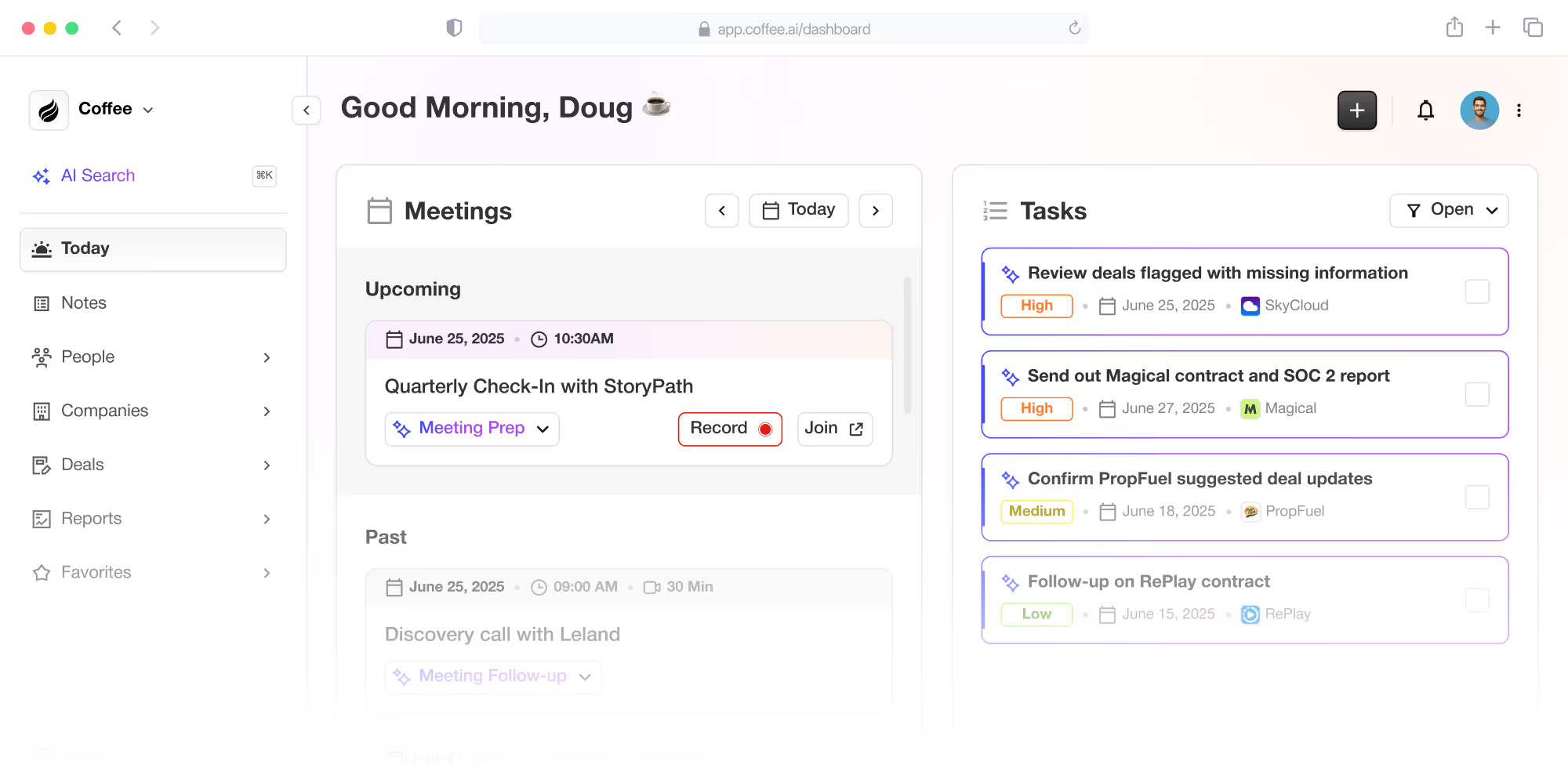
Coffee transforms meeting prep and follow-ups with automation. Its “Today” page offers briefings with attendee details and interaction history. An AI bot records calls on Google Meet, Microsoft Teams, or Zoom, while summaries, action items, and email drafts are created automatically. These align with sales methods like BANT or SPICED for consistency.
Tracking Pipeline Changes with Precision
Coffee’s “Compare” feature provides clear pipeline insights using a data warehouse to store historical snapshots. This allows quick views of weekly changes, deal progress, and stalled prospects, aiding leaders in forecasting and planning more effectively than manual methods.
Simplifying Prospecting with Natural Language Queries
Coffee’s List Builder lets users search for prospects using everyday language, such as finding sales VPs in specific company sizes or tech stacks. Integrated data ensures accuracy for targeting, supporting account-based marketing and market trend analysis. Ready to refine your prospecting? Request access to Coffee and explore AI-first tools.
Evaluating the Value of AI CRM in Lead Management
Tracking Performance Improvements
Measuring AI CRM impact requires tracking specific gains. Time saved on tasks like data entry or follow-ups is a clear indicator, with Coffee users often reclaiming 8-12 hours weekly. Pipeline accuracy also improves through automated updates, supporting better forecasting and planning.
Comparing Coffee to Traditional CRMs
Coffee’s AI-first design offers distinct advantages over traditional CRMs like Salesforce or HubSpot across key areas:
|
Feature |
Coffee (AI-First CRM) |
Traditional CRM |
Business Impact |
|
Data Entry |
Fully Automated |
Often Manual if Unconfigured |
8-12 hours saved weekly per rep |
|
Pipeline Insights |
Instant “Compare” Tool |
May Need Manual Work |
Better forecast precision |
|
Tech Stack |
All-in-One Solution |
Multiple Tools Often Needed |
Lower operational complexity |
|
User Experience |
Supportive Co-Pilot |
Can Feel Burdensome |
Stronger adoption rates |
Automation in data handling sets Coffee apart, saving time across sales processes. Its native pipeline tracking and consolidated tools reduce setup hassles, while a rep-focused design drives consistent use and data reliability.
Common Questions About AI CRM for Lead Management
How Does Coffee Improve Lead Qualification?
Coffee enhances lead qualification by automatically capturing and enriching data to build detailed lead profiles. This allows sales teams to focus on high-potential leads with actionable insights.
What Productivity Gains Come from AI CRM?
Platforms like Coffee cut down on repetitive tasks, saving reps an estimated 8-12 hours weekly. This frees up time for building customer connections and pursuing deals.
How Does Coffee Handle Data Security?
Coffee adheres to strict security standards with certifications like SOC 2, Type 2, and GDPR compliance. Customer data isn’t used for AI training without consent, prioritizing privacy.
Can Coffee Work with Salesforce or HubSpot?
Coffee’s Companion App integrates with Salesforce and HubSpot through simple authentication. It enables two-way data flow, adding AI capabilities without disrupting existing setups.
What Data Fuels Coffee’s Lead Insights?
Coffee uses both structured data, like contact info, and unstructured data from emails and call transcripts. This comprehensive approach provides a full picture of customer interactions.
Conclusion: AI-First CRM Shapes the Future of Lead Management
Traditional CRMs often create obstacles with fragmented data and manual workloads, slowing down sales teams. AI-first solutions like Coffee offer a different path by automating data tasks, streamlining workflows, and providing sharp pipeline insights, all within a single platform.
Coffee exemplifies this shift with practical automation and user-focused design, fitting into both new and existing systems through its dual-model approach. As part of the broader AI CRM trend, it shows how technology can directly support sales goals.
Interested in upgrading your lead management strategy? Request access to Coffee and learn how AI-first tools can drive your team’s success.