Written by: Doug Camplejohn, CEO & Co-Founder, Coffee | Last updated: July 21, 2026
Key Takeaways
- MEDDIC is the leading B2B sales qualification framework in 2026, used by enterprise teams at Salesforce, MongoDB, Snowflake, and HashiCorp to judge whether deals are real and closable.
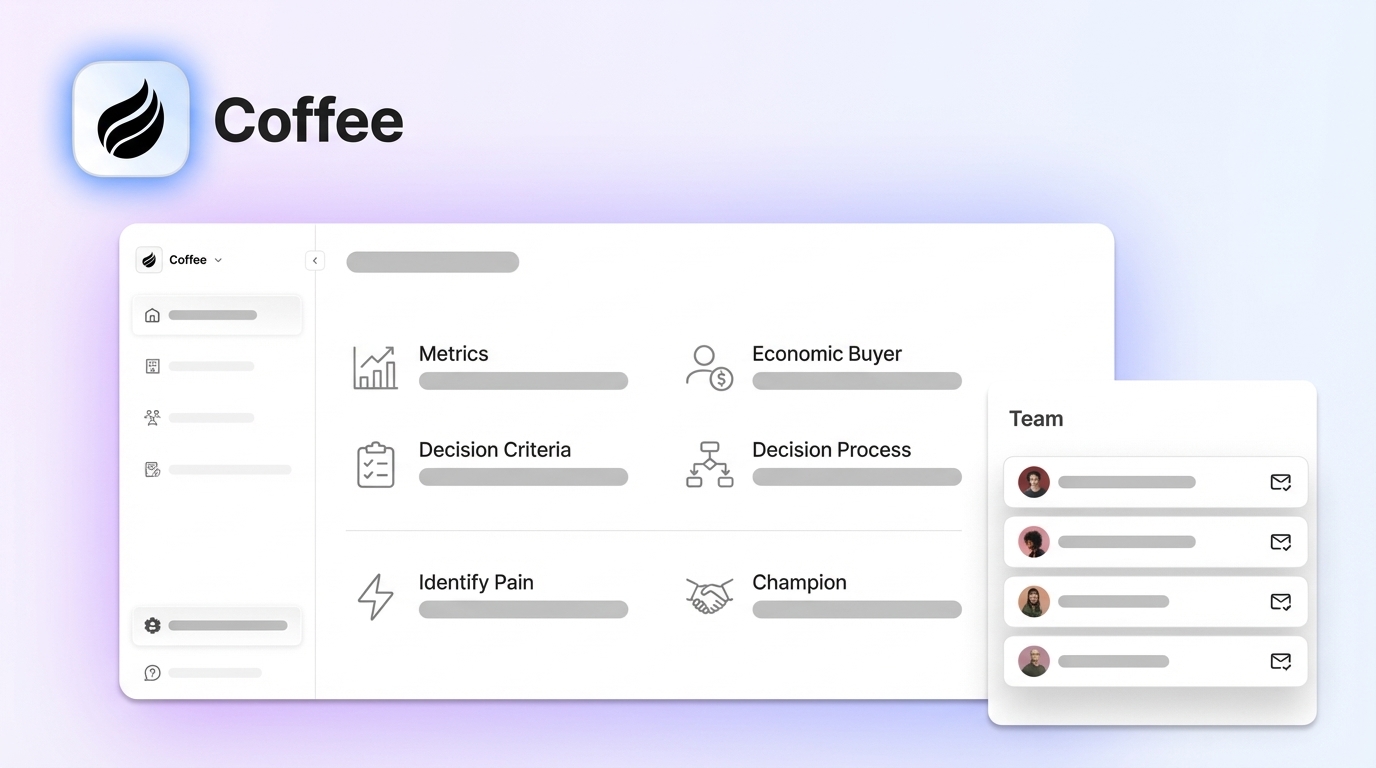
- The acronym covers six criteria: Metrics, Economic Buyer, Decision Criteria, Decision Process, Identify Pain, and Champion. Together, these elements create more reliable forecasts and reduce wishful thinking in the pipeline.
- MEDDIC outperforms simpler frameworks like BANT for complex, multi-stakeholder deals and delivers up to 61% higher forecast accuracy when teams apply it consistently.
- AI agents like Coffee capture MEDDIC data from calls, emails, and calendars, remove most manual entry, and keep CRM fields current throughout the sales cycle.
- Teams ready to enforce MEDDIC without the manual burden can automate qualification inside Salesforce or HubSpot with Coffee.
MEDDIC Components and What Each Letter Means
MEDDIC was created by Jack Napoli and Dick Dunkel at Parametric Technology Corporation (PTC) in the mid-1990s. After implementation, PTC grew revenue from $300 million to $1 billion in four years. The six letters map directly to the six qualification criteria every complex B2B deal requires. The table below breaks down each letter and shows the specific information you need to capture for every opportunity.
| Letter | Component | Definition |
|---|---|---|
| M | Metrics | The tangible, measurable outcomes a prospect expects to achieve, typically financial or time-related KPIs such as shortening the sales cycle by 20% or increasing conversions by 30%. |
| E | Economic Buyer | The individual with ultimate authority to approve or veto a purchase, typically a VP, SVP, or CXO who controls budget allocation and contract sign-off. |
| D | Decision Criteria | The 3–5 specific requirements a prospect must meet before purchasing, usually covering ease of use, integrations, cost, functionality, and ROI. |
| D | Decision Process | The specific steps, stakeholders, timelines, and internal procedures a prospect follows to evaluate and approve a purchase. |
| I | Identify Pain | The core problems or challenges driving the prospect to seek a solution, which are broader than metrics and not tied to specific KPIs. |
| C | Champion | An internal advocate within the prospect organization who feels the identified pain most acutely, lacks final sign-off power, but actively influences decision-makers and pushes the deal forward. |
Choosing Between MEDDIC, MEDDPICC, and BANT
Three qualification frameworks dominate B2B sales conversations in 2026, and each fits a different deal profile. The table below compares them across four dimensions to help you match your typical deal size, sales cycle length, and forecast accuracy needs with the right framework.
| Dimension | MEDDIC | MEDDPICC | BANT |
|---|---|---|---|
| Components | 6 letters: Metrics, Economic Buyer, Decision Criteria, Decision Process, Identify Pain, Champion | 8 letters: adds Paper Process and Competition | 4 letters: Budget, Authority, Need, Timeline |
| Ideal ACV | $25K–$100K with 3–5 stakeholders and 30–90 day cycles | $100K+ with 6+ stakeholders and 90+ day cycles involving formal procurement | Sub-$25K with fewer stakeholders and shorter cycles |
| Forecast accuracy impact | MEDDIC increases forecast accuracy by 61% and reduces forecast variance from 30–50% to under 10% | MEDDPICC forecast accuracy increases from 25% to 85% with adoption | Suited for speed, with limited predictive signal in multi-stakeholder deals |
| Adoption rate (2024) | doubled from 11% to 21% between 2021 and 2022 | 73% of SaaS companies above $100K ARR use some version of it | Widely used at SDR layer for first-touch triage |
MEDDICC is an intermediate variation that adds Competition but not Paper Process, resulting in seven total elements. It is common at mid-market SaaS companies that face competitive bake-offs but lighter procurement requirements.
BANT focuses on Budget, Authority, Need, and Timing and is often sufficient for simple inbound transactional opportunities. MEDDIC goes deeper to justify action, influence timing, and reach the Economic Buyer in complex B2B sales.
Why MEDDIC Still Matters in 2026
Gartner’s 2025 research puts the average B2B buying committee at 9 to 11 stakeholders, up from 5 to 7 in 2017, with typical ranges of 6–11 or 6–10 depending on deal size. A framework built to map multiple decision-makers, quantify pain, and track a formal decision process is more applicable now than when it was invented.
Teams using a consistent qualification framework can achieve higher win rates and shorter sales cycles than teams that qualify deals ad hoc. The Highspot State of Sales Enablement Report 2025 contains no data on MEDDIC usage rates, but it reinforces the value of structured qualification.
Beyond adoption rates, the framework’s relevance grows with the rising complexity of enterprise buying. Procurement teams can add significant time to enterprise deals through legal, security, and compliance reviews, which is exactly the blind spot that MEDDPICC’s Paper Process element helps you surface early.
Is MEDDIC certification worth it? Several providers offer structured MEDDIC and MEDDPICC training. MEDDIC Academy and inspir’em are among the providers offering MEDDPICC training and certification, alongside others such as MEDDICC and meddpicc.co. Most teams need time and practice to reach basic competency across all MEDDPICC elements. Certification delivers the most value for AEs and RevOps leaders running deals above $50K ACV where qualification rigor directly affects forecast accuracy.
See how Coffee automates MEDDIC capture inside Salesforce or HubSpot.
MEDDIC Discovery Questions and Coffee Automation
M — Metrics
Metrics are the quantifiable economic benefit and business impact a customer can expect from a solution, such as reducing manual work by 25% or increasing conversion rates. Without a buyer-owned number, there is no ROI case to present to the Economic Buyer.
Discovery question: “If this works, what number on your dashboard moves, and by how much?”
Coffee Agent automation: After a discovery call, the Coffee Agent parses the transcript and writes the confirmed metric, such as “$52,000/year in manual data-entry cost,” directly into the Metrics field in Salesforce or HubSpot. This removes post-call manual entry.
E — Economic Buyer
The Economic Buyer is the single individual who owns the budget and can approve the purchase even if all other stakeholders object, typically a VP or C-suite executive. Deals with a confirmed Economic Buyer tend to close at higher win rates.
Discovery question: “If you and I agree this is the right move, is there anyone else who’d need to approve the spend?”
Coffee Agent automation: The Coffee Agent scans email threads and calendar invites to identify the seniority and title of every participant. It then flags when a C-suite or VP-level contact enters the thread and updates the Economic Buyer field automatically.
D — Decision Criteria
Decision Criteria are the specific factors a customer uses to evaluate solutions, including pricing and ROI, tech stack compatibility, integration ease, security, compliance, and support. 72% of B2B software buyers use ChatGPT to evaluate vendors, so decision criteria are often shaped before the first call.
Discovery question: “What does the evaluation scorecard look like, and who owns the weights?”
Coffee Agent automation: When a prospect shares an RFP or evaluation document via email, the Coffee Agent extracts the listed criteria and populates the Decision Criteria field in the CRM, preserving the exact language the buyer used.
D — Decision Process
Decision Process maps the formal and informal steps, milestones, stakeholders, internal approvals, and procurement requirements a customer follows from evaluation to signed contract. An unmapped Paper Process can add significant time to enterprise sales cycles.
Discovery question: “Walk me from a verbal yes to the PO hitting our AR, every step, every name, every date.”
Coffee Agent automation: The Coffee Agent logs each new stakeholder introduced over email or on calls, updates the Decision Process field with their role and stage of involvement, and alerts the rep when a new approval gate is mentioned.
I — Identify Pain
Identify Pain involves uncovering the core urgent problems affecting the customer’s business along with the measurable consequences and cost of inaction. The absence of strong pain indicates no deal will close in the current quarter.
Discovery question: “What’s the cost of not solving this in the next six months, to the business and to your team?”
Coffee Agent automation: The Coffee Agent identifies pain statements in call transcripts, such as “we’re losing X hours per week” or “this is costing us Y per quarter,” and writes them verbatim into the Identify Pain field, timestamped to the call date.
C — Champion
A Champion is the internal advocate who wants you to win and will sell for you when you are not in the room, possessing both influence and a personal stake in the outcome. Deals with a real Champion have a higher likelihood of closing compared to those with only a supportive contact.
Discovery question: “Who inside will sell this for us? Give me their name and role.”
Coffee Agent automation: The Coffee Agent tracks which contacts proactively forward emails, schedule executive introductions, or share internal documents. It surfaces these behavioral signals as Champion confidence indicators in the CRM record.
Evaluate your current qualification process with Coffee’s automated MEDDIC capture.
How an AI Agent Enforces MEDDIC in Your CRM
The biggest barrier to MEDDIC adoption is the manual work required to update CRM fields, which takes reps approximately 10 minutes per deal and causes data to go stale. B2B data degrades roughly 22.5% per year (or 22–30% depending on data type), according to industry benchmarks commonly citing HubSpot, so fields filled at deal creation become unreliable within weeks without continuous updates.
The table below quantifies the operational cost of manual MEDDIC enforcement across five dimensions, from time spent on data entry to forecast accuracy, and shows how automation removes each bottleneck.
| Dimension | Manual MEDDIC | Agent-Enforced MEDDIC (Coffee) |
|---|---|---|
| Time spent on data entry per week | Significant research, multiple stakeholder contacts, and lengthy documentation that hampers productivity, with Coffee’s company data citing 8–12 hours per week on manual CRM tasks | Coffee Agent captures from email, calendar, and call transcripts automatically, so reps review instead of re-entering data |
| Data freshness | Degrades roughly 22–30% per year without continuous updates | Updates after every interaction, with Coffee Agent logging last activity and next activity autonomously |
| Forecast accuracy | Fewer than 50% of sales leaders have high confidence in their forecasting accuracy, according to Gartner research | Achieves the 25-to-85% forecast accuracy improvement cited earlier when MEDDPICC is fully operationalized |
| Adoption at 6 months | Without consistent reinforcement, adherence decays by 40–50% within six months after initial training | Captures data regardless of rep behavior, so adoption becomes structural rather than behavioral |
| CRM field quality | Reps prioritize selling over documentation, leaving MEDDIC fields unfilled or filled with vague, unverifiable claims | Coffee Agent writes verbatim buyer language from transcripts into structured fields, which preserves evidence standards |
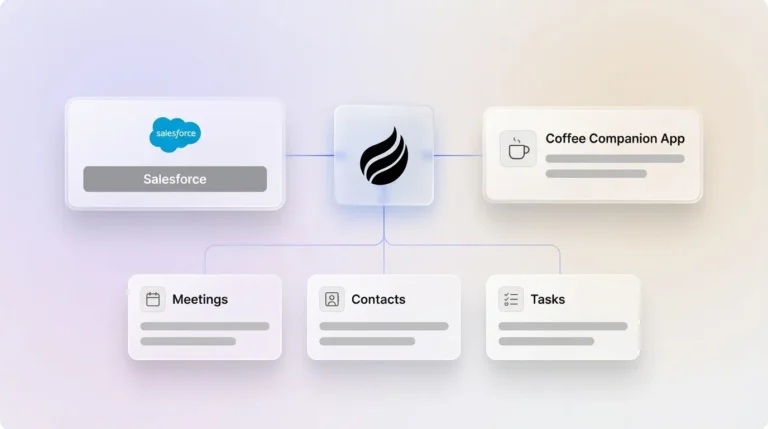
Coffee operates as a Companion App on top of existing Salesforce or HubSpot instances, which means it does not replace your CRM, it enhances it. A simple authentication allows the Coffee Agent to sync data, enrich it, and write MEDDIC field values back to the primary CRM without requiring reps to change their workflow.
Eliminate manual MEDDIC updates, and let Coffee capture qualification data automatically.
Common MEDDIC Pitfalls and How to Avoid Them
- Phantom Champion. The single biggest reason MEDDIC-qualified deals fall apart is the phantom champion, an enthusiastic contact lacking organizational influence. Test the Champion by asking them to schedule a meeting with the Economic Buyer. A Coffee Agent tracks whether that meeting appears on the calendar and flags deals where no EB contact has occurred.
- Checkbox culture. Organizations that enforce MEDDPICC with evidence standards, not just field completion, see fewer late-stage deal losses than those applying it as a checkbox exercise. One practical way to enforce evidence standards is to require verbatim buyer quotes in CRM fields rather than rep summaries, which ensures every qualification claim is traceable to a specific conversation.
- Single-threaded Economic Buyer access. Deals frequently collapse when the Economic Buyer first hears the price after months of indirect representation. The Coffee Agent surfaces when a VP or C-suite contact enters email threads and prompts the rep to schedule a direct meeting.
- Stale qualification data. Running the framework only once at Stage 1 instead of re-scoring elements after every call is among the most common implementation failures. The Coffee Agent updates fields after every logged interaction, which keeps qualification current throughout the deal cycle.
- Unmapped Paper Process. Failing to map Paper Process elements in complex deals leads to late-stage slippage from unaccounted legal, procurement, and security reviews. For deals above $100K ACV, extending to MEDDPICC and capturing Paper Process steps from early discovery calls prevents end-of-quarter surprises.
Eliminate manual MEDDIC updates, and let Coffee capture qualification data automatically.
Frequently Asked Questions
How long does it take to implement MEDDIC across a sales team?
Full behavioral adoption, where reps use the framework without prompting and CRM fields stay accurate, typically takes several months. The process usually involves two to four weeks of initial training, four weeks of live-deal application with CRM configuration, and four to six weeks of habit reinforcement through manager coaching and pipeline reviews. Teams using an AI agent to handle data capture reduce the behavioral burden significantly, because reps no longer need to manually update fields to keep qualification current. The framework becomes structural rather than dependent on individual discipline.
Is Coffee’s data secure, and does it comply with privacy regulations?
Coffee is SOC 2 Type 2 and GDPR compliant. Data ingested by the Coffee Agent, including email content, calendar metadata, and call transcripts, is not used to train public AI models. All data processed by the agent remains within the customer’s environment and is written back only to their connected Salesforce or HubSpot instance. For organizations in regulated industries, Coffee’s security posture should be reviewed against specific compliance requirements before deployment.
Does Coffee integrate with Salesforce and HubSpot for MEDDIC field capture?
Yes. Coffee operates as a Companion App that sits on top of existing Salesforce or HubSpot installations. After a simple authentication, the Coffee Agent reads from and writes to the CRM, populating MEDDIC fields such as Metrics, Economic Buyer, Decision Criteria, Decision Process, Identify Pain, and Champion directly from email threads, calendar events, and call transcripts. The agent understands the complexity of Salesforce and HubSpot configurations, including required fields, forecasting categories, and custom qualification objects, so MEDDIC data enters the system in the format each CRM expects. Additional integrations beyond Google Workspace and Microsoft 365 are available via Zapier, with deeper native integrations on the product roadmap.
What is the difference between MEDDIC and MEDDPICC, and which should my team use?
MEDDIC contains six qualification criteria. MEDDPICC adds two: Paper Process, which maps every legal, procurement, and security step between a verbal yes and a signed contract, and Competition, which requires identifying every alternative the buyer is evaluating including the status quo. The choice depends on deal profile. MEDDIC is appropriate for deals with ACV under $100K, sales cycles under 90 days, and light procurement involvement. MEDDPICC is the recommended default for deals above $100K ACV, cycles longer than 90 days, and any pursuit involving a dedicated procurement team, security review, or named incumbent to displace. As noted in the comparison above, MEDDPICC adoption has grown significantly in recent years, with nearly three-quarters of high-ACV SaaS companies now using some version of the framework.
Can MEDDIC be applied to inbound as well as outbound sales motions?
MEDDIC applies to both motions, though the sequencing differs. Inbound teams use it to qualify incoming leads quickly, confirming Metrics and Identify Pain in the first discovery call before investing AE time. Outbound reps apply it progressively across multiple calls, building the qualification picture as they earn access to new stakeholders. In both cases, the framework works best as a continuously updated instrument rather than a one-time stage gate. An AI agent that captures qualification signals from every email and call keeps the MEDDIC record aligned with the current state of the deal regardless of how the opportunity originated.