Written by: Doug Camplejohn, CEO & Co-Founder, Coffee | Last updated: August 3, 2026
Key Takeaways
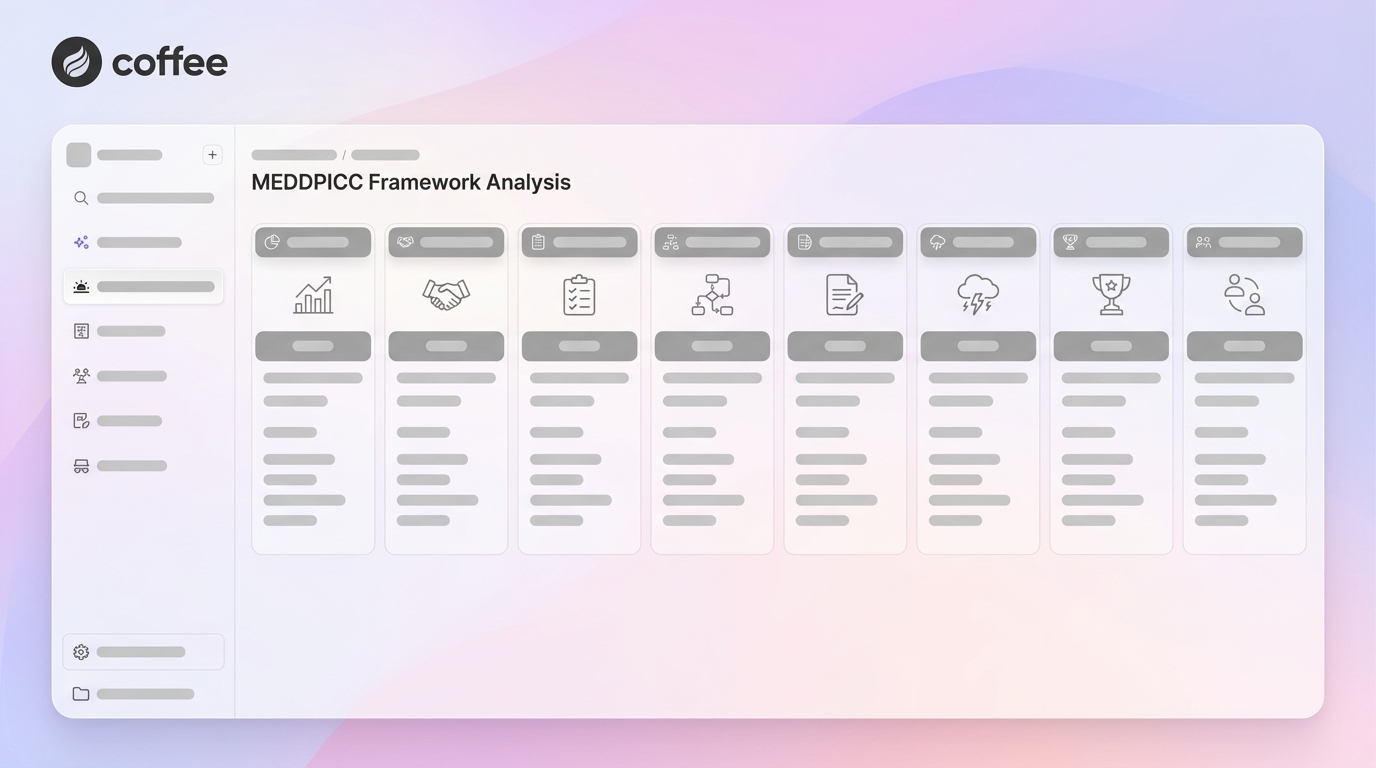
- MEDDPICC is an eight-component qualification framework for complex enterprise B2B deals: Metrics, Economic Buyer, Decision Criteria, Decision Process, Paper Process, Implicate the Pain, Champion, and Competition.
- The framework gives revenue teams a shared language to assess deal health, enforce evidence-based forecasting, and avoid late-stage surprises across multi-stakeholder buying cycles.
- Each component includes specific discovery questions and Red/Yellow/Green scoring criteria that standardize qualification evidence.
- AI-assisted procurement, remote buying committees, and data-quality erosion in 2026 make automated MEDDPICC capture essential for accurate forecasts.
- Eliminate manual data entry and enforce every MEDDPICC element automatically with Coffee.
The Eight MEDDPICC Components at a Glance
| Component | Abbreviation | One-Sentence Definition |
|---|---|---|
| Metrics | M | The quantifiable business outcomes the buyer expects to achieve and the numbers that justify the investment. |
| Economic Buyer | E | The single individual with final budget authority and the power to approve or kill the deal. |
| Decision Criteria | D | The formal and informal requirements the buying committee uses to evaluate and select a vendor. |
| Decision Process | D | The sequence of steps, approvals, and stakeholders required to move from evaluation to signed contract. |
| Paper Process | P | The legal, procurement, and security review steps that occur after commercial agreement and before signature. |
| Implicate the Pain | I | The confirmed, quantified business problem driving urgency and the cost of leaving it unsolved. |
| Champion | C | An internal advocate with credibility, influence, and a personal stake in the project's success. |
| Competition | C | All alternatives under consideration, including direct vendors, internal builds, and the status quo. |
Metrics: Quantifying Business Outcomes That Justify Change
Metrics are the specific, buyer-confirmed numbers that define success and justify budget allocation. Organizations that fully adopt MEDDPICC report 18% higher win rates and 24% larger deal sizes, per Force Management research, and Metrics is the foundation that makes every other element credible.
Enterprise discovery questions for Metrics:
- What specific KPIs does your executive team track that this project directly affects?
- What is the cost of this problem on a monthly or quarterly basis, in revenue, time, or headcount?
- If this problem is still unresolved 12 months from now, what does that cost the business in concrete terms?
- How do you measure success for this initiative internally?
- Have you built a business case yet, and what numbers are in it?
Red/Yellow/Green scoring for Metrics: Green = buyer has articulated specific quantifiable outcomes with numbers, percentages, or time frames. Yellow = directional improvement described but not yet quantified. Red = no measurable outcome defined; statements like “better reporting” do not qualify as confirmed evidence.
Economic Buyer: Securing Access to Budget Authority
The Economic Buyer is the individual who controls the budget and can approve or veto the purchase unilaterally. Early involvement from this decision-maker increases win rates and shortens cycles.
Enterprise discovery questions for Economic Buyer:
- Who has final sign-off on the budget for this initiative?
- Has this person approved similar purchases in the past 12 months?
- If your team recommends moving forward, who can still stop it?
- Can we get 15 minutes with them before the proposal stage?
- Is there a budget allocated for this project, or does it need to be created?
Red/Yellow/Green scoring for Economic Buyer: Green = named executive who has confirmed budget range and timeline in a direct conversation. Yellow = identified but no direct access secured. Red = unknown or assumed based on title alone.
Decision Criteria: Shaping How Buyers Evaluate You
Decision Criteria are the explicit and implicit requirements the buying committee uses to evaluate vendors. Enterprise AEs who uncover and influence these criteria early can shape the evaluation in their favor.
Enterprise discovery questions for Decision Criteria:
- What are the must-have requirements versus nice-to-haves for this evaluation?
- Who defined the evaluation criteria, and are they final?
- Are there specific security or compliance requirements such as SOC 2, GDPR, or HIPAA that are non-negotiable?
- Have you built a scoring matrix, and can we see the categories?
- How heavily does pricing factor relative to capability?
Red/Yellow/Green scoring for Decision Criteria: Green = formal criteria documented and shared, with must-haves confirmed. Yellow = criteria discussed verbally but not formalized. Red = criteria unknown or entirely controlled by a competitor.
Decision Process: Mapping Every Step to Signature
Decision Process maps every approval step, stakeholder, and dependency between the current conversation and a signed contract. Top-performing reps spend more discovery time on the prospect’s internal decision-making process and avoid guessing.
Enterprise discovery questions for Decision Process:
- Can you walk me through the steps between now and a signed contract?
- Is there a formal vendor selection committee, and who sits on it?
- Who else needs to evaluate or approve this purchase?
- What is your target date for having a solution in place, and are there dependencies driving that date?
- Have you been through a similar buying process recently, and how long did it take?
Red/Yellow/Green scoring for Decision Process: Green = all steps, owners, and dates mapped and confirmed. Yellow = general sequence known but key approvers or timelines unconfirmed. Red = process unknown beyond the immediate contact.
Paper Process: Preventing Quarter-End Slippage
Paper Process covers every legal, procurement, and security step that occurs after commercial agreement. Teams that track the Paper Process element experience fewer deals slipping from one quarter to the next.
The component breaks into three distinct workstreams: legal review, procurement and finance approval, and security and compliance review, and each workstream has its own timeline and stakeholders.
Enterprise discovery questions for Paper Process:
- What does your legal and procurement process look like for a purchase of this size?
- Is there a security review process, and do you need a SOC 2 report or completed security questionnaire upfront?
- Who in procurement should I contact early so we are not waiting on paperwork after you have made a decision?
- Are there any fiscal year deadlines that affect when the PO needs to be issued?
- How long does legal review typically take for new vendor agreements?
Red/Yellow/Green scoring for Paper Process: Green = full procurement, legal, and security path mapped with named owners and estimated timelines. Yellow = partial path known, with some steps or owners unconfirmed. Red = unexplored, so add a 2 to 4 week buffer to any forecast date.
Implicate the Pain: Turning Problems into Urgency
Implicate the Pain goes beyond identifying a problem and forces the buyer to articulate the quantified cost of inaction. Many deals are lost because sellers fail to connect a solution to a specific business pain with a clear financial consequence.
Enterprise discovery questions for Implicate the Pain:
- What is the business problem that started this evaluation?
- How long has this problem existed, and what changed to make it urgent now?
- What does this problem cost you on a quarterly basis, in revenue, time, or headcount?
- What happens if you do not solve this in the next six months?
- Who else in the organization feels the impact of this problem?
Red/Yellow/Green scoring for Implicate the Pain: Green = pain is explicit, buyer-confirmed, and quantified with a cost of inaction. Yellow = pain inferred from context but not yet quantified by the buyer. Red = no confirmed pain, and a hard block should prevent proposal stage entry.
Champion: Building Internal Advocacy That Sells for You
A Champion is an internal advocate who has the credibility, influence, and personal motivation to sell on your behalf when you are not in the room. Deals with tested Champions close at significantly higher rates than opportunities lacking true internal advocacy.
Enterprise discovery questions for Champion:
- When you picture this getting approved, who do you see making the case to the Economic Buyer?
- Does this person have a personal stake in solving this problem, such as promotion, performance review, or project ownership?
- Can they get us a meeting with the Economic Buyer?
- Are they willing to share internal objections and competitive intelligence with us?
- Have they gone to bat for a vendor before in a similar process?
Red/Yellow/Green scoring for Champion: Green = power and credibility tested through observable behaviors such as internal meetings scheduled, business case co-authored, and executive introductions made. Yellow = supporter only, with no demonstrated internal influence. Red = no internal advocate identified.
Competition: Winning Against Vendors and the Status Quo
Competition in MEDDPICC encompasses direct vendors, indirect alternatives, internal build options, and the status quo. Deals weak on the Competition dimension are more likely to result in no decision.
Enterprise discovery questions for Competition:
- Who else is on the shortlist for this evaluation?
- Has anyone internally proposed building a solution instead of buying one?
- What would need to be true for you to decide not to make a change at all?
- Where do you see us versus the other options you are evaluating?
Red/Yellow/Green scoring for Competition: Green = all named competitors and the status quo alternative mapped, with differentiation confirmed. Yellow = some competitors known but “do nothing” risk unassessed. Red = competitive landscape unknown.
Three Core Workstreams Inside the Paper Process
The Paper Process component breaks into three distinct workstreams that enterprise teams must map before calling a deal commit-ready.
- Legal review. Contract redlining, MSA negotiation, and DPA execution. In regulated industries, legal review can involve multiple discrete documents and take several months.
- Procurement and finance approval. Purchase order issuance, vendor onboarding, and budget confirmation. This step often requires a named procurement contact who is separate from the business sponsor.
- Security and compliance review. SOC 2 report submission, completion of 50 to 200 question security questionnaires, and insurance verification. Enterprise SaaS contracts above 100,000 dollars in annual contract value typically involve legal, security, procurement, and finance teams.
Teams that map all three workstreams at the start of the sales cycle, not after verbal agreement, have the best chance of preventing quarter-end slippage.
Three Types of Metrics That Strengthen Your Business Case
Enterprise sales teams categorize Metrics into three types so the business case stays complete and defensible at the Economic Buyer level.
- Efficiency metrics. Time saved, headcount reductions, or process automation gains. Example: eliminating 8 to 12 hours per rep per week of manual data entry.
- Revenue metrics. Pipeline growth, win rate improvement, or deal size expansion, which reflect the performance gains mentioned earlier in the Metrics section.
- Risk or cost-of-inaction metrics. The quantified consequence of not solving the problem, such as lost revenue, compliance exposure, or competitive disadvantage. Forty to sixty percent of B2B opportunities end in no decision because buyers prefer doing nothing, per Gartner research, which makes cost-of-inaction the most persuasive metric category for breaking inertia.
How MEDDPICC Extends the Original MEDDIC Framework
MEDDIC was developed at PTC in 1996 by Dick Dunkel and Jack Napoli and contains six elements: Metrics, Economic Buyer, Decision Criteria, Decision Process, Identify Pain, and Champion. MEDDPICC adds two components that address modern enterprise buying complexity.
- Paper Process (the second P). Absent from MEDDIC, this element covers the procurement, legal, and security review steps that routinely delay enterprise deals by 60 to 90 days after commercial agreement.
- Competition (the second C). MEDDIC’s original framing did not explicitly require competitive mapping. MEDDPICC treats Competition as a required qualification element, including the status quo as a named alternative.
An intermediate variant, MEDDICC, adds Competition but omits Paper Process. Most enterprise SaaS companies above 50 million dollars in annual recurring revenue have moved from MEDDIC to MEDDPICC over the past three years specifically to address procurement and legal surprises and competitors that were not qualified early. MEDDIC remains appropriate for mid-market deals with lighter procurement processes and sales cycles under 60 days.
MEDDPICC Qualification Scorecard Template for Deal Reviews
Teams can score each element from 0 to 2 using the evidence standards below, then total the eight scores for a deal score out of 16.
| Element | 0 – Red (Missing) | 1 – Yellow (Partial) | 2 – Green (Confirmed) |
|---|---|---|---|
| Metrics | No quantified outcome defined | Directional improvement described, not quantified | Specific numbers, percentages, or time frames confirmed by buyer |
| Economic Buyer | Unknown | Identified, no direct access | Named; confirmed budget range and timeline in direct conversation |
| Decision Criteria | Unknown | Discussed verbally, not formalized | Formal criteria documented and shared; must-haves confirmed |
| Decision Process | Unknown beyond immediate contact | General sequence known; key approvers or dates unconfirmed | All steps, owners, and dates mapped and confirmed |
| Paper Process | Unexplored | Partial path known; some steps or owners unconfirmed | Full legal, procurement, and security path mapped with named owners |
| Implicate the Pain | No confirmed pain | Pain inferred; cost of inaction not quantified | Explicit, buyer-confirmed pain with quantified cost of inaction |
| Champion | No internal advocate | Supporter only; no demonstrated internal influence | Power and credibility tested through observable behaviors |
| Competition | Competitive landscape unknown | Some competitors known; “do nothing” risk unassessed | All named competitors and status quo mapped; differentiation confirmed |
Forecast stage thresholds based on a 16-point MEDDPICC qualification scorecard:
- 14 to 16 points: Commit forecast
- 10 to 13 points: Upside or best case
- 6 to 9 points: Early-stage pipeline
- Under 6 points: Remove from active forecast or assign to nurture
2026 Enterprise Pitfalls for Manual MEDDPICC
Three structural shifts in 2026 enterprise buying create new failure modes for teams that run MEDDPICC manually.
AI-assisted procurement. Nineteen percent of B2B decision-makers already implement generative AI for buying and selling, with another 23 percent actively piloting solutions, per McKinsey data. Procurement teams now use AI tools to generate RFP requirements, score vendor responses, and flag contract risk, often before a sales rep knows the formal evaluation has begun. Decision Criteria and Paper Process elements can shift mid-cycle without notice, so real-time MEDDPICC updates become essential rather than optional.
Remote buying committees. B2B buyers spend only 17 percent of their buying time meeting with potential suppliers, per Gartner. With buying committees of 6 to 10 stakeholders now standard, reps have fewer live touchpoints to surface qualification evidence. Champion identification becomes harder when committee members never appear on a shared call, and Economic Buyer access requires deliberate orchestration instead of a natural meeting cadence.
Data-quality erosion. Salesforce research found that 91 percent of CRM data becomes incomplete, stale, or duplicated within a year. In long enterprise cycles, a Champion leaving the company or an Economic Buyer losing budget authority in a reorg can instantly flip a deal from Commit to At Risk. Manual CRM updates often capture this change days or weeks late, if at all, and logging MEDDPICC fields from memory after the fact produces inaccurate results.
Autonomous AI agents address all three pitfalls by capturing MEDDPICC evidence directly from emails, call transcripts, and calendar activity, then writing validated qualification data back to the CRM in real time without requiring reps to act as data entry clerks. MEDDPICC implementations can take multiple quarters to achieve consistent adoption unless the scorecard is filled automatically from conversations rather than by manual rep entry. By removing that friction, agents let reps spend discovery time asking the right qualification questions instead of trying to recall what was said well enough to log it later.
Frequently Asked Questions
Does an AI agent integrate with Salesforce or HubSpot to enforce MEDDPICC fields?
Yes. A well-built AI CRM agent connects to existing Salesforce or HubSpot instances through a simple authentication flow, then reads emails, call transcripts, and calendar data to populate MEDDPICC qualification fields automatically. It writes structured evidence back to the opportunity record, including notes fields, so validation rules and stage-gate requirements are satisfied without manual rep input. Coffee's Companion App is purpose-built for this use case, with deep knowledge of Salesforce and HubSpot field structures, required fields, forecasting categories, and quota logic that newer CRM alternatives lack.
Is MEDDPICC data captured by an AI agent secure?
Security requirements vary by vendor, but enterprise-grade agents should hold SOC 2 Type 2 certification and comply with GDPR. Coffee is SOC 2 Type 2 and GDPR compliant, and customer data is never used to train public AI models. For teams in regulated industries, confirm whether the agent stores conversation transcripts in a dedicated data warehouse with access controls and whether the vendor can complete a standard security questionnaire, the same Paper Process step your own buyers require of you.
How long does it take to implement MEDDPICC with an AI agent versus a manual rollout?
A manual MEDDPICC rollout typically requires 2 to 4 days of initial training, followed by 60 to 90 days of behavioral adoption work before reps apply the framework consistently in live deals. Broader organizational fluency often takes 12 to 18 months. An AI agent compresses the data-capture portion of that timeline significantly. Because the agent populates qualification fields automatically after every interaction, reps see MEDDPICC evidence accumulating in their CRM from day one instead of facing a blank scorecard. The coaching and deal-review habits still require manager reinforcement, but the adoption barrier of manual data entry disappears from the start.
Which MEDDPICC elements benefit most from automated data capture?
Paper Process and Champion are the two elements where automated capture delivers the highest return. Paper Process is the most commonly skipped element in manual implementations because reps treat it as administrative work. An agent that detects procurement, legal, and security signals in email threads and flags them automatically ensures this element is never blank at forecast time. Champion evidence such as internal meetings scheduled, business case language, and executive introductions surfaces naturally in email and calendar data that an agent can parse and score without rep intervention.
Can MEDDPICC be applied to deals already in mid-cycle?
Yes, and it often delivers the most value there. A practical approach is to audit all Stage 3 and above opportunities first, scoring each against the 16-point scorecard to identify which deals carry Red ratings on high-risk elements like Economic Buyer, Paper Process, or Champion. Deals scoring below 6 should move to nurture or be disqualified to protect forecast integrity. For deals scoring 6 to 13, the scorecard gaps become the coaching agenda for the next manager one-on-one. An AI agent accelerates this audit by scanning existing email and call history to pre-populate evidence fields before the review session begins.
Conclusion: Turning MEDDPICC into a Live, Trusted Forecast System
MEDDPICC gives enterprise sales teams a precise, shared language for qualifying complex deals across every stakeholder, procurement step, and competitive dynamic that defines modern B2B buying. Organizations implementing MEDDPICC report forecast accuracy improving from 25 percent to 85 percent within 6 months. The framework’s value is fully realized only when qualification data stays current throughout a deal cycle, a standard that manual data entry rarely meets in 2026 enterprise environments with remote committees, AI-assisted procurement, and 90-day-plus paper processes.
Autonomous AI agents remove the manual data-entry barrier, capture MEDDPICC evidence from every conversation, and write accurate qualification data back to the CRM in real time so revenue leaders gain the forecast confidence the framework was designed to deliver.
Put MEDDPICC enforcement on autopilot for your enterprise pipeline with Coffee.