
In today’s fast-paced sales environment, identifying and addressing bottlenecks in your sales process is more important than ever. With increasing competition and evolving customer expectations, even small inefficiencies can lead to lost deals and stalled revenue growth. Many sales leaders still rely on outdated tools or manual methods to track performance, often missing critical issues until they become major problems. The market landscape for customer relationship management (CRM) has shifted dramatically in recent years, with AI-powered solutions emerging as a game-changer for sales teams of all sizes. These tools offer real-time insights and automation, helping businesses move from reactive fixes to proactive strategies that drive consistent results.
Traditional CRMs, while foundational for organizing customer data, often struggle to keep pace with the demands of modern sales cycles. They can require extensive manual input and may not provide the depth of analysis needed to uncover hidden bottlenecks. In contrast, newer AI-driven platforms integrate seamlessly with existing workflows, pulling data from emails, calendars, and calls to create a comprehensive view of sales activities. This shift reflects a broader trend toward data unification and automation, allowing sales teams to focus on selling rather than administrative tasks. As a result, companies adopting these solutions often see measurable gains in efficiency and revenue.
This guide offers a clear, step-by-step approach to identifying, analyzing, and resolving sales process bottlenecks using AI CRM tools. We’ll explore how platforms like Coffee, a standout in this evolving space, help sales leaders gain visibility into their pipelines and address issues before they impact outcomes. By following these steps, you’ll learn how to optimize your sales process with data-driven decisions, ultimately boosting productivity and growth.
Understanding the Cost of Sales Bottlenecks
Sales bottlenecks can quietly drain resources and hinder growth if left unaddressed. To tackle them effectively, you need a basic understanding of your sales pipeline stages and access to a CRM system, even if it’s an older one. Bottlenecks often hide in plain sight, manifesting as stalled deals, prolonged sales cycles, or inconsistent performance across teams. When ignored, they lead to missed opportunities, lower productivity among sales reps, and unpredictable revenue streams.
Older CRM systems can sometimes contribute to these issues by requiring manual data entry, which takes time away from selling. Fragmented data across multiple tools can also make it hard to get a clear picture of where problems lie. Without real-time insights, sales leaders may struggle to spot bottlenecks until after deals are lost. Studies suggest that sales reps spend only about 36% of their time on actual selling, with much of the rest consumed by administrative tasks often tied to outdated systems Salesforce Sales Stats.
Fortunately, AI-powered CRM solutions are changing the game. Tools like Coffee automate data collection and provide actionable insights, helping teams pinpoint pipeline issues quickly. This reflects a wider move in the industry toward smarter, more integrated systems that prioritize efficiency. By adopting these tools, sales teams can shift focus back to closing deals while addressing bottlenecks in real time.
Ready to start identifying where your sales process needs improvement? Request access to Coffee’s AI CRM platform and gain precise visibility into your pipeline challenges today.
Step 1: Map Out Your Sales Process for Better Visibility
Start by creating a detailed map of your current sales process to uncover potential bottlenecks. This involves documenting every stage from lead generation to deal closure, paying close attention to how deals move through your organization in reality, not just on paper.
- Detail each stage, decision point, and team handoff in a flowchart. Observe real sales activities to ensure accuracy, as intended processes often differ from what happens day-to-day.
- List all tools, actions, and communication channels used at each stage, including CRM, email, calling software, and any manual workarounds. Older systems may scatter data, so capturing these gaps is key.
- Note what data is collected at each step and where information is missing. Identify spots requiring manual entry or where assumptions fill in for incomplete data.
By the end, you’ll have a visual overview of your sales workflow, highlighting areas of complexity or weakness. A common mistake is assuming documented processes match reality, so take time to interview reps and observe their actual routines for a true picture.
Step 2: Automate Data Capture with Coffee’s AI CRM
Next, streamline data collection to eliminate manual work and gain a clear view of sales activities. Coffee, an AI-powered CRM, simplifies this by automatically gathering data from everyday tools, freeing up time for your team to focus on selling.
- Connect Coffee to your Google Workspace or Microsoft 365 account. It instantly pulls data from emails, calendars, and meetings, creating a full activity timeline without extra effort.
- Let Coffee auto-create contacts and companies based on email and calendar interactions. This ensures accurate, complete data while saving reps an estimated 8-12 hours per week on manual entry.
- Use Coffee as a companion app alongside your existing CRM. It enhances data visibility and provides AI insights without disrupting your current setup.
With Coffee, you get a unified, up-to-date dataset that reveals sales activities and pipeline progress clearly. Avoid the pitfall of relying on reps for manual input when automation can handle it more accurately and efficiently.
Step 3: Spot Bottleneck Signs with Coffee’s Pipeline Tools
With data automated, use Coffee’s pipeline intelligence to detect specific issues in your sales process. These features uncover patterns that traditional CRMs often miss, giving you a real-time view of pipeline health.
- Track changes over time with Coffee’s “Pipeline Compare” tool. It shows which deals are moving forward, stalling, or slipping back, highlighting problem areas instantly.
- Monitor key metrics like deal stage duration, conversion rates, and activity outcomes. Coffee keeps these figures current through automated tracking.
- Review AI-generated summaries of meetings and action items. These capture subtle signs of buyer hesitation or qualification issues that standard metrics might overlook.
Expect to pinpoint underperforming deals or stages quickly, with clear insights into how bottlenecks affect overall performance. Success means identifying stalled deals within set timeframes, spotting drop-off rates between stages, and noticing changes in pipeline speed.
Step 4: Uncover Root Causes with AI Insights from Coffee
Identifying bottleneck symptoms is just the start. Use Coffee’s AI tools to dig deeper into why these issues occur, so you can address them with targeted solutions.
- Analyze call transcripts using Coffee’s meeting management features. Structured summaries based on sales frameworks like BANT or MEDDPICC reveal consistent gaps in discovery or messaging.
- Check automated activity logs to compare reps with stalled deals versus those closing successfully. Look for differences in follow-up habits or engagement levels that point to specific causes.
- Query prospect segments with Coffee’s List Builder to see if bottlenecks affect certain industries or buyer types more than others. This helps tailor your response strategies.
By the end, you’ll understand whether bottlenecks stem from poor qualification, messaging issues, or process gaps. Coffee’s blend of quantitative data and qualitative insights from conversations sets it apart from older systems, offering a fuller picture of underlying problems.
Step 5: Resolve Bottlenecks and Track Results with Coffee
Finally, apply solutions based on your analysis and use Coffee’s automation to ensure consistent follow-through while monitoring progress.
- Update sales playbooks with insights from Coffee. Refine messaging, qualification steps, or competitive strategies, and communicate changes to your team.
- Set up automated workflows in Coffee for pre- and post-meeting tasks. This ensures consistent follow-ups and preparation, addressing bottlenecks systematically.
- Keep an eye on “Pipeline Compare” and key metrics to measure the impact of changes. This ongoing tracking spots new issues early and confirms solutions work.
Look for improvements in conversion rates, shorter deal cycles, and faster pipeline movement as indicators of success. Coffee’s real-time feedback loop helps validate fixes and adapt quickly, a clear advantage over less flexible legacy tools.
How Coffee Stands Out Against Traditional CRM Approaches
| Feature/Approach | Manual or Legacy CRM | Coffee (AI CRM) | Impact on Bottleneck Resolution |
|---|---|---|---|
| Data Entry & Quality | Manual, prone to errors, scattered across tools. | Automated, accurate, unified from emails and calendars, saving 8-12 hours weekly. | Full visibility for precise bottleneck spotting. |
| Bottleneck Identification | Reactive, based on guesswork or delayed reports. | Proactive, real-time insights via “Pipeline Compare” to reveal hidden issues. | Early action prevents revenue loss. |
| Root Cause Analysis | Challenging, reliant on anecdotal feedback, disconnected data. | AI-driven meeting summaries and activity logs offer detailed understanding. | Accurate focus on core problems. |
| Scalability & Adoption | Hindered by complexity, low user buy-in. | Designed for growth, intuitive interface, high team acceptance. | Lasting bottleneck monitoring for expanding teams. |
Why Choose Coffee for Sales Process Optimization?
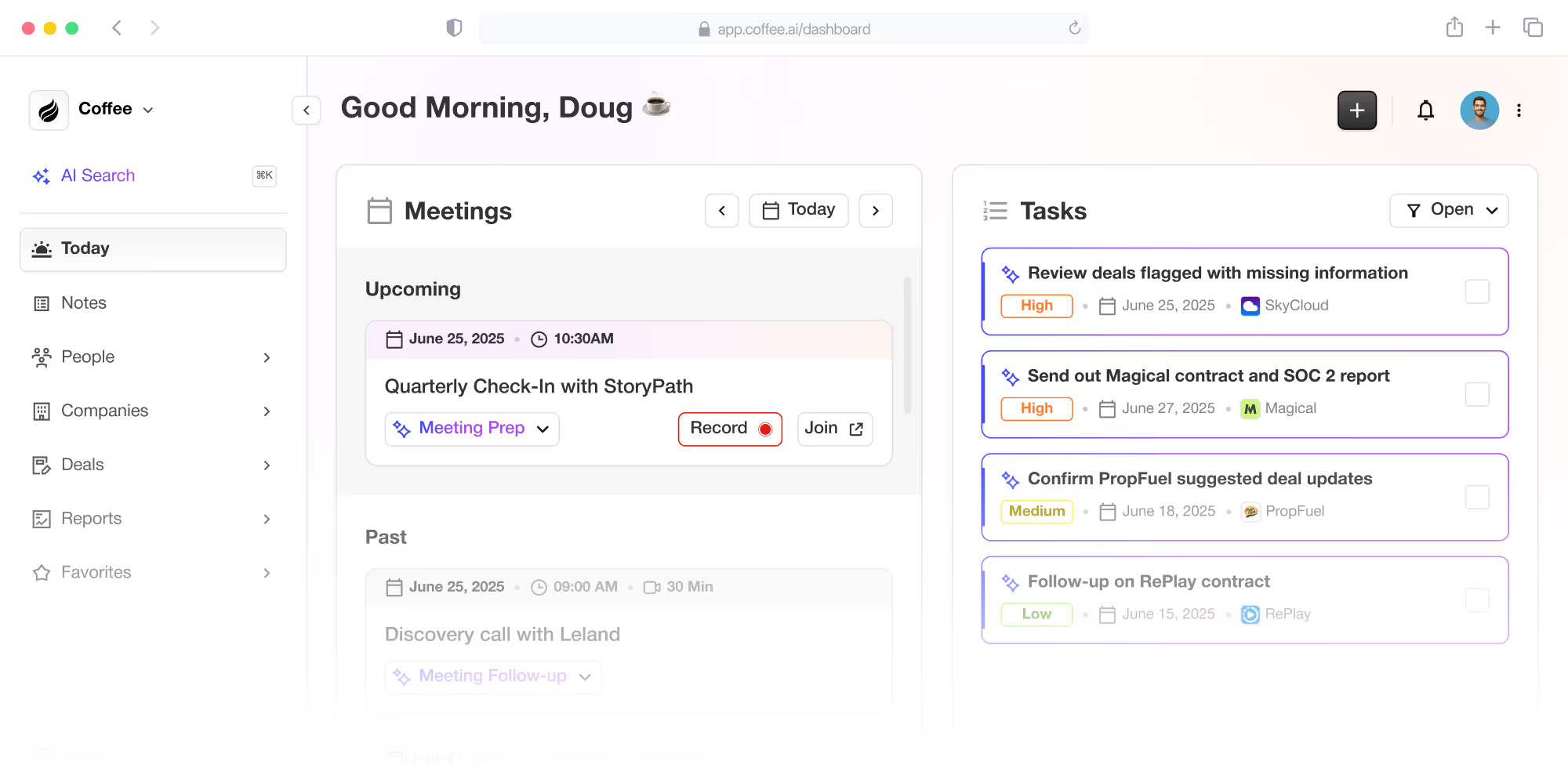
Coffee exemplifies the power of AI-driven CRM in tackling sales bottlenecks. By automating data capture from emails, calendars, and calls, it eliminates manual workload and builds a complete dataset for analysis. Its “Pipeline Compare” feature offers week-over-week pipeline tracking, making it easy to spot stalled deals or slowing stages. Additionally, AI-generated meeting summaries and activity logs provide both numerical and conversational insights, helping uncover root causes behind bottlenecks. As a companion app, Coffee integrates with existing CRMs like Salesforce or HubSpot, enhancing rather than replacing current systems. This positions Coffee as a leader within the broader trend of AI tools reshaping sales efficiency.
Advanced Strategies for Ongoing Sales Improvement
Once you’ve tackled initial bottlenecks with Coffee, consider these strategies to keep optimizing your sales process over time.
- Link Coffee’s API to business intelligence tools for custom reports, connecting sales data with marketing or financial metrics for a broader view.
- Use Coffee’s insights to improve sales training. Pinpoint skill gaps through meeting summaries and build targeted coaching to address them.
- Target specific prospect segments with Coffee’s List Builder. Craft outreach campaigns for groups showing recurring bottleneck patterns to address their unique concerns.
- Develop predictive models with historical data in Coffee to flag deals at risk of stalling, allowing early intervention before issues arise.
Common Questions About Monitoring Sales Bottlenecks
Why do older CRMs sometimes contribute to bottlenecks for smaller or mid-sized businesses?
Older CRMs can create challenges through heavy reliance on manual data entry, which reduces selling time and risks incomplete records. Data often sits in separate tools, making it tough to see the full sales picture. Additionally, their designs may not easily support modern AI features or handle unstructured data like call notes, sometimes leading to lower user adoption and reliance on unofficial workarounds.
How does AI CRM improve bottleneck monitoring compared to traditional tools?
AI CRM platforms like Coffee automate data collection from emails, calendars, and calls, ensuring accuracy without manual effort. Features like “Pipeline Compare” offer real-time tracking of deal progress and stalls. They also analyze both numbers and conversation details, spotting emerging issues and their causes before significant impact.
What results can I expect from resolving bottlenecks with Coffee?
Using Coffee to address bottlenecks can increase lead conversion through better qualification and follow-up. Deal cycle times often shorten as delays are removed. Win rates may rise as reps focus on promising opportunities, and revenue becomes more predictable with a consistent, streamlined process.
How soon will I see benefits after starting with Coffee?
Results depend on your sales process complexity, but most see gains within weeks. Coffee starts organizing data immediately, offering visibility in days. Initial bottleneck insights emerge in 2-4 weeks as patterns form, with deeper impacts on metrics often visible within 6-8 weeks after implementing solutions.
Will Coffee work with our existing sales tools without workflow disruption?
Yes, Coffee integrates smoothly with current systems. It acts as a companion to popular CRMs, syncing data both ways through simple setup. It also connects with other tools via Zapier or custom APIs, allowing teams to adopt its features gradually while maintaining familiar workflows.
Conclusion: Boost Sales Efficiency with Coffee’s AI Tools
Eliminating sales bottlenecks doesn’t have to involve guesswork or fragmented data anymore. With the structured approach in this guide and Coffee’s AI capabilities, you can enhance team productivity and achieve steady revenue growth. Moving away from reactive fixes, modern platforms like Coffee enable proactive bottleneck detection before revenue takes a hit.
Through automated data capture, immediate pipeline insights, and detailed analysis, Coffee cuts through the manual workload that hides issues. Its unique features work together to reveal problems and their causes, supporting effective solutions with measurable outcomes. Remember, bottleneck resolution is a continuous cycle. Top sales teams use Coffee to maintain a loop of spotting issues, analyzing causes, solving problems, and monitoring results for ongoing improvement.
Don’t let bottlenecks hold back your team’s potential. Start transforming your sales process now by requesting access to Coffee’s platform and build a more efficient, high-performing sales operation.