
In today’s fast-paced business environment, sales teams face a complex landscape of challenges and opportunities. With the rise of digital transformation, organizations are juggling multiple tools, vast amounts of data, and increasing pressure to deliver results. Traditional CRM systems, once hailed as the solution to streamline customer interactions, often fall short by burdening teams with manual tasks and fragmented information. This creates a gap between potential and performance, leaving companies searching for ways to optimize their sales processes. Over the past decade, artificial intelligence has emerged as a game-changer in this space, offering tools that automate repetitive work, unify data, and provide actionable insights. Among these innovations, platforms like Coffee stand out as examples of how AI-first CRMs can address real pain points for sales professionals. This article explores the evolving role of AI in sales, evaluates its benefits and trade-offs, and highlights how solutions like Coffee contribute to better efficiency.
Whether you’re a small business scaling up or an enterprise refining operations, understanding how AI can enhance CRM functionality is key to staying competitive. We’ll dive into the specific ways these tools save time, improve decision-making, and help close more deals, grounded in research and practical application.
Ready to explore how AI can support your sales goals? Request access to Coffee’s AI-powered CRM and see the difference for yourself.
Why Traditional CRMs Often Slow Down Sales Teams
Many sales teams find that traditional CRM systems, designed to centralize customer data, can sometimes create inefficiencies if not tailored to their workflows. These systems require significant manual input and often fail to integrate seamlessly with other tools, leading to wasted time and missed opportunities. Recognizing these issues is the first step toward adopting more effective alternatives.
Fragmented data remains a core challenge. Sales reps frequently work across multiple platforms for outreach, call logging, and customer tracking, resulting in scattered information. This disconnection means reps spend valuable time piecing together details before each interaction, which delays responses and risks inconsistent communication with prospects.
Manual data entry adds to the burden. Sales representatives often spend up to 65% of their time on non-selling activities like updating records. After every call or meeting, they must log notes and adjust deal stages, turning a tool meant to boost productivity into a time sink.
These inefficiencies carry a high cost. New hires take longer to become productive due to complex systems, team performance varies widely without streamlined processes, and revenue goals slip out of reach as opportunities are lost to slow follow-ups or poor data quality. Addressing these bottlenecks is critical for any sales organization aiming to improve results.
Want to move beyond outdated systems? Request access to Coffee’s AI-driven platform to help your team focus on selling.
Building Sales Efficiency with an AI-First CRM Approach
AI-powered CRM systems offer a different way to manage sales operations by prioritizing automation and data quality over manual effort. At their core, these platforms aim to provide accurate, unified information that fuels smarter decisions, a principle that drives tools like Coffee to deliver practical value.
Data quality forms the foundation of effective AI. If customer information is incomplete or inconsistent, even advanced algorithms struggle to produce useful insights. Many traditional systems rely on reps to input data, which can lead to errors or gaps. AI-first platforms address this by capturing details directly from communication channels like email and calendars, ensuring the information is current and reliable.
With clean data in place, AI can take on repetitive tasks. This includes creating contact records, enriching them with relevant details like job titles or company size, and logging activities without user intervention. Such automation reduces administrative workload, letting reps dedicate more time to engaging with prospects and closing deals.
Over time, these systems also build a historical view of your sales pipeline. By storing snapshots of deal progress, they enable analysis of trends and changes, offering a level of visibility that manual tracking can’t match. This capability supports better forecasting and strategic planning for sales leaders.
How Coffee Enhances Sales Workflows with AI
As an example of AI-first CRM innovation, Coffee integrates automation and intelligence to address common sales challenges. Designed to work as both a standalone system and a companion to platforms like Salesforce or HubSpot, it focuses on reducing manual effort while improving data accuracy and usability.
Coffee connects directly to tools like Google Workspace or Microsoft 365 to pull in data from emails and calendars. This means contacts, companies, and interactions are logged automatically, cutting out the need for manual updates. It also enriches this data with information from licensed partners, providing details like funding status or LinkedIn profiles without extra tools.
Meeting management is another area where Coffee adds value. Before calls, it compiles briefings with attendee details, past interactions, and company background, saving reps from lengthy prep. During meetings, an AI bot records and transcribes discussions on platforms like Zoom or Teams, while post-call summaries and follow-up email drafts ensure no detail is missed.
For pipeline management, Coffee stores historical data to track deal progression over time. This allows users to compare weekly changes, spot stalled opportunities, and refine forecasts with clear, actionable insights. Prospecting is simplified too, with a natural language tool that builds targeted lists based on specific criteria like company size or location.
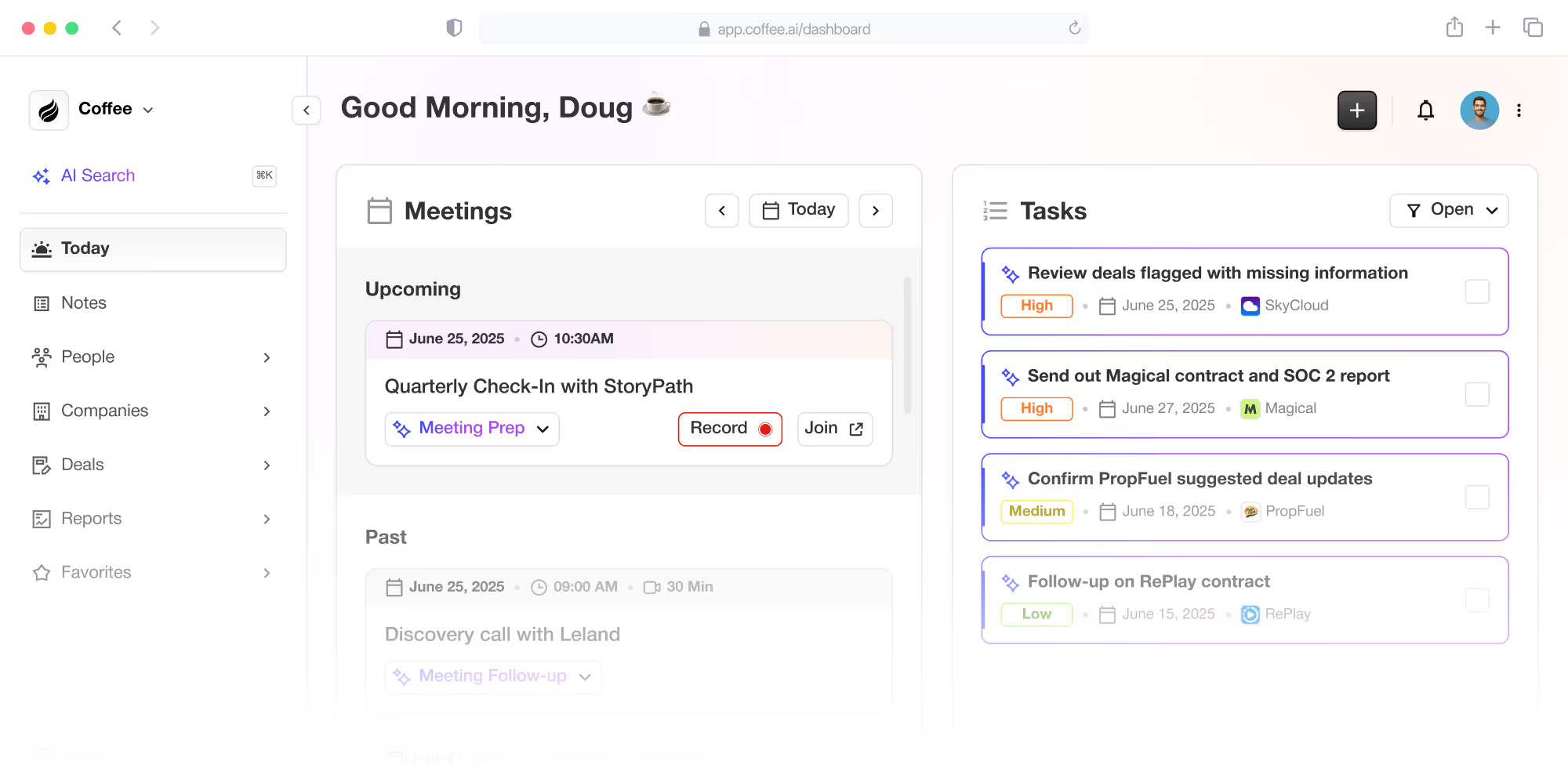
Step-by-Step: Implementing AI CRM for Better Sales Results
Adopting an AI-powered CRM involves a clear process to integrate automation into daily workflows. Using Coffee as an example, here’s how sales teams can build efficiency at each stage.
Step 1: Cut Down Data Entry with Automation
Start by linking your email and calendar accounts to the platform. Coffee scans these sources to create and update contact records automatically. Every interaction, from emails to meetings, gets tied to the right profiles, keeping your database accurate without manual input.
Step 2: Improve Meeting Efficiency
Before meetings, access auto-generated briefings with key details about attendees and prior communications. During calls, let the AI capture notes and transcripts. Afterward, review summaries and send tailored follow-up emails drafted by the system, saving hours each week.
Step 3: Gain Pipeline Clarity
Use historical pipeline data to track deal movement and identify trends. With features like Coffee’s Pipeline Compare, see which opportunities are advancing or stalling, enabling precise adjustments to your sales strategy without relying on outdated reports.
Step 4: Target Prospects Effectively
Leverage AI-driven prospecting to build lists of high-value leads. Input criteria in everyday language, such as “VPs in tech firms with over 100 employees,” and let the system compile detailed profiles, complete with enriched data for immediate outreach.
Comparing AI-Powered CRM to Traditional Systems
To understand the practical differences, here’s a direct comparison of AI-first platforms like Coffee against conventional CRM approaches across key areas of sales operations.
| Feature | AI-Powered CRM (e.g., Coffee) | Traditional CRM |
|---|---|---|
| Data Handling | Automated capture and enrichment | Manual entry, often inconsistent |
| Meeting Support | Auto briefings and summaries | Manual preparation and notes |
| Pipeline Analysis | Historical tracking, real-time updates | Static reports, frequent updates needed |
| Prospecting Tools | Conversational search, integrated data | Separate tools, manual research |
| Cost Efficiency | Unified platform, clear pricing | Multiple subscriptions, added fees |
Benefits and Trade-Offs of AI in Sales CRM
AI-powered CRMs bring clear advantages, but it’s important to weigh both sides for an informed decision. On the positive side, automation saves time by handling tasks like data entry and follow-ups, with studies showing a potential 20-30% increase in sales productivity. Unified data also means better insights, helping reps prioritize high-value leads and improve close rates.
However, there are considerations. Initial setup may require time to integrate with existing systems, and some teams might face a learning curve, even with user-friendly tools. Data security is another concern, though platforms like Coffee address this with compliance to standards like SOC 2 and GDPR. Balancing these factors against the efficiency gains helps determine if AI fits your organization’s needs.
Common Questions About AI-Powered CRM Solutions
How Do These Tools Ease Technology Adoption?
AI-first platforms like Coffee focus on simplifying workflows rather than adding complexity. By automating disliked tasks like data entry, they reduce resistance among sales reps. Many functions operate in the background, integrating with familiar tools like email, so there’s little need for extensive training.
Is Sales Data Protected in AI Systems?
Data security is a priority for platforms like Coffee, which adhere to strict standards such as SOC 2 Type 2 and GDPR. These measures ensure customer information is safeguarded through audited processes. Additionally, policies prevent using client data for public AI training, maintaining privacy.
What Ensures Data Accuracy in AI CRMs?
High-quality data is critical for AI effectiveness. Coffee pulls information directly from emails, calendars, and transcripts, avoiding errors from manual input. It also enriches records with verified details from data partners, ensuring a reliable foundation for insights and recommendations.
How Does Coffee Stand Out Among CRM Options?
Coffee differentiates itself by being built as an AI-first system, not just adding AI as an afterthought to older architecture. This design ensures seamless data capture and usability. Its flexibility as either a standalone CRM or a companion to existing systems makes it adaptable to various business setups.
Conclusion: Elevate Your Sales with AI Tools Like Coffee
Conventional CRM systems often struggle to keep pace with the demands of modern sales, bogged down by manual processes and disjointed data. AI-powered platforms offer a way forward by automating routine tasks, unifying information, and delivering insights that drive results. Coffee exemplifies this trend, providing a solution that tackles inefficiencies while fitting into broader sales strategies.
From automating data entry to enhancing pipeline visibility, tools like Coffee create space for sales reps to focus on building relationships and closing deals. As businesses adopt these technologies early, they position themselves to gain a competitive edge in a crowded market.
Ready to improve your sales outcomes? Request access to Coffee’s AI-powered CRM and start optimizing your team’s performance today.