Written by: Doug Camplejohn, CEO & Co-Founder, Coffee | Last updated: June 21, 2026
Key Takeaways for 2026 AI CRM Buyers
- HubSpot Sales Hub Professional starts at $100 per user per month with usage-based AI credits, while sales reps lose 24 hours weekly to manual administrative tasks.
- Agentic AI CRMs now automate contact capture, activity logging, and follow-ups without manual triggers, which shifts the market away from traditional database systems.
- Coffee offers both standalone and companion deployment models, and both include full AI agent capabilities in simple seat-based pricing.
- Key evaluation criteria for 10-50 person US teams include AI automation depth, total cost of ownership, data quality, implementation effort, and long-term scalability.
- Teams ready to eliminate manual data entry can get started with Coffee and experience automated CRM capabilities from day one.
Evaluation Criteria for AI CRM Alternatives
Seven criteria determine fit for 10-50 person US teams in 2026.
- AI automation depth: The system should proactively capture contacts, log activities, and generate follow-ups instead of waiting for manual triggers.
- Total cost of ownership (TCO): Consider seat fees plus required add-ons for AI, enrichment, and integrations.
- Data quality and enrichment: Prefer built-in enrichment over reliance on third-party tools like ZoomInfo or Apollo.
- Implementation effort: Favor days to value instead of weeks of configuration.
- Integration flexibility: Native connectors reduce risk compared with middleware dependency. Most CRM setups require 5-15 third-party integrations, each a potential point of failure.
- User adoption: A high-quality rep experience prevents shadow CRMs and the bad data cycles they create.
- Pipeline visibility: Automated pipeline tracking beats manual CSV exports for accuracy and speed.
- Long-term scalability: Evaluate performance and pricing as teams grow beyond 50 employees.
Side-by-Side Comparison of Affordable AI CRM Alternatives
This table shows published 2026 US seat-based pricing for the entry-level paid plan of each platform. AI feature availability and enrichment costs vary by plan tier, so those details appear in the analysis sections instead of a single numeric column.
| Platform | Entry Paid Plan (per user/month) | Free Tier | AI Included at Entry |
|---|---|---|---|
| HubSpot Sales Hub | $100 (Professional) | Yes (limited) | Usage-based credits |
| Pipedrive | $14 (Lite) | Up to 3 users | Limited |
| Zoho CRM | $14 (Standard) | Up to 3 users | Enterprise/Ultimate tier only |
| Freshsales | $11 | Yes | Freddy AI add-on |
| Copper | $9 (Starter, billed annually) | No | Limited |
| monday CRM | $17 (Standard, billed annually, 3-seat min) | No | Standard plan+ |
| Attio | Contact vendor | Yes | Limited |
| Close | Contact vendor | No | Limited |
| Coffee (Standalone) | Seat-based; agent labor included | No | Full agent included |
| Coffee (Companion) | Seat-based; agent labor included | No | Full agent included |
Attio and Close do not publish standardized per-seat pricing comparable to the figures above, so teams should contact each vendor for current quotes. Day.ai and Clarify also use custom pricing models and appear in the capability analysis below.
How Each CRM Performs on Core AI Capabilities
Pricing alone does not show which platforms deliver meaningful AI automation. The following categories connect directly to the evaluation criteria and reveal how much manual work remains after implementation.
Automatic data capture. This capability forms the base of AI automation depth. Pipedrive, Zoho, and Freshsales log emails when configured, yet they still require reps to create contacts and update deal stages by hand. Freshworks charges Freddy AI as an add-on, and Zoho’s Zia AI features sit behind Enterprise and Ultimate plans. Copper is Gmail-native and syncs Google Workspace activity automatically, which helps Google-first teams, but enrichment depth remains limited. Coffee’s agent scans emails and calendars after Google Workspace or Microsoft 365 connection and auto-creates contacts, companies, and activities without any manual trigger.

Meeting management automation. This layer builds on automatic capture and extends automation to live customer conversations. Conversational intelligence tools that analyze sales calls to extract sentiment, objections, and coaching insights represent an emerging trend in the AI-powered sales tool market. Most platforms in this comparison rely on separate tools like Gong or Fathom to achieve that level of analysis. Coffee’s agent joins Zoom, Teams, and Meet calls natively, generates summaries structured to BANT, MEDDIC, or SPICED, and launched Custom Meeting Briefings and Summaries in February 2026, which let users define exact formats such as high-level executive summaries or granular technical breakdowns.

Pipeline intelligence. Reliable forecasting depends on accurate, current data instead of gut feelings and spreadsheets. Traditional forecasting methods that rely on rep roll-up produce errors of 25-35%. Coffee’s Pipeline Compare feature automatically visualizes week-over-week changes. Coffee’s AI search on deals, released in January 2026, answers natural-language questions such as “Which deals are stuck in negotiation?” or “What is closing this month?” Teams can access these insights without manual exports.
Visitor identification. Identifying anonymous traffic connects marketing interest to sales action. This capability is absent from Pipedrive, Zoho, Freshsales, Copper, Attio, Close, and monday CRM at the base level. Coffee includes a tracking pixel that identifies named individuals visiting your site and surfaces suggested leads that match your buyer persona directly in Slack.

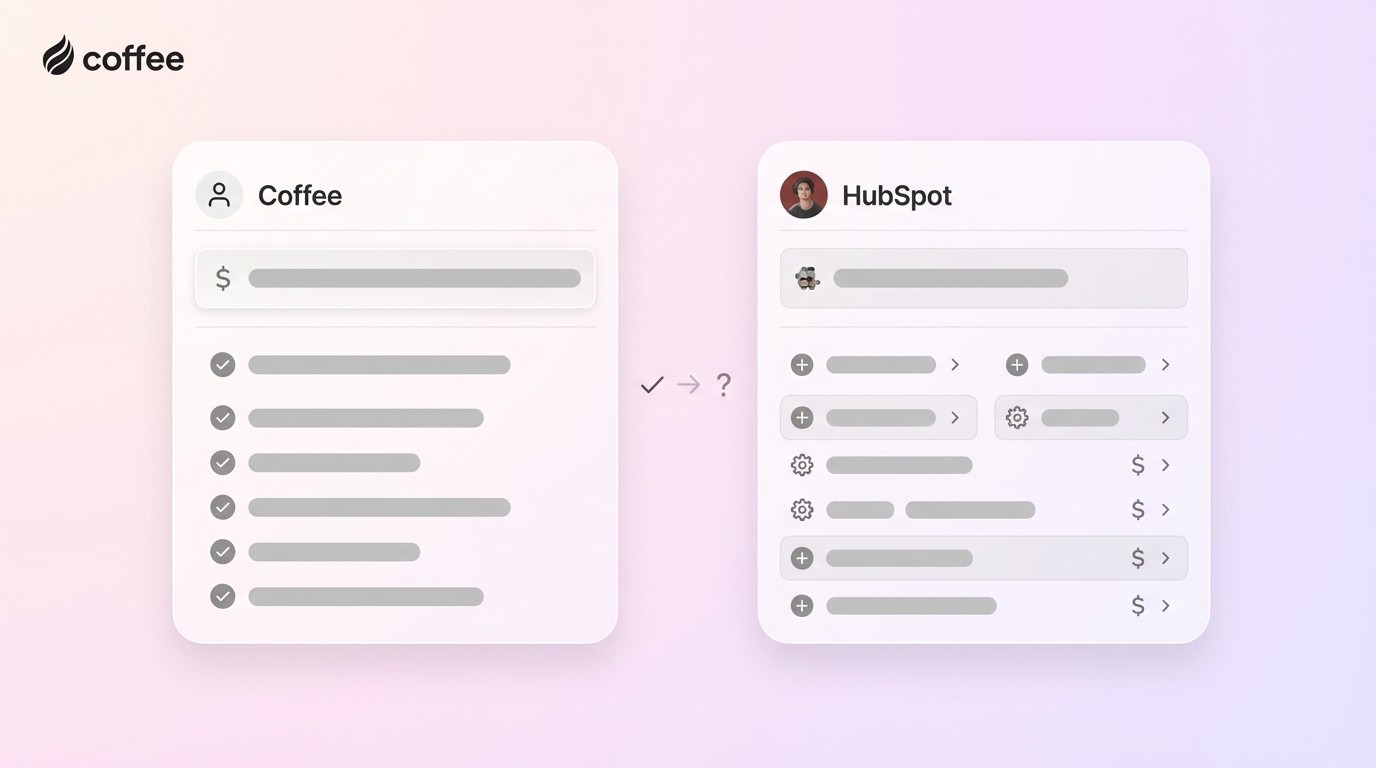
Integration complexity. Integration depth determines whether a new CRM can sit beside or replace legacy systems. Teams with years of data in Salesforce or HubSpot face major migration barriers when they consider a switch to AI-native CRMs, and existing integrations built on top of legacy CRMs increase the complexity and cost of migrating. Day.ai and Clarify offer modern UX but lack the depth required for Salesforce and HubSpot companion deployments that involve quotas, forecasting, and required fields. Coffee’s Companion model targets this integration complexity directly. Improved summary templates released in November 2025 are customizable and writable back to Coffee, HubSpot, or Salesforce.
Best-Fit AI CRM Scenarios for 2026 Teams
Early-stage teams outgrowing spreadsheets (1-20 employees). These teams need structure without heavy admin work. Copper at $9 per user per month suits Google Workspace-only teams that want Gmail-native syncing. Freshsales at $11 per user per month adds lead scoring for slightly more guidance. Coffee Standalone fits teams that want automated contact creation, meeting intelligence, and pipeline tracking without the overhead of configuring a traditional CRM.
Growing teams frustrated with HubSpot’s manual work and cost (20-50 employees). These teams want lower costs and less data entry. Pipedrive and Zoho reduce seat costs but still keep the data entry grind, so reps continue to lose hours each week to manual CRM maintenance. monday CRM adds workflow flexibility that can remove some repetitive tasks, yet it still relies on manual contact creation and deal updates. For teams that want to eliminate manual work instead of just reducing it, Coffee Standalone replaces HubSpot with an agent-led system that handles data entry automatically. Coffee’s Stripe integration, launched in January 2026, automatically imports customers, enriches them, and adds paid invoices to deals as Closed Won, which removes a common manual reconciliation task.
Mid-market teams committed to existing HubSpot or Salesforce instances. These organizations want better data without a risky rip-and-replace project. Full migration carries substantial risk and often disrupts revenue operations. Legacy CRMs maintain dominance partly because of their established ecosystems, including AppExchange and partner networks, which make full replacement challenging. Coffee’s Companion model deploys the agent on top of the existing instance and improves data quality while the core CRM remains in place.
Get started with Coffee as either a standalone CRM or a companion layer for HubSpot and Salesforce.
Operational and Long-Term Considerations for AI CRM Adoption
Change management often becomes the most underestimated migration cost. Sales teams using legacy CRMs develop muscle memory around existing workflows, so switching platforms disrupts daily routines and typically causes a temporary drop in rep productivity during the change management period. Platforms with lower configuration burden, such as Coffee, Copper, and Freshsales, reduce this risk for small teams.
Compliance requirements also shape long-term viability for US teams that handle customer data. Coffee is SOC 2 Type 2 and GDPR compliant, and its data is not used to train public models. Organizations should avoid solutions that lock users into a single ecosystem, since composable platforms provide greater long-term integration flexibility.
Risks, Limitations, and Common Misconceptions
Hidden maintenance requirements. Before adopting AI CRM, organizations must ensure data is clean, complete, and properly structured, because AI effectiveness depends on unified, real-time customer data from multiple sources. Migrating dirty data from HubSpot into any new system recreates the same bad-data-out problem.
Integration gaps with legacy systems. Migrating from legacy CRMs often requires middleware, custom development, or workflow adjustments to maintain end-to-end data flows, and data migration rarely achieves 100% perfection because some customizations lack equivalents in new platforms. Coffee currently integrates with third-party tools through Zapier, and deeper native integrations sit on the roadmap.
Software alone does not resolve process issues. An AI agent improves data capture quality, but humans still own sales process definition, ICP clarity, and rep coaching. Coffee’s Intelligence layer, introduced in February 2026, allows users to define and store deep context on business model, product specifics, ICP, and competitors for tailored AI suggestions, and that context must come from the team.
Decision Framework and Summary Matrix
| Scenario | Best-Fit Options | Key Trade-off |
|---|---|---|
| 1-20 employees, no existing CRM, Google Workspace | Coffee Standalone, Copper, Freshsales | Automation depth versus price floor |
| 20-50 employees, leaving HubSpot, budget-sensitive | Coffee Standalone, Pipedrive, monday CRM | Migration effort versus TCO reduction |
| 20-50 employees, keeping HubSpot or Salesforce | Coffee Companion | Add-on cost versus data quality improvement |
| Teams needing visitor identification built in | Coffee (either model) | Pixel setup versus standalone tools (RB2B, Warmly) |
Frequently Asked Questions
How long does migration from HubSpot typically take for a 25-person sales team?
Migration timelines depend on data volume, integration count, and whether the team chooses full replacement or a companion layer. A full CRM replacement for a 25-person team typically takes four to twelve weeks, including data extraction, cleaning, field mapping, integration rebuilding, and user training. Shadow CRMs such as spreadsheets and Notion often contain data that never lived in HubSpot, which adds reconciliation time. Coffee’s Companion model avoids this by authenticating with the existing HubSpot instance and enriching and logging data without a migration event. For teams that choose Coffee Standalone, the agent auto-populates contacts and companies from Google Workspace or Microsoft 365 on day one, which shortens the data entry phase of setup.
What technical expertise is required to implement an AI-native CRM companion layer?
Most AI-native companion layers, including Coffee, target non-technical buyers. Implementation usually involves OAuth authentication with Google Workspace or Microsoft 365, a CRM API connection for HubSpot or Salesforce, and a tracking pixel drop for visitor identification. No dedicated admin or developer is required for initial setup. More complex configurations such as custom summary templates, BANT or MEDDIC note structures, or Zapier-based integrations with outbound tools can be handled by a RevOps generalist. The main technical requirement is clean required-field definitions in the existing HubSpot or Salesforce instance, since the agent writes data back to those fields and any gaps in field mapping appear quickly.
How do 2026 AI CRM pricing models affect total cost of ownership for 10-50 employee companies?
The dominant pricing models in 2026 are seat-based, which use a flat per-user monthly fee with agent labor included, and outcome-based, which charge per resolution, action, or lead. Outcome-based models from HubSpot Breeze, Salesforce Agentforce, and Zendesk can look affordable at low volumes but scale unpredictably as usage grows. HubSpot’s AI features carry an additional $50 per month on top of the Professional plan pricing mentioned earlier. Salesforce Agentforce adds Flex Credits at $0.10 per action on top of Enterprise licenses starting at $165 per user per month, which makes it unsuitable for most sub-50-employee teams. Coffee uses simple seat-based pricing where the agent’s unlimited labor is included in the seat fee, with no metering on LLM usage or automated processes. For a 25-person team, this structure provides predictable TCO without surprise overages.
Which alternatives deliver measurable reductions in manual data entry while remaining SOC 2 and GDPR compliant?
Among the platforms evaluated, Coffee states its automated data capture scope and compliance posture most clearly. Coffee is SOC 2 Type 2 and GDPR compliant, and its agent auto-creates contacts, logs activities, enriches records, and generates post-meeting summaries without manual input, while data is not used to train public models. Copper automates Gmail and Google Calendar sync for Google Workspace users and is SOC 2 compliant, although enrichment depth stays limited. Freshsales and Zoho CRM provide partial automation but gate AI features behind higher tiers or add-ons, and teams should verify their current compliance certifications directly with each vendor. Pipedrive, Attio, and Close offer activity logging with varying levels of automation but require more manual configuration to reach similar data capture coverage. Any team that evaluates compliance should request current SOC 2 Type 2 reports and data processing agreements directly from shortlisted vendors before signing.
Conclusion: Choosing the Right AI CRM for Your 2026 Stack
The main trade-off in this evaluation sits between cost reduction and automation depth. Budget-oriented platforms like Copper at $9 per user per month, Freshsales at $11 per user per month, and Pipedrive at $14 per user per month lower seat cost but keep the data entry grind. The sales automation segment now leads the global AI-powered sales tool market, which reflects demand for systems that remove administrative work instead of just organizing it.
Teams that want to eliminate the data entry grind entirely, whether by replacing HubSpot or augmenting it, can use Coffee’s agent-led approach to address the root cause: bad data in produces bad data out. The dual deployment model means teams do not need to choose between migration risk and status quo costs.
Get started with Coffee and see how the agent handles your data entry from day one.