
Interest in HubSpot alternatives reflects ongoing frustration with traditional CRM limitations. Many businesses now prioritize stronger automation, better integration, and solutions tailored to their size or industry, rather than broad platforms that may not match specific sales processes.
HubSpot offers an extensive marketing and sales suite, but some teams find the workflows less focused on sales efficiency. This gap often prompts evaluations of other tools that provide deeper support for daily sales activities.
The core pain points that push some businesses to explore HubSpot alternatives include:
- Data entry challenges: HubSpot includes automation features, but many users still handle contact and deal management manually, which slows down specific workflows.
- Workflow integration needs: Some teams add tools for data enrichment, outbound outreach, or call intelligence on top of HubSpot, which can increase complexity and overall software spend.
- Pipeline intelligence expectations: HubSpot offers reporting, but some leaders want more proactive and intuitive insights built directly into their daily view of the pipeline.
- Pricing complexity and cost escalation: Cost and usability are frequent reasons organizations look for alternatives, especially when advanced features require higher-tier plans as teams grow.
Defining a Proactive CRM: Key Evaluation Criteria
Evaluating proactive CRM alternatives starts with clear criteria that distinguish AI-first platforms from legacy systems. These factors help teams select tools that support current needs and long-term growth.
- AI-driven automation and intelligence: Modern CRMs should use AI to automate routine tasks and surface insights that reduce manual work. This includes automatic contact creation, data enrichment, and proactive preparation for meetings.
- Comprehensive data unification and enrichment: Effective CRMs bring together structured data such as contacts, companies, and deals with unstructured data such as emails, call transcripts, and meeting notes. Built-in enrichment reduces the need for separate data tools while maintaining quality.
- Seamless user experience and adoption: The CRM should function as a sales co-pilot instead of just a reporting database. High adoption and intuitive interfaces signal that the platform fits into daily workflows with limited training.
- Tech stack consolidation: Proactive CRMs can replace multiple point solutions by including data enrichment, call recording, forecasting, and pipeline management in one system. This consolidation reduces integration overhead and total cost of ownership.
- Pipeline intelligence and forecasting: Native capabilities for tracking pipeline changes and generating actionable reports should be available without complex add-ons or heavy manual configuration.
How Coffee Provides an AI-First Proactive CRM Option
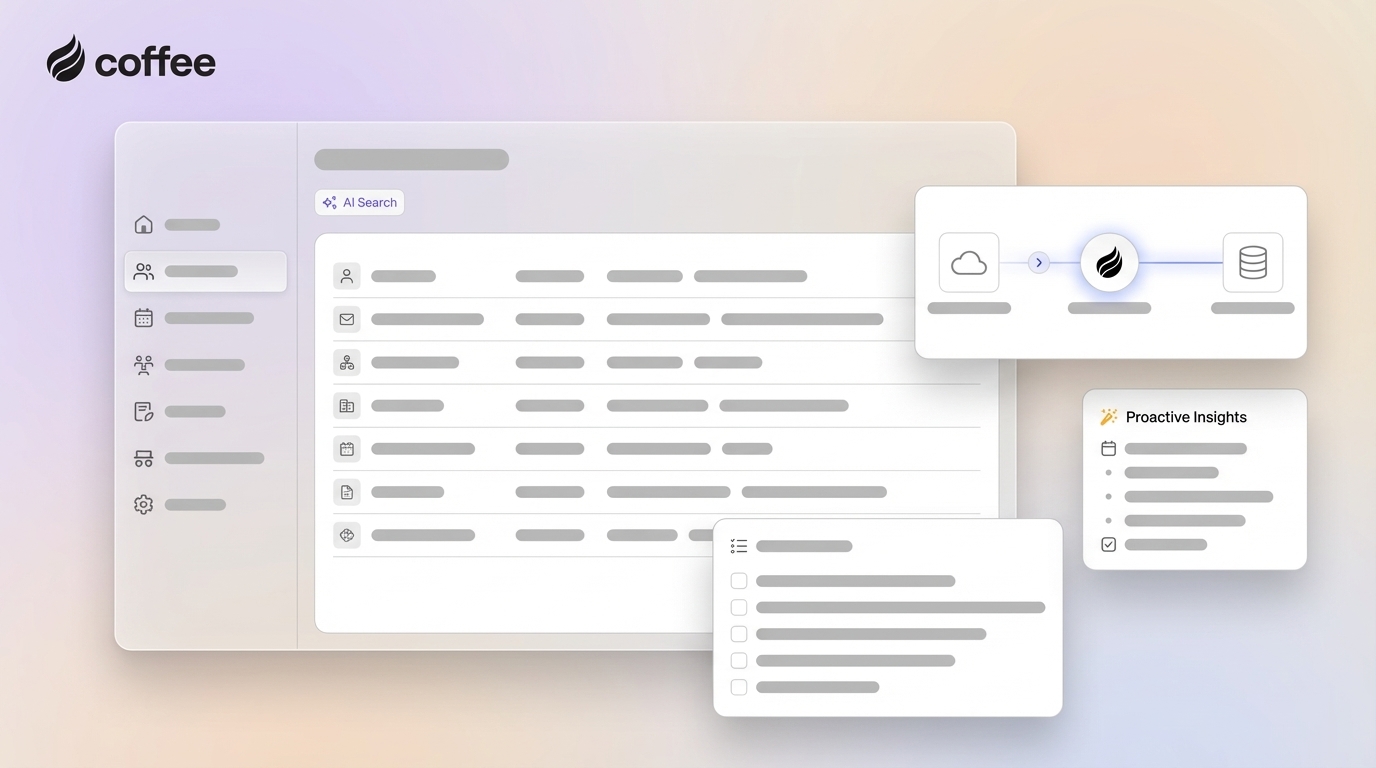
Coffee is built as an AI-first CRM that addresses common limitations of legacy platforms. Its native AI agents focus on automation and unified data, helping teams manage customer relationships more proactively.
- Automated data entry and enrichment: Coffee automatically creates contacts, companies, and activities from email and calendar interactions. The platform can save sales representatives an estimated 8–12 hours per week by auto-populating CRM records with enriched information from licensed data partners, which reduces dependence on separate tools such as ZoomInfo or Apollo.
- AI-powered meeting and workflow management: Coffee acts as an assistant before and after sales interactions. It provides briefings with attendee details, company context, and interaction history, then generates summaries, identifies action items, and drafts follow-up emails. Sales methodologies such as BANT, MEDDIC, MEDDPICC, or SPICED can be applied to keep deal qualification consistent.
- Actionable pipeline intelligence with Compare: Coffee includes a built-in data warehouse that powers the Compare feature for one-click week-over-week pipeline analysis. It highlights deal progress, new opportunities, closed deals, and stalled prospects, replacing manual data exports and spreadsheet work.
- Tech stack consolidation: Coffee combines CRM, data enrichment, call recording, meeting intelligence, and forecasting in a single platform, which can simplify workflows and lower overall tool costs.
- Rep-centric experience: Coffee is designed around the daily needs of sales representatives, emphasizing features that support productivity and adoption instead of focusing solely on management reporting.
Request access to see how Coffee’s AI-first approach can improve CRM productivity.
Head-to-Head Comparison: HubSpot and Its Leading Proactive Alternatives
This section compares HubSpot with several leading CRM platforms, focusing on how each addresses proactive customer relationship management and the criteria outlined above.
HubSpot: The Established Baseline
HubSpot maintains a strong position with its combined marketing, sales, and service suite. It includes integrated email marketing, content management, and CRM tools in one environment, along with automation for marketing workflows and AI features such as content writing, chatbots, and predictive lead scoring.
Some users still encounter limitations in daily use. Many teams continue to explore more affordable or specialized alternatives due to needs around deeper automation, different data models, or pricing for advanced capabilities.
Zoho CRM: Value and Comprehensive Features
Zoho CRM positions itself as a feature-rich option with competitive pricing and extensive customization. The platform includes Zia, an AI sales assistant that supports forecasting, prediction modeling, and workflow suggestions. Zoho CRM is often recognized for strong customization and relatively simple data import.
However, the interface can feel complex for some teams, and configuration may require more time compared with options that emphasize faster setup, which can affect adoption for organizations seeking an out-of-the-box experience.
Salesforce: Enterprise-Grade Power
Salesforce is widely used in the enterprise CRM market, offering deep customization, a large ecosystem of integrations, and robust reporting. It fits organizations that need complex workflows and extensive third-party app support.
For small and mid-market businesses, Salesforce’s architecture and configuration requirements can be challenging. The platform may feel heavy and expensive for teams that want a straightforward CRM. While Salesforce Einstein brings AI into many areas, achieving an efficient setup often still requires significant administrative effort.
Pipedrive: Visual Pipeline Management
Pipedrive focuses on visual pipeline management with an interface built for sales representatives. Many users value its clear deal tracking and simple layout.
Pipedrive, however, offers limited AI-driven automation compared with proactive CRMs. Teams often rely on additional tools for data enrichment, advanced reporting, and broader stack consolidation, which can reduce its effectiveness as a single system of record.
Comparison Overview: HubSpot vs. Proactive Alternatives vs. Coffee
|
Feature |
HubSpot |
Zoho CRM |
Salesforce |
Coffee |
|
Core architecture |
Legacy, marketing-first |
Feature-rich, modular |
Enterprise-focused, complex |
AI-first |
|
AI integration |
Integrated in key areas |
Advanced AI (Zia) |
Integrated (Einstein) |
Native AI agents |
|
Data entry automation |
Partially automated |
Manual/some automation |
Partially automated |
Highly automated |
|
Data unification |
Good with setup |
Good, requires setup |
Complex integrations |
Native, real-time |
How to Match Proactive CRMs to Your Business Stage
Different CRM models fit different growth stages and tech stacks. Aligning your choice with your current context helps capture more value from automation and AI.
Startups and SMBs graduating from spreadsheets
Coffee’s standalone AI-first CRM is designed for small companies with roughly 1–20 employees that are outgrowing tools such as Notion, Airtable, or spreadsheets. These organizations typically need immediate value, automated data management, and a simple interface. Coffee offers automatic contact creation, built-in enrichment, and AI-supported meeting management to deliver this with limited setup.
Mid-market teams with Salesforce or HubSpot in place
Coffee’s Companion App supports teams that already use Salesforce or HubSpot but struggle with low CRM adoption or incomplete data. The Companion App adds an AI layer for automation, data capture from emails and calls, and pipeline intelligence without requiring a full migration.
Sales leaders and RevOps teams dealing with manual workflows
For organizations managing fragmented tools, manual data entry, and limited pipeline visibility, Coffee can help consolidate CRM, data enrichment, call recording, and pipeline intelligence in one environment. This consolidation aims to reduce context switching and manual administrative work.
Total Value of Ownership: Beyond the Feature List
Evaluating CRM alternatives involves more than checking features. Implementation, training, maintenance, and scalability all contribute to the total value of ownership over time.
Implementation and setup efficiency
Coffee’s AI-first architecture allows deployment through integrations with Google Workspace or Microsoft 365. Once connected, Coffee begins auto-creating contacts and companies from existing email and calendar data, which can shorten the time to initial value compared with CRMs that require extensive manual configuration.
Training and adoption acceleration
Coffee’s interface is designed to be intuitive so that sales representatives can start using automated data entry, meeting preparation, and follow-up support with minimal training. This approach encourages early and consistent adoption.
Maintenance and scalability advantages
Coffee’s unified architecture reduces the need to maintain multiple integrations and separate data sources. By capturing and enriching data automatically, the platform aims to keep records accurate as teams grow without adding significant administrative overhead.
Long-term strategic value
Coffee’s data warehouse preserves historical activity in a structured way. Over time, this supports more reliable pipeline intelligence and strategic insights as the system processes more interactions.
The Dual-Model Advantage: Standalone CRM and Companion App
Coffee’s dual product model is designed to fit both organizations adopting their first robust CRM and those enhancing an existing enterprise system.
Standalone AI-first CRM for growth-stage companies
Organizations with 1–20 employees and early-stage sales teams can use Coffee as a complete CRM. These companies often find enterprise tools too complex or costly while needing more structure than spreadsheets. Coffee offers automatic data entry, built-in enrichment, and AI-guided workflows to support productivity without long setup cycles.
Companion App for established CRM users
Mid-market companies that have invested in Salesforce or HubSpot can layer Coffee on top as a Companion App. This model targets pain points such as low user adoption, inconsistent data, and time-consuming updates. The Companion App syncs information and writes enriched insights back to the primary CRM, improving its accuracy and usefulness.
This dual-model strategy helps Coffee provide value in different environments and offers a path as organizations grow and their CRM needs change.
Industry Context: The AI Inflection Point in CRM Technology
Recent advances in AI are reshaping what CRMs can do, prompting many teams to reexamine how they capture and use customer data.
From reactive to proactive customer management
Traditional CRMs mainly function as reactive databases that depend on manual updates. AI-first platforms such as Coffee work more proactively, identifying interactions, enriching data, and preparing meeting context with less manual input.
Unstructured data integration
Legacy architectures often struggle to handle unstructured information such as email content or call transcripts. Coffee’s AI agents are built to process this type of data, extract relevant details, and connect them to CRM records.
Automation and real-time insights
Modern AI enables more advanced automation and real-time analysis, which can streamline routine tasks and surface insights that traditional CRMs would require manual effort to uncover.
Together, these capabilities can create productivity gains that go beyond simple workflow automation.
Frequently Asked Questions About Proactive CRM and HubSpot Alternatives
Why are businesses looking for proactive CRM alternatives to HubSpot?
Many businesses find that HubSpot’s architecture does not fully align with their needs for deeper automation or specialized workflows, and they may experience rising costs as they add advanced features. They look for AI-driven CRMs that act as sales co-pilots, helping teams with automation and insights instead of adding administrative work.
How does an AI-first CRM like Coffee differ from HubSpot?
Coffee is built around AI agents that automate core CRM tasks such as data entry, meeting preparation, and follow-ups, with a focus on the daily sales workflow. HubSpot includes AI features within a broader marketing and sales platform, which may still require additional configuration or tools to support certain sales-specific needs.
Can Coffee integrate with my existing HubSpot or Salesforce instance?
Yes. Coffee offers a Companion App that integrates with existing HubSpot or Salesforce instances. This allows organizations to use Coffee’s automation and AI features to improve data quality and rep adoption without replacing their current CRM. The integration uses secure authentication to sync data into Coffee, and teams can choose which enriched data and insights are written back.
What are the main benefits of switching to a proactive CRM like Coffee for sales teams?
Sales teams may benefit from reduced manual data entry, with Coffee estimated to save 8–12 hours per week per rep. Automatic enrichment can improve data quality, AI-driven insights can increase pipeline visibility, consolidating tools can reduce complexity, and a rep-focused interface can make the CRM easier to use.
Is Coffee suitable for small businesses as well as mid-market companies?
Yes. Coffee’s standalone AI-first CRM fits small businesses with 1–20 employees that are outgrowing basic tools. The Companion App is designed for mid-market organizations that want to enhance existing Salesforce or HubSpot deployments with better automation and data intelligence.
Implementation Strategy: Making the Transition to Proactive CRM
A structured implementation plan helps teams move from HubSpot or other legacy CRMs to AI-first platforms while limiting disruption.
Assess current pain points and goals
Start by documenting specific challenges with your current CRM, such as time spent on manual entry, missing customer details, low adoption, or limited pipeline visibility. Translate these issues into measurable goals for improvement.
Choose the appropriate Coffee model
Organizations without an established CRM or those relying on basic tools can evaluate Coffee’s standalone AI-first CRM. Companies already using Salesforce or HubSpot can consider the Companion App to enhance existing investments.
Plan for data migration and integration
Coffee automatically ingests data from connected email and calendar systems, capturing much of the day-to-day customer activity. For organizations with large volumes of historical CRM data, Coffee can support dedicated migration efforts.
Focus on user adoption and training
Although Coffee is designed to be easy to use, clear communication about new capabilities encourages adoption. Emphasizing how automation reduces administrative work can help sales teams engage with the new workflows.
The Future of Sales: Choosing a Proactive CRM with Coffee
Limitations in legacy CRMs such as HubSpot, including varying levels of automation, workflow fit, and adoption challenges, can hold back some sales teams. AI-first platforms make it possible to rethink CRM as a more proactive sales assistant.
Coffee applies this approach by combining AI integration, unified data, automated workflows, and a rep-centric interface.
Selecting between a traditional CRM and an AI-first alternative is a strategic choice that affects productivity and customer relationship quality. Organizations that adopt proactive CRM tools position their teams for more efficient operations and more informed decision-making.
Request access to Coffee to evaluate an AI-first approach to CRM for your sales team.