Written by: Doug Camplejohn, CEO & Co-Founder, Coffee
Many sales organizations rely on CRMs that were meant to be a single source of truth but now function as fragmented, inefficient systems. When traditional CRMs are not well integrated, they create data silos that block a unified customer view and limit effective engagement.
Sales representatives often juggle multiple disconnected tools, which creates blind spots and makes it difficult to see complete customer histories or accurate pipeline status.
The manual data entry burden makes this worse. Many sales reps report that they spend too much time logging data and too little time selling, so CRM usage can feel like an administrative chore instead of a valuable resource. When reps avoid the system, data quality drops, and leaders lose confidence in reports and forecasts.
How Proactive CRM Unified Data Uses AI to Fix Fragmentation
Proactive CRM unified data solutions replace reactive, fragmented workflows with integrated, intelligent customer relationship management. These AI-driven platforms automatically collect, organize, and enrich customer data across touchpoints to create a single, comprehensive view of each relationship.
Instead of relying on manual entry and brittle integrations, proactive unified data solutions use artificial intelligence to capture and structure information from email, calendars, call transcripts, and other interactions. This helps maintain data quality, reduces manual work for sales teams, and keeps records current without constant intervention.
Coffee: An AI-First CRM and Sales AI Agent for Unified Data
Coffee is built as an AI-first platform to address the core issues that limit traditional CRMs. It can operate as a standalone CRM for small to mid-sized businesses or as a companion app that works alongside existing Salesforce and HubSpot implementations.
This dual model gives teams flexibility in how they adopt AI-driven CRM capabilities while still improving how they collect and use customer data.
Key features that define Coffee’s approach to proactive CRM unified data include:
- Automated data entry: Reduces manual tasks and can save sales reps an estimated 8–12 hours per week by automatically creating and enriching contacts from email and calendar interactions.
- Unified customer view: Brings together structured data such as contacts, companies, and deals with unstructured data such as emails, call transcripts, and meeting notes for a complete customer profile.
- Intelligent pipeline management: Offers real-time tracking and week-over-week pipeline comparison to support more effective deal management.
- Consolidated tech stack: Combines CRM, data enrichment, call recording, and forecasting capabilities to lower complexity and operating costs.
- High user adoption: Functions as a sales rep’s co-pilot rather than only a management reporting tool, which supports engagement and data quality.
Request access to Coffee to see how proactive CRM unified data works in practice.
Deep Dive: How Coffee Improves Sales With Unified Data
Automated Data Entry and Enrichment for Accurate, Real-Time Records
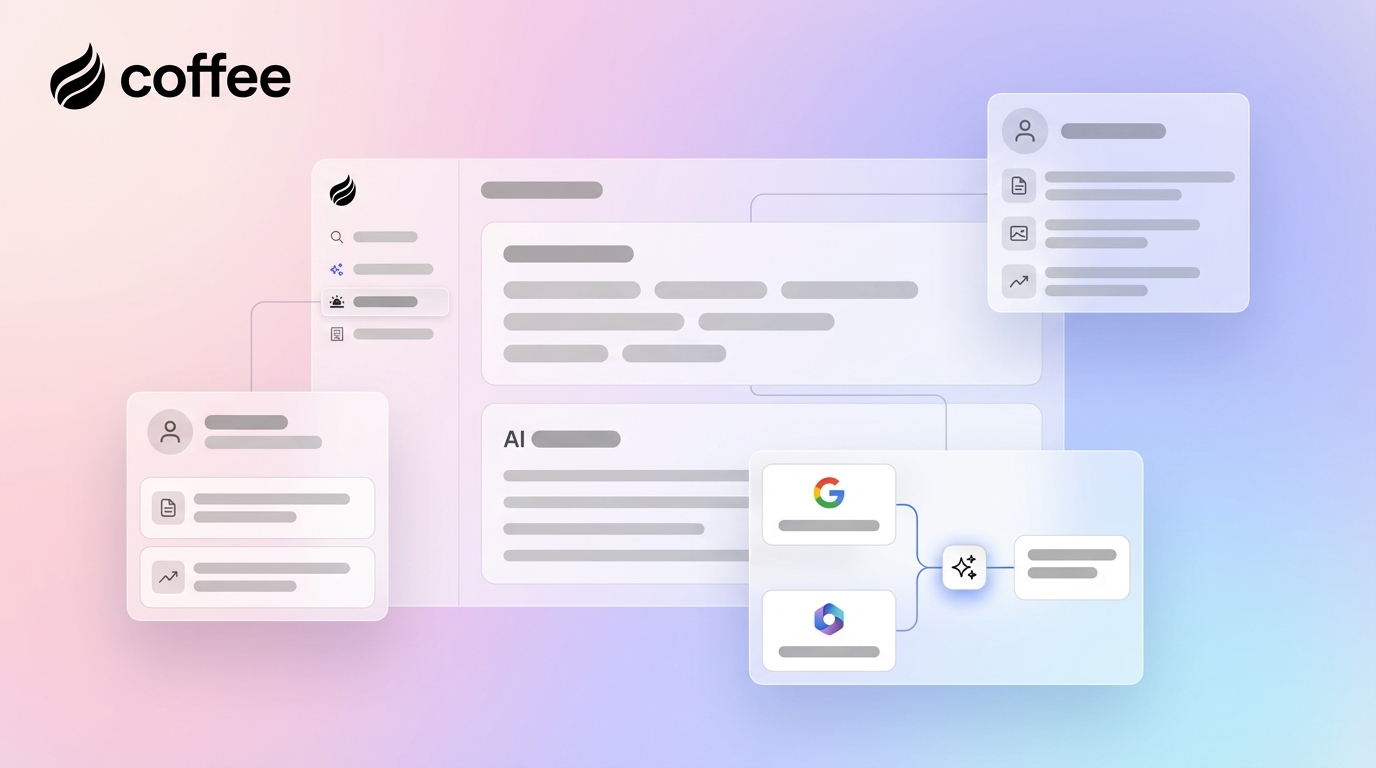
Effective CRM usage depends on accurate, complete data. Coffee supports this by automatically capturing and structuring customer interactions as soon as you connect your Google Workspace or Microsoft 365 account. It scans emails and calendar invites to identify new contacts and companies, then populates your CRM with relevant details.
The platform enriches these records with attributes such as job titles, company information, funding status, LinkedIn profiles, and location data sourced from licensed data partners. This reduces the need for manual research and keeps profiles more complete.
Coffee’s activity logging then tracks fields such as “last activity” and “next activity” directly from email and calendar systems. Deal information stays current based on real activity, so reps do not need to spend time updating fields after every interaction.
AI-Powered Meeting Management for Actionable Conversation Insights
Sales conversations hold context that often never makes it into traditional CRMs. Coffee’s AI-powered meeting management turns these interactions into structured, searchable, and actionable information.
Before each meeting, Coffee provides a briefing in its “Today” page. This view includes attendee details, roles, company background, and summaries of prior interactions so reps can prepare quickly.
During meetings, Coffee’s AI bot can join Google Meet, Microsoft Teams, and Zoom calls to record and transcribe conversations. After the call, the AI generates concise summaries, highlights action items, and drafts follow-up emails that sales reps can review and send from Gmail.
The platform also supports sales methodologies like BANT, MEDDIC, MEDDPICC, and SPICED to encourage consistent qualification and documentation across the team.
Pipeline Intelligence for More Focused Growth Discussions
Coffee’s pipeline intelligence uses a built-in data warehouse architecture to keep historical snapshots of the pipeline. The “Compare” feature allows teams to view week-over-week or custom interval changes in deals.
This view highlights deals that moved stages, new opportunities added, closed deals, and stalled opportunities. Pipeline review meetings can then shift from basic status updates to more focused discussions about specific risks, trends, and next steps.
Tech Stack Consolidation for Efficiency and Cost Control
Coffee helps reduce tech stack sprawl by bringing multiple sales tools into one platform. Built-in data enrichment can reduce dependence on separate enrichment vendors for many teams. AI-powered meeting management can remove the need for standalone call recording or conversation intelligence tools.
Integrated pipeline intelligence also lessens the need for additional forecasting add-ons. This consolidation can simplify workflows, lower subscription spend, and make tooling easier to manage for both sales and operations teams.
Request access to Coffee to evaluate how a unified platform could fit your sales stack.
Traditional CRM vs. Coffee: A Unified Approach to Proactive Sales
Comparing traditional CRM setups with Coffee’s unified data approach highlights clear differences in how each supports daily sales work.
|
Feature/Benefit |
Traditional CRMs |
Coffee |
Impact on Sales |
|
Data Entry |
Manual, time-consuming, and prone to errors |
Automated, AI-driven, and structured |
Reps can save an estimated 8–12 hours per week and improve data quality |
|
Data Unification |
Fragmented if integrations are incomplete or inconsistent |
Unified across structured and unstructured data |
More complete customer view and better-informed decisions |
|
Pipeline Management |
Often static if not supported by automation |
Dynamic, with a real-time Compare feature |
More effective reviews and clearer insights into changes |
|
Tech Stack |
Can rely on multiple point solutions |
Consolidated platform with several capabilities in one place |
Simplified operations and potential budget savings |
This comparison shows how Coffee addresses common limitations in traditional systems by reducing fragmentation and automating many manual processes. The result is more time for selling and better visibility into customer and pipeline data.
Real-World Impact: Coffee in Action
The impact of proactive CRM unified data becomes clearer when viewed through real usage. One company with tens of millions of dollars in revenue, building custom AI solutions for Fortune 500 organizations, originally managed its sales process in spreadsheets.
The team evaluated multiple CRM options, including Salesforce, HubSpot, Attio, and newer platforms such as Rox. They selected Coffee based on several factors: an intuitive interface, automatic contact creation from Google Workspace that filtered out spam contacts, straightforward weekly pipeline reviews through the Pipeline Compare feature, and API access for custom data prompts and detailed briefings.
This shift gave them a more structured sales process without adding significant administrative overhead for their team.
Implementation Best Practices for Proactive CRM Unified Data Solutions
Successful implementation of proactive CRM unified data solutions starts with a clear view of your current data environment. Teams benefit from mapping where customer data lives today, how it flows between tools, and where gaps or inconsistencies appear.
Coffee supports strong data governance with SOC 2 Type 2 and GDPR compliance, along with defined policies for data protection. These controls help organizations align CRM practices with security and privacy standards.
The product is designed as a sales enablement tool, which helps address change management challenges. When reps see immediate value in automated data capture, meeting preparation, and follow-up support, they are more likely to adopt new workflows and keep data current.
The Future of Sales: Proactive, Intelligent, and Unified
The move toward proactive CRM unified data reflects a broader shift in how organizations manage customer relationships. AI-driven platforms such as Coffee help maintain more complete data sets, surface timely insights, and reduce routine manual work.
With more accurate data and automated context around deals and accounts, sales teams are better positioned to adapt to changing markets and customer expectations.
Request access to Coffee to explore a proactive, unified approach to CRM.
Frequently Asked Questions
How does Coffee handle data security and privacy with its AI capabilities?
Coffee maintains defined standards for data security and privacy through SOC 2 Type 2 and GDPR compliance. The platform follows documented security policies to protect customer data and guide how information is processed.
Can Coffee integrate with our existing sales tools or CRMs?
Coffee offers a Companion App that integrates with Salesforce or HubSpot so organizations can use Coffee’s AI and automation while keeping their current systems. For other tools, Coffee supports connections through Zapier, and additional native integrations are planned.
How does Coffee’s data enrichment compare to established providers?
Coffee includes built-in data enrichment that automatically enhances contact records using licensed data partners. For many use cases, this provides a practical alternative to separate enrichment subscriptions.
Is Coffee suitable for growing small businesses or primarily for larger companies?
Coffee serves small to mid-sized companies with a dual model. The standalone AI-first CRM is well suited to small businesses with roughly 1 to 20 employees. The Companion App enhances Salesforce or HubSpot for small to mid-market companies. Seat-based pricing and an accessible interface help make the platform practical for growing teams.
What makes Coffee different from other AI-powered CRM solutions?
Coffee is designed as a system that sales representatives actively want to use, functioning as a sales co-pilot. Its AI-first architecture captures both structured and unstructured data, and a built-in data warehouse enables features such as the Pipeline Compare function and historical pipeline views.
Conclusion: Moving Toward Proactive, Unified, AI-Driven Sales
The era of heavily manual CRM processes and fragmented data is giving way to more proactive, unified models. Proactive CRM unified data solutions such as Coffee’s AI-first approach position CRM as a strategic asset instead of a passive database.
By reducing data entry time, improving visibility into pipeline changes, and consolidating key sales tools, Coffee shows how AI can support sales teams in a practical, day-to-day way.
Request access to Coffee to assess whether proactive CRM unified data aligns with your sales goals.