
The sales environment has evolved into a fast-paced, data-driven arena where timing and accuracy are crucial. Businesses face intense competition, and outdated tools or disjointed data systems can hinder performance. Sales reps often find themselves bogged down by repetitive tasks instead of focusing on closing deals, with 71% of their time spent on administrative work rather than selling. This article explores the broader market landscape and presents seven practical ways that real-time data analysis, powered by AI-driven CRM tools, can address these challenges. You’ll discover how these solutions streamline operations, uncover opportunities, and drive revenue growth, helping sales teams stay ahead in a demanding industry.
Understanding the Sales Productivity Landscape: A Shifting Market
Today’s sales teams operate in a complex environment shaped by technological advancements and changing customer expectations. The rise of digital interactions has increased the volume of data available, yet many organizations struggle to harness it effectively. Traditional CRM systems, once hailed as the solution for managing customer relationships, often fall short due to clunky interfaces and heavy reliance on manual input. This results in incomplete data, delayed responses, and missed opportunities, creating a gap between potential and performance.
Market trends show a growing demand for tools that unify data sources and provide actionable insights in real time. Companies are moving away from rigid, siloed systems toward platforms that integrate seamlessly with existing workflows while automating routine tasks. AI technology plays a central role in this shift, offering predictive analytics, personalized engagement strategies, and streamlined operations. As businesses of all sizes seek to optimize their sales processes, tools like AI-first CRMs are emerging as key enablers, with adoption rates rising across industries. This reflects a broader recognition that efficiency and adaptability are now prerequisites for success in sales.
Amid these trends, platforms like Coffee stand out by addressing core pain points with innovative features. However, the focus remains on the larger movement toward intelligent, data-driven sales solutions that empower teams to prioritize relationships over repetitive chores. Let’s dive into the specific challenges and the strategies that can help overcome them.
The Core Sales Productivity Problem: Why Real-Time Data Matters
Sales efficiency faces significant hurdles due to outdated tools and fragmented processes. Many teams struggle with common issues such as difficulty identifying leads, inefficient qualification, slow follow-ups, and manual tracking of customer interactions. These problems often arise from data being scattered across multiple platforms, requiring reps to piece together insights manually.
Traditional CRMs exacerbate the issue with their dependence on manual updates, which leads to errors and outdated information. Sales reps spend just 35% of their time engaging with prospects, while the rest goes to administrative tasks. Real-time data analysis, supported by AI, offers a way to unify information, automate repetitive work, and deliver insights as events unfold. This allows teams to act quickly and strategically, addressing issues before they escalate.
Coffee: A Leading Example of AI-Driven Sales Intelligence
As part of the wave of modern solutions, Coffee offers an AI-first CRM platform built to make data actionable for sales teams. Designed with user needs in mind, it moves beyond the limitations of older systems by automating key processes and providing clear, immediate insights. Coffee focuses on practical features that tackle everyday challenges faced by sales professionals.
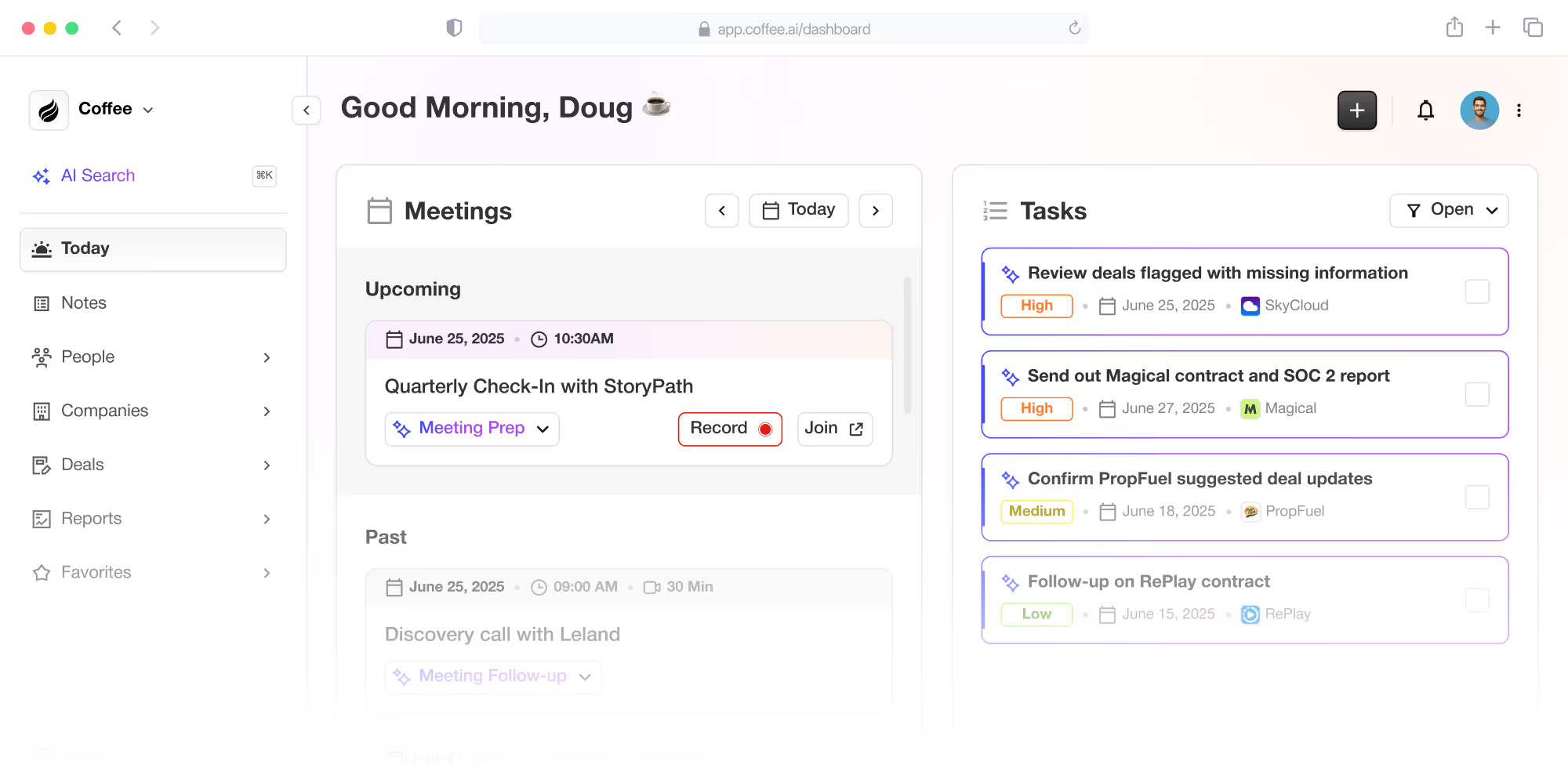
The platform automatically captures data from emails, calendars, and calls to create and update contacts and activities, maintaining a reliable, up-to-date record. It also streamlines meeting workflows with AI-generated briefings before calls and summaries with action items afterward. Additionally, its Pipeline Intelligence tool provides historical comparisons of deal progress, helping teams spot emerging opportunities or risks. Coffee further simplifies operations by combining CRM, data enrichment, call recording, and forecasting into a single system.
With two models available, Coffee caters to diverse needs. Its Standalone CRM serves small to mid-sized teams looking for a fresh, efficient system, while the Companion App enhances existing Salesforce or HubSpot setups with AI capabilities. This flexibility ensures value for organizations at different stages of tech adoption.
Ready to explore how AI can enhance your sales process? Request access to Coffee and see the difference firsthand.
7 Practical Ways AI CRM Enhances Sales Productivity with Real-Time Data
1. Cut Down on Manual Data Entry to Focus on Selling
Manual data entry slows sales teams considerably, as reps spend much of their time logging details instead of engaging with clients. According to data, 71% of a rep’s workday often goes to non-selling tasks. AI-driven CRM tools address this by capturing information automatically from emails, calls, and meetings, reducing errors and freeing up time.
Coffee automates this process by scanning connected accounts to build and update records for contacts and companies. It also enriches data with details like job roles and company info, eliminating the need for additional tools. This can save reps an estimated 8 to 12 hours weekly, allowing more focus on direct customer interactions.
2. Speed Up Lead Qualification with Precise Insights
Qualifying leads based on outdated or limited data often results in wasted effort on uninterested prospects. AI CRMs improve this by delivering current, detailed information for better targeting. Coffee’s List Builder tool lets users create prospect lists with specific criteria, such as industry or funding status, using natural language inputs. This ensures reps prioritize leads with higher potential, streamlining outreach efforts.
3. Shorten Sales Cycles with Timely Deal Updates
Waiting for periodic reviews to spot stalled deals can delay action and prolong sales cycles. Real-time insights help identify issues as they occur. Coffee’s Pipeline Compare feature shows week-over-week changes in deal status, highlighting progress or setbacks instantly. This allows managers to step in early with targeted support, keeping deals on track.
4. Improve Pipeline Oversight with Accurate Data
Inconsistent data in traditional systems often leads to unreliable forecasting and pipeline management. AI tools provide clarity by maintaining accurate, current records. With Coffee, users can track pipeline health through automated comparisons, replacing manual effort with straightforward, data-backed insights. This helps leaders make informed decisions without guesswork.
5. Streamline Meeting Prep and Follow-Ups with Automation
Preparing for meetings and drafting follow-ups take up significant time for sales reps. AI can handle these tasks efficiently. Coffee offers a personalized page with call briefings, including attendee details and past interaction summaries. It records and transcribes calls, then generates action items and follow-up drafts tailored to specific sales frameworks. This automation keeps engagements consistent and effective.
Want to see how meeting automation can save time? Request access to Coffee and experience it yourself.
6. Strengthen Customer Interactions with Full Data Access
Buyers today value outreach tailored to their specific needs, but reps often lack a complete view of customer history. A unified data set resolves this. Coffee integrates information from various touchpoints, including emails and call notes, enabling reps to craft messages that resonate. This comprehensive approach helps maintain momentum in key conversations.
7. Simplify Your Tech Setup by Consolidating Tools
Using multiple tools for different sales functions creates inefficiencies and data discrepancies. Many teams juggle separate systems for CRM, outreach, and analytics, as noted in industry observations of fragmented tech stacks. Coffee combines these capabilities into one platform, cutting down on redundant tasks and costs. For those using Salesforce or HubSpot, its Companion App adds AI features without disrupting current systems.
Comparing AI-First CRM and Traditional Systems for Data Handling
The differences between modern AI-driven CRMs and older systems are clear when looking at how they manage data and support sales teams. Here’s a breakdown:
| Feature | Traditional CRM (e.g., Salesforce/HubSpot) | AI-First CRM (e.g., Coffee) |
|---|---|---|
| Data Entry | Depends on manual updates, prone to gaps or errors | Automated capture from communications, maintains accuracy |
| Data Organization | Often scattered across tools, requires integrations | Centralized platform, consistent and accessible data |
| Pipeline Tracking | May need extra setup for real-time updates | Instant comparisons, tracks changes automatically |
| User Adoption | Can be challenging without extensive training | Intuitive design, supports reps like a partner |
Key Questions About AI CRM and Sales Efficiency
How Does Real-Time Data Analysis in AI CRM Improve Sales Outcomes?
Real-time data analysis in AI CRMs boosts outcomes by automating updates and delivering actionable insights. Tools like Coffee ensure information stays current without manual effort, letting reps spend more time on client engagement and less on data management.
Can AI CRM Help Reps Spend More Time Selling?
AI CRMs cut down on non-selling tasks significantly. With about 71% of a rep’s time currently tied to administrative work, platforms like Coffee automate data entry and meeting tasks, saving an estimated 8 to 12 hours per week for focusing on sales.
How Is Data Security Managed in AI CRM Platforms?
Data security remains a priority in AI CRMs. Coffee adheres to strict standards like SOC 2 Type 2 and GDPR, ensuring data privacy. It also maintains policies to prevent company data from being used in general AI training, protecting confidentiality.
Does Real-Time Data Support Both Strategy and Daily Tasks?
Real-time data aids both long-term planning and everyday actions. Coffee’s features, such as pipeline tracking for strategy and meeting summaries for daily use, ensure reps have the information needed for immediate decisions and future planning.
What’s the Difference Between a Full AI CRM and Adding AI to Existing Systems?
A full AI CRM like Coffee is designed with integrated data and AI capabilities from the start, offering a cohesive experience. Adding AI to systems like Salesforce or HubSpot can be less seamless, but Coffee’s Companion App enhances these platforms while maintaining existing workflows.
Looking Ahead: AI as the Foundation of Sales Success
Sales processes are moving beyond manual and reactive methods. Teams need tools that reduce administrative burdens and enable a focus on building client relationships. AI-first CRMs, with Coffee as a notable example, provide a solid foundation for improving productivity and supporting growth.
The seven strategies discussed show how real-time data and AI can overhaul sales operations, from automating data entry to unifying tech tools. Coffee delivers these benefits through its flexible offerings, whether as a standalone solution for growing teams or as an enhancement to established systems like Salesforce or HubSpot.
Interested in elevating your sales performance with AI insights? Request access to Coffee and discover how data-driven strategies can benefit your team.