
In today’s competitive business environment, the divide between sales and marketing teams remains a persistent barrier to growth. As companies navigate digital transformation, the need for alignment between these two functions has become more critical than ever.
The market landscape reflects a growing reliance on technology to bridge this gap, with AI-driven tools emerging as a key solution. Businesses across industries are recognizing that fragmented operations not only hinder efficiency but also impact customer experiences and revenue potential.
This guide explores how AI CRM platforms, with tools like Coffee as a leading example, address these challenges by fostering collaboration and streamlining operations. By diving into the mechanics of alignment, practical benefits, and strategic considerations, we aim to provide a clear path for improving coordination and driving measurable outcomes.
The push for sales and marketing unity stems from a broader trend in business: the integration of data and technology to create cohesive customer journeys. Traditional CRM systems, while useful for organizing information, often fall short in delivering real-time insights or automating repetitive tasks. Many organizations struggle with siloed systems that create friction rather than collaboration.
AI CRM platforms step in to address these pain points by offering intelligent automation and unified data access. Among these, Coffee stands out by focusing on practical solutions that both sales and marketing teams can adopt with ease, reflecting a larger movement toward user-friendly, results-driven technology.
Why Sales and Marketing Teams Often Operate in Silos
Sales and marketing misalignment often arises from differing goals and workflows. Sales teams prioritize closing deals and driving revenue, while marketing focuses on generating leads and building brand awareness. This fundamental disconnect creates separate priorities, where each team develops its own processes without fully considering the other.
Data isolation worsens the issue. When marketing operates without insight into sales interactions, campaigns may target the wrong audience. Similarly, sales teams miss out on valuable marketing context, leading to inconsistent messaging. Fragmented tools and platforms only deepen this divide, making it harder to form a complete picture of the customer journey.
The cost of this disconnect is high. Marketing efforts may produce leads that don’t match sales needs, wasting time and budget. Sales reps end up spending too much effort on unqualified prospects, while customers experience disjointed interactions.
Studies collected by Coffee indicate that only about 35% of a sales rep’s time is spent on actual selling, with much of the rest consumed by administrative tasks like data entry. This inefficiency highlights the urgent need for a solution that aligns both teams around shared objectives.
How AI CRM Builds Stronger Sales and Marketing Collaboration
AI CRM platforms offer a practical way to unify sales and marketing by focusing on shared data and automated processes. These tools create a single source of customer information, accessible to both teams, ensuring decisions are based on the same insights. Platforms like Coffee lead this trend by eliminating common friction points in traditional setups.
Automation plays a central role in reducing manual workloads. Tasks like logging interactions or scoring leads happen in the background, freeing up time for strategic work. Both teams benefit from immediate access to updates, whether it’s a marketing campaign’s impact or a sales conversation’s outcome. This shared visibility fosters accountability and helps align efforts toward common goals.
AI also delivers actionable analysis. By identifying trends in customer behavior or deal progression, these platforms guide marketing on where to focus campaigns and help sales prioritize high-potential opportunities. The result is a more coordinated approach that directly supports revenue growth.
Coffee: A Leading Example of AI-Driven Alignment
Coffee stands out as an AI-first CRM designed to tackle the specific challenges of sales and marketing coordination. Built to integrate seamlessly into daily workflows, it automates tedious tasks and provides clear, data-driven insights. Coffee serves as a practical tool for teams looking to move beyond outdated systems and embrace a more collaborative way of working.
Key features of Coffee that support alignment include:
- Automatic data capture from emails, calls, and calendars, ensuring all customer interactions are logged without manual input.
- Enriched profiles with business intelligence, giving both teams a fuller view of contacts and companies.
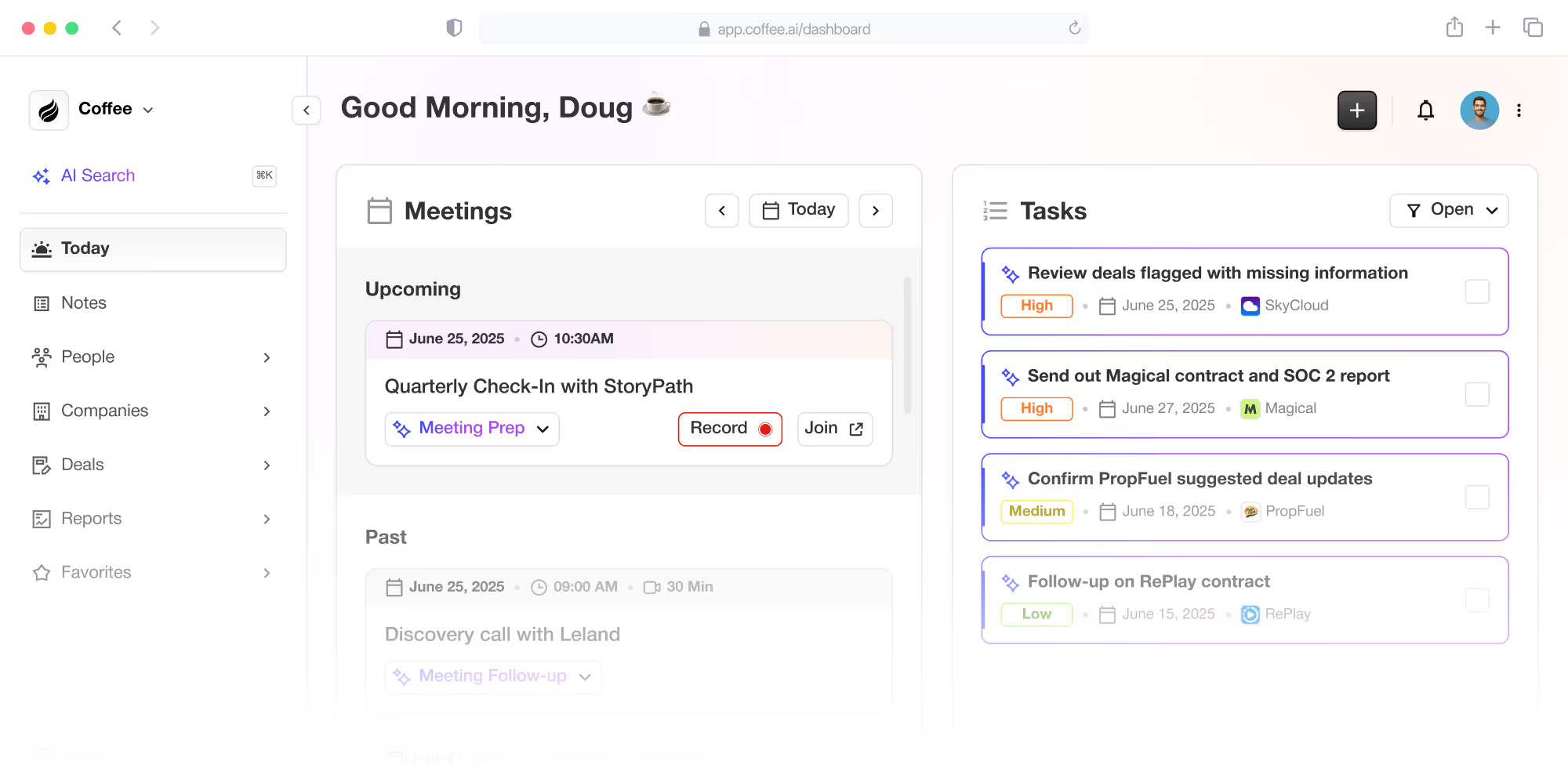
- Meeting preparation tools that provide briefings on attendees and past interactions, plus post-meeting summaries for follow-up.
- Pipeline tracking with a comparison feature to highlight weekly changes, aiding strategic discussions.
- A unified platform that reduces the need for multiple tools, simplifying tech management.
For companies already using tools like Salesforce or HubSpot, Coffee offers a companion app that adds AI capabilities without requiring a full system replacement. This flexibility makes it an accessible option for enhancing existing setups. By focusing on user adoption and data accuracy, Coffee addresses common pain points in CRM usage, positioning it as a valuable player in the broader trend of AI-driven business tools.
Ready to improve team alignment? Request access to Coffee and see how AI CRM can help.
What to Consider When Adopting AI CRM for Alignment
Implementing an AI CRM requires careful planning to ensure success. Leadership must set shared goals for sales and marketing, encouraging collaboration from the start. Training and communication are essential to overcome resistance to new tools. Solutions like Coffee help by offering immediate time savings through automation, which can ease the transition.
Data quality directly impacts AI effectiveness. Accurate, complete data from sources like email and calendars, as handled by Coffee, supports reliable insights. Establishing clear guidelines for data management prevents inconsistencies and ensures both teams trust the system.
Measuring the impact of alignment involves tracking specific outcomes. Metrics like revenue tied to marketing efforts, time saved on administrative tasks, and overall tool adoption provide a clear view of progress. These indicators help refine strategies over time.
Comparing AI-First CRM to Traditional Systems
|
Aspect |
Traditional CRM |
Coffee (AI-First CRM) |
Impact on Alignment |
|
Data Handling |
Relies on manual updates, often incomplete |
Automatic logging and enrichment |
Both teams work from accurate, current data |
|
Workflow Support |
Manual steps between teams |
Automated briefings and follow-ups |
Smoother handoffs and consistent messaging |
|
Pipeline Visibility |
Requires manual reporting |
Instant comparison of changes |
Clearer insight into joint efforts |
|
Team Adoption |
Often seen as extra work |
Valued as a helpful tool |
Improved data input for better collaboration |
Common Challenges to Avoid with AI CRM Implementation
Adopting AI CRM isn’t without risks. Relying solely on technology without addressing team dynamics can limit results. Ongoing training ensures users stay comfortable with the system. Defining roles for data sharing and tool integration prevents confusion and maintains focus on alignment goals.
Want to sidestep implementation issues? Request access to Coffee for support in aligning your teams.
Key Questions About AI CRM for Team Alignment
How does Coffee handle scattered customer data?
It pulls information from emails, calls, and calendars into a single profile, ensuring both teams have access to the full picture in real time.
Can AI CRM reduce the time spent on data entry for sales?
Yes, Coffee automates logging and updating information, saving users an estimated 8 to 12 hours weekly for more impactful tasks.
Does Coffee work with existing systems like Salesforce or HubSpot?
Absolutely, its companion app adds AI features to these platforms, improving usage and data reliability without a full switch.
What quick wins can teams expect from Coffee for alignment?
Look for better data sharing, more targeted marketing, higher sales efficiency, and clearer tracking of revenue sources.
How does AI CRM track alignment progress?
Coffee provides analytics on pipeline trends, revenue impact, time savings, and data quality to measure the effectiveness of joint efforts.
Looking Ahead: AI CRM as the Foundation for Growth
Aligning sales and marketing is no longer optional for businesses aiming to stay competitive. AI CRM tools like Coffee offer a solid starting point by unifying data and automating processes. However, lasting success depends on cultural shifts and well-defined workflows.
The future of revenue growth lies with companies that use technology to turn sales and marketing into a single, effective unit. Embracing platforms like Coffee, as part of this wider trend, positions organizations to adapt quickly and meet customer needs with precision.
Ready to boost your sales and marketing with AI CRM? Request access to Coffee now.