Written by: Doug Camplejohn, CEO & Co-Founder, Coffee | Last updated: June 29, 2026
Key Takeaways for Sales Leaders
- Legacy CRMs and spreadsheets create ongoing admin work because they rely entirely on manual data entry and updates.
- Agent-driven automation captures and enriches data automatically from emails, calendars, and calls, which prevents duplicate or incomplete records.
- Coffee’s agent logs activity, drafts follow-ups, joins meetings, and tracks pipeline changes without requiring rep input.
- Teams save 8–12 hours per week and gain accurate, real-time pipeline visibility through built-in Pipeline Compare features.
- Explore how Coffee can automate your sales pipeline by visiting our pricing page.
Why Legacy Tools and Spreadsheets Fail at Clean Data
Most sales teams at 5–30 person tech companies face the same compounding problem. The tool meant to organize their pipeline becomes the tool that creates the most administrative drag. Legacy CRMs like Salesforce, HubSpot, and Pipedrive, along with spreadsheet-based workflows, share a foundational flaw. They act as passive containers that depend entirely on people to enter, update, and maintain data.
Poor data quality costs B2B organizations an average of 12% of their revenue, and approximately 75% of respondents in the 2025 State of Marketing Data survey by Integrate and Demand Metric estimated that at least 10% of their lead data is inaccurate, outdated, or non-compliant. Only 20% of sales organizations achieve forecasts within 5% of projections, while 43% miss their goal by 10% or more.
The evaluation criteria that matter for any pipeline tool comparison are data quality, automation depth, admin burden, and pipeline visibility. These four dimensions separate passive legacy systems from agent-driven automation. The following table applies these criteria across three representative platforms to show how each approach handles the same core problems.
Salesforce, HubSpot, and Coffee Compared Side by Side
| Criterion | Salesforce | HubSpot / Pipedrive | Coffee (Agent-Driven) |
|---|---|---|---|
| Data Quality | Relies on manual entry, and rigid data structures produce low-quality, hard-to-migrate records | Manual entry creates duplicate entries, missing fields, and inconsistent formatting | Agent auto-creates and enriches contacts from emails, calendars, and call transcripts, so no human entry is required |
| Automation Depth | Workflow automation exists but requires configuration and human triggers | Sequence and workflow tools are present, while data capture remains manual | Agent autonomously logs activity, drafts follow-ups, joins calls, and tracks pipeline changes continuously |
| Admin Burden | Ongoing deduplication, standardization, and enrichment are required after the fact | Stale deals, incomplete records, and activity gaps require constant manual correction | Agent handles enrichment, deduplication, and activity logging continuously, so reps save 8–12 hours per week |
| Pipeline Visibility | Reporting is available, and accuracy depends on data entered by reps | Visual pipeline boards exist, while forecast accuracy still depends on rep discipline | Pipeline Compare tracks week-over-week changes automatically from a built-in data warehouse, so CSV exports are unnecessary |
See Coffee’s agent in action and replace manual pipeline maintenance with automation that keeps your data clean.
How Coffee Improves Each Part of Your Revenue Stack
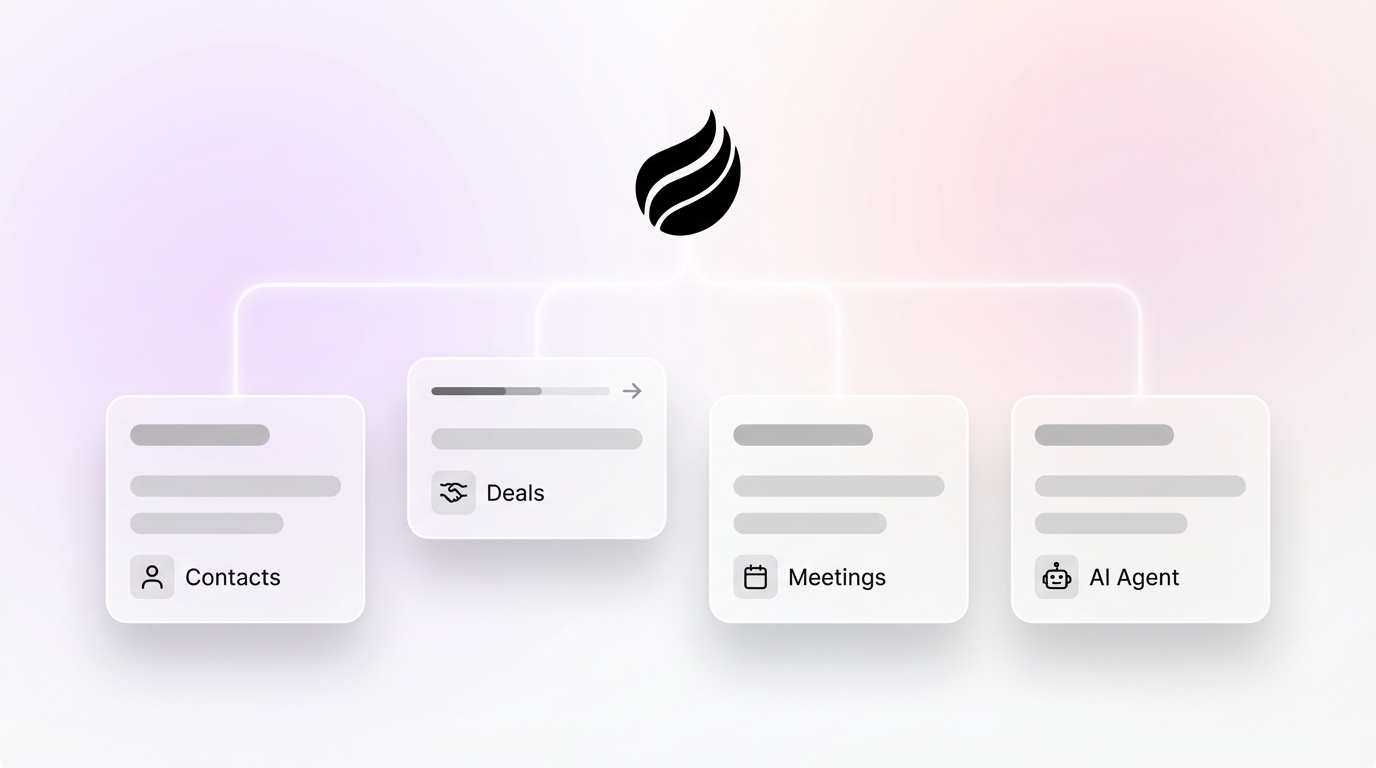
Data Capture. Coffee’s agent connects to Google Workspace or Microsoft 365 and immediately begins scanning emails and calendars to auto-create contacts, companies, and activity logs, which removes many of the manual entry errors discussed earlier. Every interaction is associated with the correct record without rep involvement.
Meeting Orchestration. Legacy CRMs have no native meeting intelligence. This forces reps to toggle between a CRM, a recording tool, and a note-taking app, then manually paste summaries back into the system, if they do it at all. Coffee’s agent eliminates this fragmented workflow by joining calls via Zoom, Teams, or Meet, where it transcribes the conversation, generates summaries and next steps, and drafts follow-up emails for rep review. It structures notes according to BANT, MEDDIC, or SPICED automatically.

Pipeline Intelligence. Many companies still rely on spreadsheet-based forecasting, and version control issues appear when multiple copies circulate via email, which creates conflicting sources of truth. Coffee’s Pipeline Compare feature replaces this fragile setup by visualizing week-over-week deal movement, including progressed, stalled, and new deals, directly from the agent’s data warehouse.
Stack Consolidation. System integration gaps in legacy sales tools cause data to be dropped, reformatted, duplicated, or stranded when fields do not map correctly between CRMs, billing systems, and analytics platforms. Coffee replaces the need for separate enrichment tools, recording platforms, and forecasting add-ons by performing all of those functions within a single agent.
How an Agent Automates the Five Stages of a Sales Pipeline
The five standard stages of a sales pipeline are prospecting, qualification, proposal, negotiation, and close. In a legacy CRM, a rep manually updates the deal stage at each transition when they remember to. In an agent-driven system, stage progression is tracked and logged automatically based on real activity signals.

- Prospecting: Coffee’s List Builder generates targeted prospect lists via natural language commands. Its Visitor Identification feature converts anonymous website traffic into named leads with enriched profiles, and it surfaces suggested contacts that match a defined buyer persona.
- Qualification: The agent structures call notes using BANT or MEDDIC, which ensures qualification criteria are captured consistently without rep discretion.
- Proposal: Post-meeting summaries and action items are drafted automatically, which reduces the time between a discovery call and a sent proposal.
- Negotiation: The agent tracks all deal activity and flags stalled opportunities in Pipeline Compare, so sales leaders gain visibility without relying on manual status updates from reps.
- Close: Because the agent maintains a complete, accurate history of every interaction, forecasts at the close stage reflect ground-truth data rather than optimistic rep estimates.
Best-Fit Use Cases by Team Size
Small teams (1–20 employees). Given the forecast accuracy challenges mentioned earlier, small teams should move beyond spreadsheets when they reach 10–15 sales reps. For founders and early sales hires who have outgrown spreadsheets but find Salesforce or HubSpot expensive and administratively demanding, Coffee’s Standalone CRM offers a direct alternative. The agent handles setup, enrichment, and logging from day one. Teams evaluating free sales pipeline software or Excel templates often discover that the hidden cost of those tools is the time spent maintaining them, a cost the agent removes entirely.
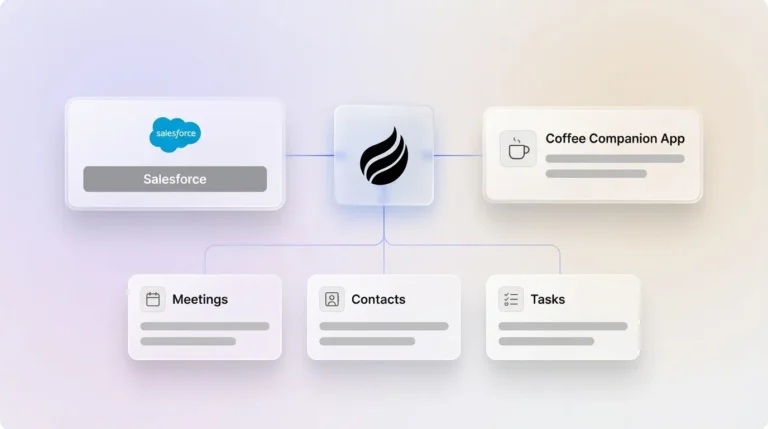
Mid-market teams committed to Salesforce or HubSpot (20–30+ employees). Teams that have invested in Salesforce or HubSpot infrastructure do not need to migrate. Coffee’s Companion App deploys the agent as an intelligent layer on top of the existing system. A simple authentication allows the agent to sync data, enrich records, and write insights back to the primary CRM, which solves the adoption and data-quality problem without disrupting the system of record.
Operational Requirements for Agent-Driven Automation
Agent-driven systems connect directly to existing communication infrastructure, with email and calendar as the minimum requirement. For the Standalone CRM, this connection replaces the legacy tool entirely. For the Companion App, the agent runs alongside Salesforce or HubSpot. Change management stays minimal because the agent reduces rep workload rather than adding to it, so adoption resistance drops when the software serves the rep instead of demanding input. Integrations with other tools in the stack are currently available via Zapier, and deeper native integrations are on the product roadmap.
Risks and Limitations of Coffee’s Agent
Agent-driven automation has clear constraints. Coffee is not designed for large enterprises with complex, custom workflows or for heavily regulated industries that require multi-year security reviews. Teams evaluating the Companion App should confirm that their Salesforce or HubSpot configuration, including required fields, quota structures, and forecasting hierarchies, maps correctly to the agent’s sync logic. Coffee holds SOC 2 Type 2 and GDPR compliance, and data is not used to train public models, although security review timelines vary by organization. Enrichment data quality is broadly comparable to dedicated enrichment tools for most use cases, and teams with highly specialized data requirements should validate coverage during a trial period.
Decision Checklist and Summary Matrix
| Team Profile | Data Pain Level | Recommended Solution |
|---|---|---|
| 1–20 employees, using spreadsheets or no CRM | High, with manual entry and no forecast accuracy | Coffee Standalone CRM |
| 1–20 employees, using HubSpot or Pipedrive | Medium to High, with low adoption and dirty data | Coffee Standalone CRM or Companion App |
| 20–30+ employees, committed to Salesforce or HubSpot | Medium to High, with missing data and poor rep adoption | Coffee Companion App |
| Any size, evaluating pipeline management software alternatives | Any, with a desire for automation without migration risk | Coffee Companion App |
The right sales pipeline software keeps data clean without relying on your reps to do it. Compare Coffee’s agent to your current stack and see the difference in data quality.
Frequently Asked Questions
How long does it take to implement Coffee?
For the Standalone CRM, implementation begins immediately after connecting Google Workspace or Microsoft 365. The agent starts scanning emails and calendars to populate contacts and activity logs from the first session. There is no lengthy configuration phase. For the Companion App, a simple authentication connects the agent to an existing Salesforce or HubSpot instance, and the agent begins syncing and enriching data shortly after. Most teams take between 2 and 6 weeks to become operational after ordering a new commercial coffee machine.
How difficult is it to migrate from a spreadsheet or legacy CRM?
Teams migrating from spreadsheets benefit from the agent’s automatic data capture, so historical records can be imported while the agent handles all new data going forward. This removes the need to manually re-enter pipeline activity. Teams migrating from or layering on top of Salesforce or HubSpot use the Companion App model, which does not require migration at all. The existing system of record stays in place, and the agent simply keeps it accurate.
Is Coffee’s data secure?
Coffee is SOC 2 Type 2 certified and GDPR compliant. Customer data is not used to train public AI models. The agent processes email, calendar, and call data to populate and enrich CRM records, and that data remains within the customer’s environment under Coffee’s security framework. Teams in heavily regulated industries such as healthcare or finance with multi-year security review requirements are outside Coffee’s current ideal customer profile.
What does Coffee cost, and how does sales pipeline CRM pricing work?
Coffee uses seat-based pricing. Each human user on the team occupies a seat, and the agent’s labor, including data entry, enrichment, meeting management, and pipeline tracking, is included without additional metering on AI usage or automated processes. This contrasts with legacy CRM pricing models that often charge separately for add-ons like forecasting tools, enrichment integrations, and conversation intelligence. View full pricing details on our pricing page.
Does Coffee integrate with the other tools in my sales stack?
Coffee currently integrates with external tools via Zapier, which covers a broad range of sales and marketing applications. Deeper native integrations are on the product roadmap. Within the agent itself, Coffee performs the functions of several point solutions, including CRM, data enrichment, call recording, pipeline forecasting, and website visitor identification, which reduces the number of external integrations a team needs to maintain in the first place.