
Key Takeaways
- Sales teams lose a large share of selling time to manual CRM data entry and fragmented tools, which reduces productivity and data quality.
- Agent-led sales productivity software shifts work from humans to AI agents that capture, enrich, and organize data automatically.
- Coffee offers both a standalone AI-first CRM and a companion agent for Salesforce and HubSpot to modernize existing investments.
- Organizations that evaluate tools based on automation, adoption, and business outcomes gain more value than those focused on feature checklists.
- Coffee provides an agent-led platform that automates admin work, meeting workflows, and forecasting; explore options at Coffee.
The Evolving Sales Landscape: Why Traditional CRMs and Point Solutions Fall Short
Modern sales teams need speed, accurate data, and a clear focus on revenue. Many still spend most of their time on administrative updates instead of customer conversations, with some teams reporting that more than half of their week goes to non-selling work.
Traditional CRMs often create four core problems that limit productivity:
- Manual data entry removes time from selling and leads to incomplete, inconsistent records.
- Fragmented workflows push teams across many tools for enrichment, outreach, and call recording, which creates silos and context switching.
- Legacy architectures carry technical debt and struggle to turn unstructured inputs like emails and transcripts into usable insights.
- Poor user experience encourages “shadow CRMs” in spreadsheets, which further erodes data quality and trust in reports.
These issues make it difficult for leaders to rely on their pipeline views, forecasts, and performance metrics when making decisions.
Introducing the Agent-Led Shift: Coffee’s Approach to Sales Team Productivity
Agent-led systems treat software as an active teammate that handles routine work. Instead of asking reps to feed a database, an AI agent observes activity, updates records, and surfaces insights in the background.
Coffee focuses on the principle that software should work for humans. The Coffee Agent captures accurate “ground truth” data from email, calendar, and meetings, then uses that data to keep the CRM current and useful.
Coffee supports two main deployment models:
- Standalone AI-first CRM for small and mid-sized teams that have outgrown spreadsheets and want a fast system that runs on automation instead of manual entry.
- Companion App for Salesforce and HubSpot that layers the Coffee Agent on top of existing CRMs to handle data capture, enrichment, and workflows inside the current system of record.

Key Pillars of Agent-Led Sales Productivity Software
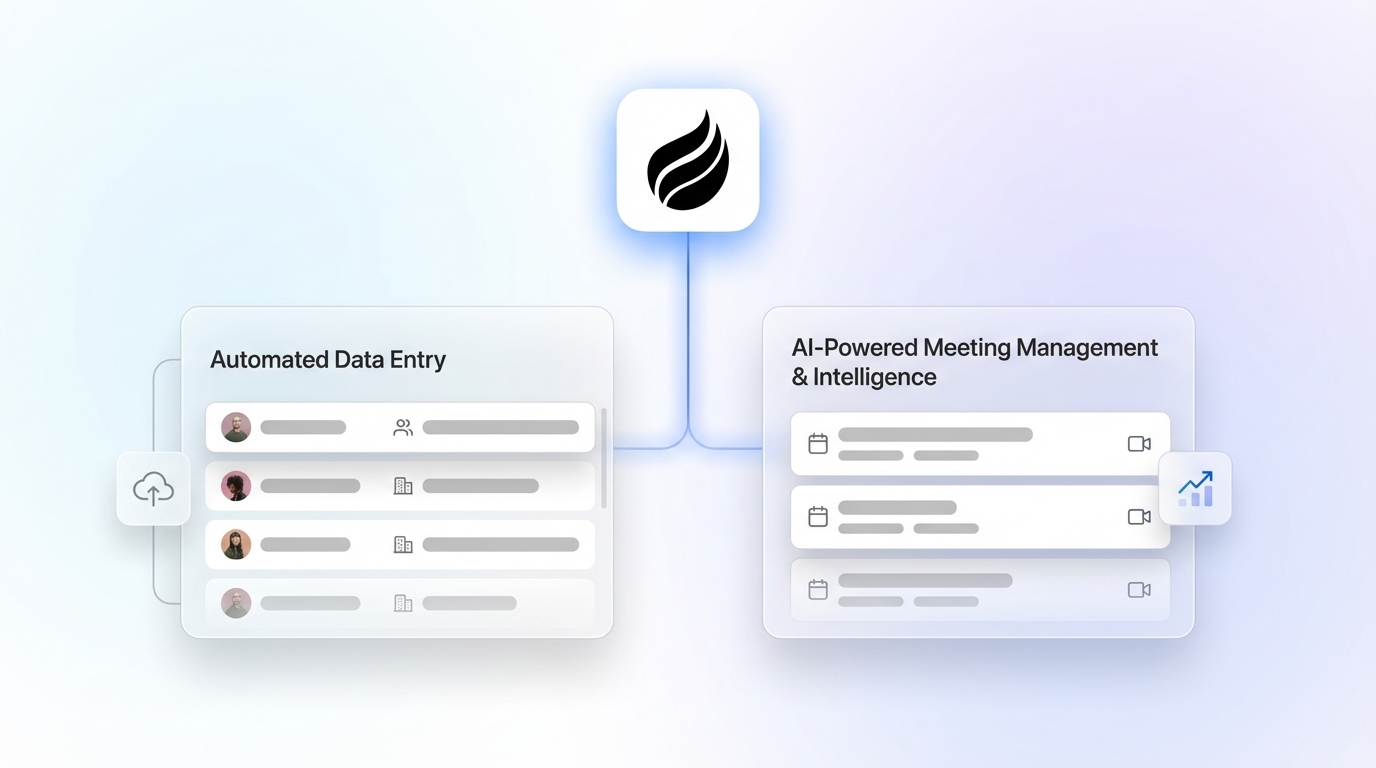
Automated Data Entry and Enrichment
The Coffee Agent connects to Google Workspace or Microsoft 365 and creates contacts, companies, and activities from emails and calendar events. Every interaction links to the right record without manual input from the rep.
Licensed enrichment partners add details such as titles, company funding data, and LinkedIn profiles so reps see complete profiles inside one system. Automatic activity logging keeps deal stages and interaction history current, which improves forecast reliability.
AI-Powered Meeting Management
Sales teams gain structured support before, during, and after meetings. The Coffee “Today” view summarizes who reps are meeting, the role of each attendee, and prior interactions, so preparation feels focused and fast.

During calls, an AI bot joins Zoom, Teams, or Meet to record and transcribe the conversation. Notes are organized into consistent frameworks such as BANT, MEDDIC, or SPICED, so qualification data is standardized across the team.
After the meeting, the agent drafts summaries, next steps, and follow-up emails directly in Gmail for the rep to review and send. This reduces the risk of stalled deals caused by delayed or missing follow-ups.
Pipeline Intelligence and Forecasting
Pipeline management improves when updates no longer depend on manual reporting. Coffee’s Pipeline Compare feature tracks changes week over week and highlights new, progressed, or stalled deals automatically.
The built-in data warehouse stores detailed activity history, which supports more accurate forecasting and pattern analysis. Pipeline reviews then shift from fact-finding to strategic discussion about risk, coverage, and next actions.
Consolidate Your Sales Tech Stack
Many sales operations leaders manage a patchwork of tools for enrichment, recording, coaching, and forecasting. Each new product adds contracts, integrations, and training overhead.
The Coffee Agent covers core needs that often sit across several platforms, including CRM data capture, enrichment, meeting intelligence, and pipeline insights. Consolidation can lower software spend, reduce integration work, and make administration easier.
How To Build a CRM Reps Want To Use
CRM adoption improves when the system gives more value than it demands. With Coffee, reps focus on activities that move deals forward while the agent does most of the logging and organizing.
This dynamic encourages consistent usage, fewer side spreadsheets, and better data quality. Leaders gain a clearer picture of the business without adding more manual requirements to the team.
Strategic Considerations for Adopting Modern Sales Team Productivity Software
How To Evaluate Solutions for Agent-Led Capabilities
Evaluation in 2026 should focus less on static feature lists and more on how automation will change daily work. Key considerations include:
- Depth of automation across email, calendar, and meetings.
- Ability to work as both a standalone CRM and a companion to existing systems.
- Ease of rollout, change management support, and admin simplicity.
- Quality of reporting and forecasting based on automatically captured data.
Teams also benefit from planning how roles and workflows will change when reps no longer spend large blocks of time on data entry.
ROI Expectations from Agent-Led Sales Productivity Software
Agent-led platforms create value in time savings, accuracy, and faster cycles. Many teams see each rep reclaim several hours per week that can shift from admin to selling.
Impact should be measured across metrics such as conversion rates, forecast accuracy, cycle length, and rep satisfaction, not just logins or feature usage.
|
Feature Category |
Coffee Agent Approach |
Legacy CRM + Point Solutions |
Impact |
|
Data Entry |
Automated (AI Agent) |
Manual (Human Rep) |
Hours per week returned to selling |
|
Data Quality |
High (Ground truth capture) |
Variable (Human fallibility) |
More reliable forecasts |
|
Meeting Intelligence |
AI bot, summaries, follow-ups |
Manual notes, separate tools |
Consistent qualification data |
|
Stack Complexity |
Consolidated |
Multiple point tools |
Lower costs and admin load |
Teams that want a single place for accurate data and insights can review Coffee pricing and plans to align deployment with current systems and growth goals.
Avoid Strategic Pitfalls When Choosing Sales Team Productivity Software
Many deployments underperform because of a few repeatable mistakes. Common pitfalls include:
- Focusing on dashboards while ignoring the quality and completeness of the underlying data.
- Underestimating the change management effort required to adopt an agent-led workflow.
- Adding more point tools instead of consolidating around a unified platform.
- Prioritizing extensive feature checklists over clear business outcomes and adoption.
Leaders can reduce risk by aligning selection criteria with productivity gains, user experience, and the ability to automate key workflows across the funnel.
Conclusion: Move From Manual CRM to Agent-Led Sales Productivity in 2026
Sales organizations that rely on manual entry and fragmented point tools face growing pressure from teams that use agent-led platforms. Automated capture and enrichment give leaders a clearer view of their pipeline while freeing reps to spend more time with customers.
Coffee delivers this agent-led model through a flexible platform that can stand alone as an AI-first CRM or enhance Salesforce and HubSpot. Teams that adopt this approach in 2026 can expect higher productivity, better data quality, and more confident revenue planning.
Teams ready to upgrade their sales productivity stack can get started with Coffee and put an AI agent to work across their CRM and meetings.
Frequently Asked Questions (FAQ) About Sales Team Productivity Software
How does Coffee handle data security and privacy?
Coffee maintains SOC 2 Type 2 and GDPR compliance standards and uses enterprise-grade security practices to protect customer data. Customer information is not used to train public AI models, so sales data stays private to each organization.
Can Coffee work with our existing CRM, such as Salesforce or HubSpot?
Yes. The Coffee Agent can run as a Companion App that integrates with Salesforce or HubSpot. In this mode, the agent captures and enriches data while using your current CRM as the system of record.
How does Coffee’s pricing model work for growing teams?
Coffee uses transparent, seat-based pricing where organizations pay for human users, and the agent’s work is included. This structure avoids complex usage-based AI fees and remains predictable as teams grow.
What happens to our existing CRM data when Coffee is introduced?
Coffee can import, clean, and enrich existing records in the standalone CRM. For companion deployments, the agent improves data quality inside your current CRM without requiring a full migration.