Written by: Doug Camplejohn, CEO & Co-Founder, Coffee | Last updated: July 3, 2026
Key Takeaways for HubSpot Sales Teams
- HubSpot stays your source of truth, so the real decision is which automation layer removes the most manual work without extra complexity.
- Native workflows and connectors automate only structured data, which keeps reps responsible for most data entry and deal updates.
- Coffee’s autonomous agent captures contacts, activities, and deal signals directly from email, calendar, and call transcripts, so manual CRM work disappears at the source.
- Teams using Coffee typically recover 8–12 hours per rep per week while maintaining data quality and lowering long-term administrative effort.
- Start saving hours every week and see Coffee’s pricing and plans.
How This Guide Evaluates HubSpot Automation Options
Depth of data-entry elimination measures whether a tool removes the human act of logging contacts, activities, and interactions, or only routes data that a human already entered elsewhere. If a tool only automates routing, the rep still functions as a data clerk, just with an extra step.
Deal stage transitions measure whether pipeline stages advance automatically based on real sales signals, such as email replies, meeting completions, and contract opens, or whether a rep must manually drag a card to reflect reality.
Follow-up automation covers whether the tool drafts, schedules, and logs follow-up communications without rep intervention after each touchpoint.
Implementation effort captures the time from contract to live automation, including configuration, field mapping, and testing.
Integration complexity reflects the number of authenticated connections, maintenance points, and failure modes that the tool introduces.
Time saved per rep per week is the key operational outcome. Coffee’s internal market data indicates that 71% of sales reps report spending too much time on data entry, leaving only 35% of their time for actual selling. The target for any automation investment is recovering 8–12 hours per rep per week.
Data quality measures whether the system of record reflects ground-truth deal state or degrades over time because of inconsistent human input.
Long-term administrative burden captures the ongoing cost of maintaining automation rules, connector mappings, and field logic as the team and product evolve.
With these criteria in place, the next sections apply them to native HubSpot workflows, connector platforms, and Coffee’s autonomous agent layer.
Side-by-Side Comparison of Sales Workflow Automation Tools
The table below shows how each tool category performs against the criteria that most affect rep productivity: data entry elimination, autonomous deal stage transitions, and time saved each week.
| Tool Category | Data Entry Eliminated | Deal Stage Transitions | Time Saved per Rep (2026 Est.) |
|---|---|---|---|
| Native HubSpot Workflows | Partial, triggers require structured field inputs from humans | Rule-based only, rep must update trigger field manually | 2–4 hrs/week |
| Connectors (Zapier, Apollo) | Partial, automates routing of data already entered elsewhere | Dependent on source-system updates, no autonomous signal capture | 3–5 hrs/week |
| Autonomous Agent Layer (Coffee) | Full, agent captures contacts, activities, and interactions from email, calendar, and call transcripts | Automatic, agent updates deal state from real sales signals without rep action | 8–12 hrs/week |
Time-saved figures for native HubSpot workflows and connectors reflect the ceiling when automation covers only structured, human-initiated data. The 8–12 hours figure for Coffee reflects autonomous capture of unstructured data sources such as email threads, calendar events, and call transcripts, which drive most manual CRM work.
Setup and Onboarding Effort Across Tools
Native HubSpot workflows require no third-party authentication. A RevOps admin configures enrollment triggers, actions, and delays inside HubSpot’s workflow editor. Setup time stays low for simple sequences but increases sharply as deal complexity grows. Each workflow requires individual maintenance as sales processes change.
Connector platforms such as Zapier require authentication between HubSpot and each source system. A team running HubSpot with a dialer, an enrichment tool, and a sequencing platform may maintain six or more active Zaps. Each connection creates a potential failure point. Apollo’s native HubSpot sync reduces some connector overhead but remains limited to Apollo-sourced data.
Coffee’s Companion App deploys through a single authentication to the existing HubSpot instance. The agent connects to Google Workspace or Microsoft 365 and begins capturing data immediately. Core contact and activity objects require no field mapping exercise. Most teams measure implementation time in hours instead of weeks.
Data Capture and Ongoing Maintenance
The core limitation of native HubSpot workflows is architectural. HubSpot workflows operate on enrollment triggers, so automation only fires when structured data meets specific conditions. If a rep forgets to log a call or update a contact record, the workflow never triggers. Automation reliability matches the consistency of human input.
Connector platforms inherit this same limitation. They automate routing of data that humans already entered in other tools, but they do not capture the initial interaction. If a rep does not log a call in the dialer or update a field in the sequencing tool, the connector has nothing to sync.
Coffee’s agent removes this dependency by capturing interactions at the source. When a rep sends an email, joins a calendar meeting, or completes a call, the agent logs the activity and updates the deal record automatically. HubSpot receives accurate data whether or not the rep remembers to log it.

Usability for Frontline Reps and Manager Visibility
Native HubSpot workflows stay invisible to reps during their workday. Reps still open HubSpot to log calls, update stages, and enter notes. The workflow automates what happens after a field changes, not the act of changing it. Manager pipeline visibility therefore depends on rep compliance.
Connector platforms add tools to the rep’s stack instead of removing them. A rep using Apollo for sequencing, Fathom for call recording, and Zapier to sync both into HubSpot manages three interfaces. Context switching between tools consumes time and increases the chance of data gaps.
Coffee’s Companion App surfaces a “Today” page that briefs reps before each meeting with attendee context, past interactions, and deal history, all populated by the agent. After the call, the agent generates summaries, next steps, and follow-up email drafts in Gmail. Managers see pipeline changes reflected in HubSpot in real time without chasing reps. The Pipeline Compare feature visualizes week-over-week deal movement automatically and replaces manual CSV exports.

Try Coffee’s Companion App to give your managers accurate pipeline intelligence without manual updates.
Scalability as Deal Volume and Team Size Grow
Native HubSpot workflows require a RevOps admin to build and maintain each automation rule. As deal volume grows and sales processes evolve, the workflow library expands. Without a central registry or dependency map, the library becomes harder to audit, and multiple workflows may trigger on the same field change or leave gaps where no workflow covers a scenario. Teams often discover these conflicts or enrollment gaps only after data quality problems appear in forecasting.
Connector platforms scale poorly because each new tool in the stack requires new authenticated connections and new Zap logic. A mid-market team that adds a new dialer or enrichment source must rebuild connector logic and retest every affected workflow. Administrative burden compounds with team size.
Coffee’s agent-based architecture scales without extra administrative overhead. The agent handles new contacts, new deal types, and new communication channels through the same underlying logic. Seat-based pricing keeps cost growth tied to headcount instead of data volume or process complexity. Teams avoid per-workflow fees and connector licensing costs.
Best-Fit Use Cases for Small and Mid-Market Teams
Small growing teams (under 15 reps) with a HubSpot instance and limited RevOps capacity gain the most from Coffee’s Companion App. The single-authentication deployment removes the need for a dedicated workflow administrator. The agent handles data entry from day one and prevents the data quality debt that appears when early-stage teams rely on rep discipline.
Established mid-market teams (15–100 reps) already running HubSpot with native workflows and connector integrations face a different challenge. They have automation in place but still see significant manual work per rep each week because automation does not reach unstructured data sources. Coffee layers on top of the existing HubSpot instance without displacing current workflows and adds autonomous capture for data that rule-based systems cannot reach.
Risks and Limitations Across Automation Approaches
Incomplete automation is the primary risk with native workflows and connectors. When automation covers only structured data, reps remain responsible for most data entry. Teams often overestimate coverage and underestimate the manual work that persists, which keeps the shadow-CRM risk high.
Hidden maintenance work accumulates in connector-heavy stacks. Zap failures, API deprecations, and field mapping drift require ongoing RevOps attention. This work rarely appears in initial ROI models but becomes material over time, especially for teams that rely heavily on Zapier-style integrations.
The shadow-CRM problem emerges when reps find the CRM too burdensome to maintain. To avoid the manual work, they move their working context to spreadsheets or Notion, which creates a parallel record that management cannot see. Because the official CRM no longer serves as the working system, pipeline data in HubSpot becomes stale and unreliable, which in turn degrades forecasting accuracy. Any strategy that leaves significant manual work in place, such as native workflows or connectors alone, accelerates this outcome.
Integration gaps in newer AI-native CRM alternatives create a different risk. Tools that lack deep HubSpot integration, including proper handling of required fields, forecasting categories, and custom objects, introduce data integrity problems when they write back to HubSpot. Coffee’s Companion App is built with explicit knowledge of HubSpot’s data model, including quota structures, deal pipelines, and required field logic, which reduces this risk.
Decision Framework for Choosing a HubSpot Automation Tool
Use this framework to match your team’s constraints to the tool category that addresses them. When a constraint in the left column matches your environment, review which option the table recommends.
| Constraint | Native HubSpot Workflows | Connectors (Zapier/Apollo) | Coffee Companion App |
|---|---|---|---|
| No RevOps admin available | Not recommended | Not recommended | Recommended |
| Need to eliminate manual data entry fully | Not sufficient | Not sufficient | Recommended |
| Automated deal stage transitions required | Partial only | Partial only | Recommended |
| HubSpot must remain system of record | Native | Compatible | Recommended |
| Target: maximum time savings per rep | Not achievable | Not achievable | Achievable |
Frequently Asked Questions
How long does it take to implement Coffee’s Companion App on an existing HubSpot instance?
Implementation requires a single authentication between Coffee and HubSpot, plus a connection to Google Workspace or Microsoft 365. Most teams are live within a few hours. Standard contact, company, and activity objects require no field mapping. Custom objects and required fields specific to a team’s HubSpot configuration are handled through Coffee’s deep integration with HubSpot’s data model.
Does Coffee replace HubSpot, or does it work alongside it?
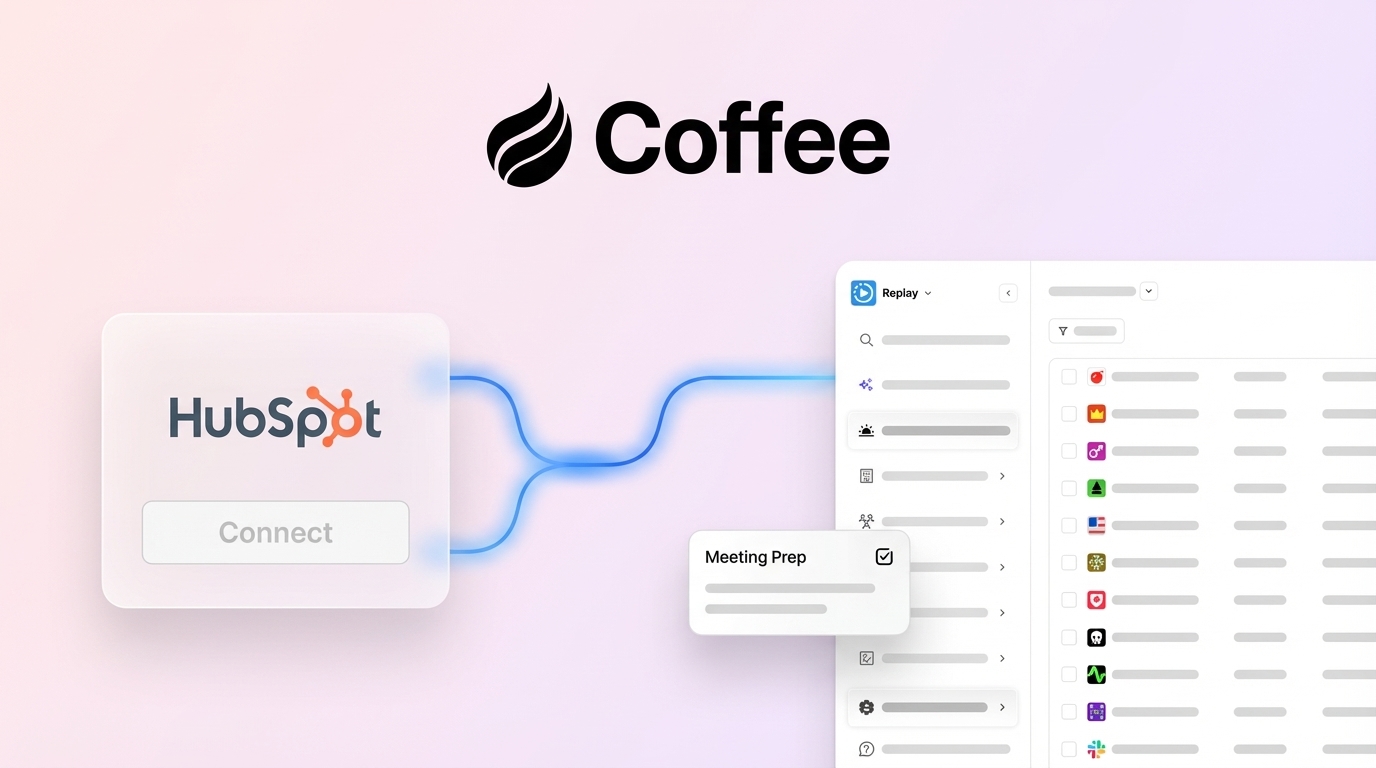
Coffee’s Companion App works alongside HubSpot. HubSpot remains the system of record, while Coffee’s agent writes enriched contacts, logged activities, meeting summaries, and deal stage updates back into HubSpot automatically. Managers and reps continue to work in HubSpot, and the agent handles the data entry work that previously required human effort.
How does Coffee handle data security and compliance?
Coffee is SOC 2 Type 2 and GDPR compliant. Data captured by the agent is not used to train public AI models. For mid-market teams in regulated environments, these certifications satisfy standard security review requirements. Teams in heavily regulated industries such as healthcare or finance with multi-year security review cycles fall outside Coffee’s current ideal customer profile.
What happens to data quality if a rep misses logging an interaction?
With native HubSpot workflows or connector platforms, a missed log means the automation never fires and the deal record stays incomplete. With Coffee, the agent captures interactions directly from email and calendar data, so the rep does not need to log anything. If a meeting occurs and appears on the rep’s calendar, the agent logs it, generates a summary, and updates the deal record regardless of rep action.
How does Coffee’s pricing scale as the team grows?
Coffee uses seat-based pricing. Each human seat includes unlimited agent labor, with no per-workflow fees, connector licensing costs, or usage-based charges for data volume or AI processing. As headcount grows, cost scales linearly and predictably. Teams avoid hidden costs when they add new automation rules or expand data capture to new communication channels.
Conclusion: Choosing the Right Automation Layer for HubSpot
Native HubSpot workflows and connector platforms reduce manual work at the margins but leave the core problem intact. Deal stage transitions and data entry still depend on human action. When reps do not update fields, automation does not fire, pipeline data degrades, and the shadow-CRM problem follows.
An autonomous agent layer removes manual data entry at the source by capturing contacts, activities, and interactions from unstructured data such as email, calendar, and call transcripts, then writing accurate records back to HubSpot without rep involvement. Coffee’s Companion App delivers this capability with single-authentication deployment, SOC 2 Type 2 and GDPR compliance, seat-based pricing, and deep HubSpot integration that handles required fields, forecasting categories, and custom objects correctly.
For mid-market sales leaders and RevOps teams targeting the time savings described earlier while maintaining their existing HubSpot investment, an autonomous agent layer provides the only architecture that fully achieves that outcome. Start your free trial and let the agent handle the work.