
In today’s fast-evolving sales landscape, artificial intelligence is fundamentally changing how businesses manage customer relationships and drive growth. The market for customer relationship management (CRM) systems is witnessing a significant shift, with traditional platforms often failing to keep pace with the demands of modern sales teams. Many organizations grapple with fragmented data, manual processes, and systems that can’t handle increasing complexity. Meanwhile, AI-first CRMs are emerging as a solution, offering automation and real-time insights to address these challenges. This guide explores the dynamics of scaling AI-powered CRM systems, focusing on practical strategies for sales leaders to enhance performance while navigating the competitive terrain of sales technology.
The transition to AI-driven tools reflects a broader trend in the industry, where efficiency and adaptability are becoming non-negotiable for growth. Research indicates that companies adopting AI in sales processes can see productivity gains of up to 40%, highlighting the urgency to modernize outdated systems AI’s impact on sales productivity. Yet, not all solutions are created equal, and understanding the trade-offs between legacy CRMs and AI-native platforms is critical. This guide will break down these differences, offering actionable insights into building scalable sales operations. As an example of this trend, Coffee stands out with its innovative approach, and we’ll examine how it fits into the larger movement toward AI-first systems.
Why Traditional CRMs Struggle with Modern Sales Demands
Many traditional CRM systems, built on outdated architectures, face significant hurdles in meeting the needs of today’s sales environments. Originally designed for simpler times, these platforms often can’t adapt to the volume and variety of data that modern teams handle daily.
Key challenges include fragmented workflows. Sales reps frequently juggle multiple tools for CRM, outreach, data enrichment, and call recording, leading to inefficiency. Another issue is the time spent on manual tasks. About 71% of sales professionals say administrative work takes up too much of their day, leaving only a small portion for actual selling Salesforce data on administrative burden. Additionally, tracking historical data for pipeline insights often becomes cumbersome as data accumulates over time.
What Scalability Means for AI-First CRMs
Scalability in an AI-first CRM isn’t just about supporting more users. It’s about managing larger data volumes, automating repetitive tasks, and delivering real-time insights without slowdowns. For sales leaders, performance translates to processing unstructured information, like emails or call transcripts, and turning it into immediate, actionable intelligence for the team.
Unlike older CRMs that focus on storing data, AI-native platforms aim to convert raw information into practical tools for sales reps. This shift enables consistent performance, even as organizations expand, ensuring teams stay agile and informed at any scale.
How Coffee Delivers Scalability for Sales Teams
Coffee represents the growing wave of AI-first CRM platforms, designed specifically for the challenges of modern sales organizations. Built with automation and data unification at its core, Coffee tackles the inefficiencies of traditional systems while prioritizing scalability and user experience.
One key feature is its automated data entry and enrichment. By scanning emails and calendar invites, Coffee creates and updates contact and company information, saving reps an estimated 8 to 12 hours weekly. This automation performs reliably, whether handling a few dozen or thousands of interactions. It also pulls in detailed data, such as job titles and funding status, through licensed partners, reducing the need for separate tools like ZoomInfo and cutting down on integration costs.
Another strength is meeting management. Coffee acts as a virtual assistant, offering pre-meeting briefings, recording calls across platforms like Zoom and Microsoft Teams, and generating summaries with follow-up actions. This functionality remains effective whether a team handles a handful of meetings or hundreds each week.
For pipeline visibility, Coffee’s Pipeline Compare tool uses a data warehouse to store historical states. With one click, users can track changes in deal progression, new opportunities, or stalled deals over time. This becomes increasingly useful as businesses grow, eliminating the manual tracking common in older CRMs.
Coffee also simplifies the sales tech stack by combining CRM, data enrichment, call recording, and forecasting into one platform. This reduces the hassle of managing multiple systems and ensures data consistency as teams scale. It offers two deployment options: a standalone CRM for smaller businesses seeking a fresh start, or a companion app that enhances existing CRMs with AI features for larger organizations.
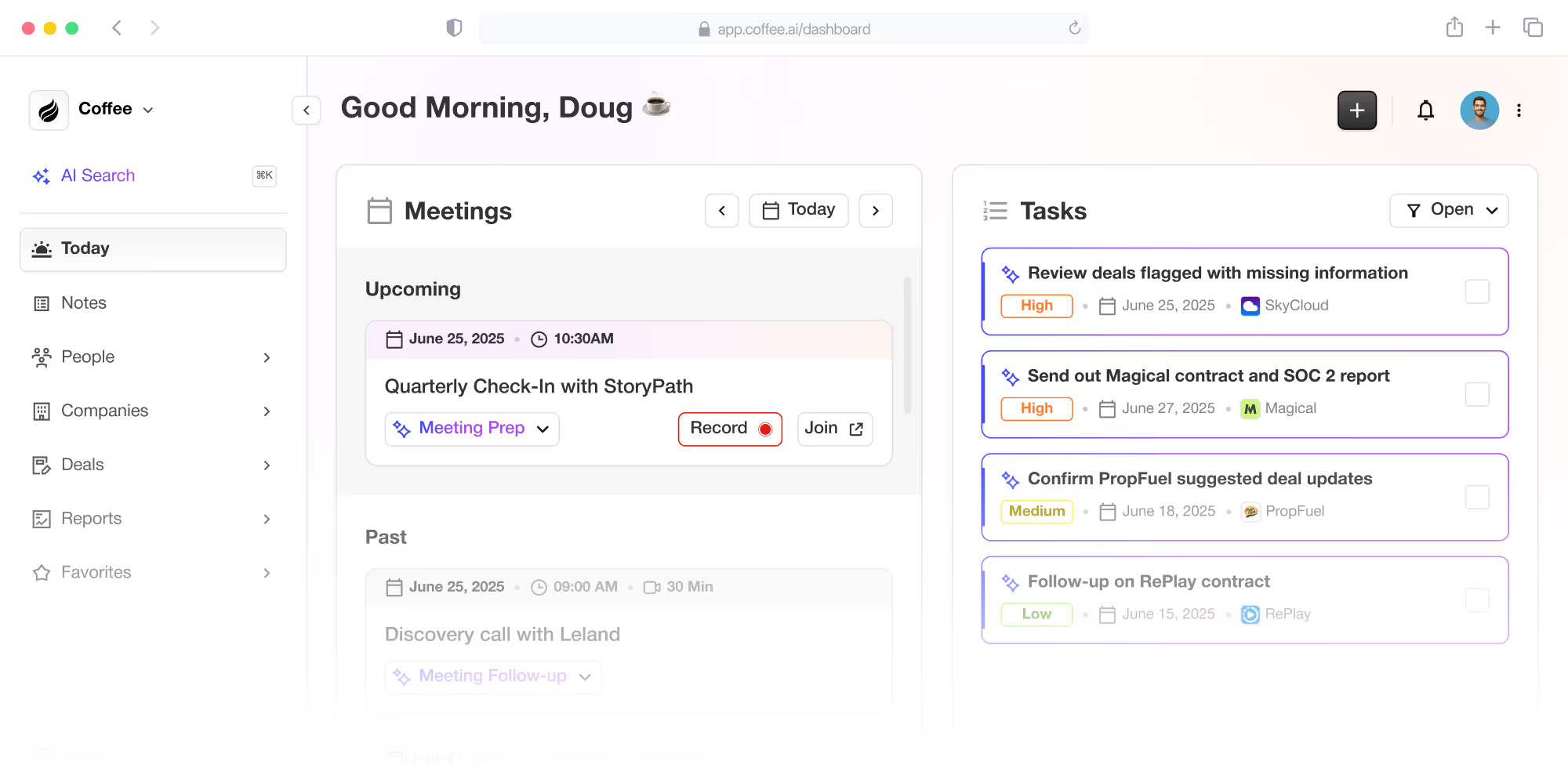
Interested in seeing how Coffee can streamline your sales process? Request access to explore its capabilities firsthand.
Real-World Impact: A Growing Company’s Experience with Coffee
A tech firm generating tens of millions in revenue, focused on custom AI solutions for large enterprises, faced challenges managing sales data in spreadsheets as their team expanded. After reviewing several options, they selected Coffee for its user-friendly design, automatic contact syncing with Google Workspace, weekly pipeline insights through Pipeline Compare, and API access for tailored data needs.
This example shows how Coffee adapts to the needs of growing teams, providing an efficient, automated alternative to cumbersome legacy tools or manual methods.
Comparing Coffee to Other AI CRM Options
While Coffee offers a compelling solution, it’s worth exploring how it stacks up against competitors in the AI CRM space to understand the trade-offs. Salesforce, for instance, has introduced AI features through Einstein, but its core platform remains rooted in traditional architecture, which can lead to slower adaptation for full AI integration. HubSpot also incorporates AI tools for lead scoring and automation, yet its focus on inbound marketing may not suit sales teams needing deep pipeline analysis.
In contrast, Coffee is built from the ground up as an AI-first platform, emphasizing data unification and automation over retrofitted features. However, it may lack the extensive customization options of Salesforce for very large enterprises. Gong.io, another player, excels in call analytics but doesn’t offer a full CRM experience, often requiring integration with other systems, which can complicate workflows.
Each tool has strengths and limitations. Salesforce and HubSpot suit organizations already invested in their ecosystems, though they may carry higher costs and complexity. Gong.io is ideal for conversation intelligence but isn’t a standalone solution. Coffee, as part of the AI-first trend, provides a balanced option for teams prioritizing ease of use and scalability without excessive customization needs.
Best Practices for Implementing an AI-First CRM
Roll Out Gradually for Smooth Adoption
Start with a small group of users to test an AI CRM’s workflows. Gather feedback to refine processes before expanding to the wider team. This phased approach reduces disruption and helps tailor the system to actual needs as adoption scales up.
Plan Integrations for a Unified Tech Stack
Focus on connecting the CRM with essential tools your team already uses. Coffee, for example, integrates with key business systems and supports Zapier for broader connectivity. A clear integration plan ensures performance remains steady as your tech stack grows.
Focus on User Experience to Drive Usage
An AI CRM’s success hinges on whether reps will use it. Coffee emphasizes features that directly benefit sales professionals, not just management reporting, helping overcome the adoption barriers often seen with older systems.
Ready to see how an AI-first CRM can boost your team’s efficiency? Request access to Coffee and discover its impact on sales performance.
Common Questions About Scaling AI CRMs
How Does Coffee Maintain Performance with Growing Teams and Data?
Coffee is built to scale, automating data entry and enrichment to handle increasing interaction volumes. Its data warehouse architecture powers tools like Pipeline Compare, maintaining speed and reliability even as data grows.
What Sets Coffee Apart from Traditional CRMs with AI Add-Ons?
Coffee is designed as an AI-first platform, prioritizing data unification and automation from the start. Unlike legacy CRMs that add AI as an afterthought, its structure focuses on clean data ingestion and historical tracking for precise insights.
How Does Coffee Ensure Data Quality for AI Effectiveness?
Data quality drives effective AI. Coffee captures accurate information from emails, calendars, and call transcripts, minimizing manual errors. Built-in enrichment from trusted partners keeps data complete and reliable, even at larger scales.
How Can Sales Leaders Evaluate Readiness for an AI-First CRM?
Assess your current setup by looking at data quality, tech stack complexity, and the burden of manual tasks. Identify if your team has outgrown basic tools like spreadsheets or if legacy CRMs are holding you back. Also, consider future growth to ensure your system can handle more users and data over time.
Final Thoughts: Building Sales Growth with AI CRM
AI-first CRM systems are shaping the future of sales operations, offering a path to overcome the limitations of traditional platforms. Coffee exemplifies this shift with its focus on automation, pipeline insights, and a streamlined tech stack, adapting seamlessly as businesses expand.
Scaling effectively requires a platform that aligns with modern sales needs. By reducing manual workloads and delivering actionable data, solutions like Coffee help turn CRM into a foundation for growth. Ready to elevate your sales operations? Request access to Coffee and take the next step toward scalable success.