
Sales teams often face the challenge of managing customer data in Salesforce, where inaccuracies and fragmented information can slow down workflows and affect forecasting. This guide explores how Coffee, an AI-first CRM companion app, integrates with Salesforce to streamline data handling and reduce manual tasks. Let’s dive into practical ways Coffee can enhance your Salesforce experience and boost sales efficiency.
Understanding the Current Landscape of Salesforce Data Management
The CRM market has evolved significantly over the past decade, with Salesforce remaining a dominant player due to its robust features and scalability. However, many organizations struggle with data quality issues, manual input demands, and integration gaps that prevent a unified view of customer interactions. Studies estimate that sales reps spend up to 20% of their time on administrative tasks like data entry, pulling focus away from direct customer engagement. This persistent challenge has fueled a growing demand for tools that automate and optimize CRM processes.
In this crowded market, AI-driven solutions are emerging as a key trend, aiming to address inefficiencies by automating data capture and providing actionable insights. From startups to established vendors, companies are racing to integrate intelligent features into CRM systems, promising time savings and better decision-making. Coffee stands as a notable example of this shift, offering a companion app that works alongside Salesforce to tackle data management hurdles. Before exploring Coffee in detail, let’s examine why effective data handling remains critical and the common obstacles sales teams face.
Why Salesforce Data Management Matters for Sales Performance
The Real Impact of Inaccurate Data on Sales Outcomes
Inaccurate data in Salesforce can create serious setbacks for sales teams. It often leads to unreliable forecasts, causing missed targets and inefficient resource use. Incomplete customer profiles mean missed chances to close deals and strained client relationships. When reps can’t rely on their CRM data, they spend extra time double-checking details instead of focusing on selling, which cuts into productivity and potential revenue.
This issue also affects team morale and CRM usage. If Salesforce feels unreliable, reps may avoid using it, turning instead to personal spreadsheets or other tools. This fragments data further, making it harder to maintain a clear picture of customer interactions and worsening the cycle of poor data quality.
Common Pain Points in Traditional Salesforce Data Handling
Manual data entry in Salesforce eats up valuable time that sales reps could spend with customers. After every call or meeting, they need to log notes, update fields, and record emails, a process that’s not only tedious but also prone to errors and inconsistencies across teams.
Data spread across emails, calendars, and call logs adds another layer of difficulty. Without a unified system, reps must piece together customer information manually, often missing critical details. Unstructured data, like email threads or meeting notes, holds valuable insights, but traditional Salesforce setups lack efficient ways to organize this information without significant manual effort.
What Coffee Offers as a Salesforce Companion
How Coffee Enhances Your Existing Salesforce Setup
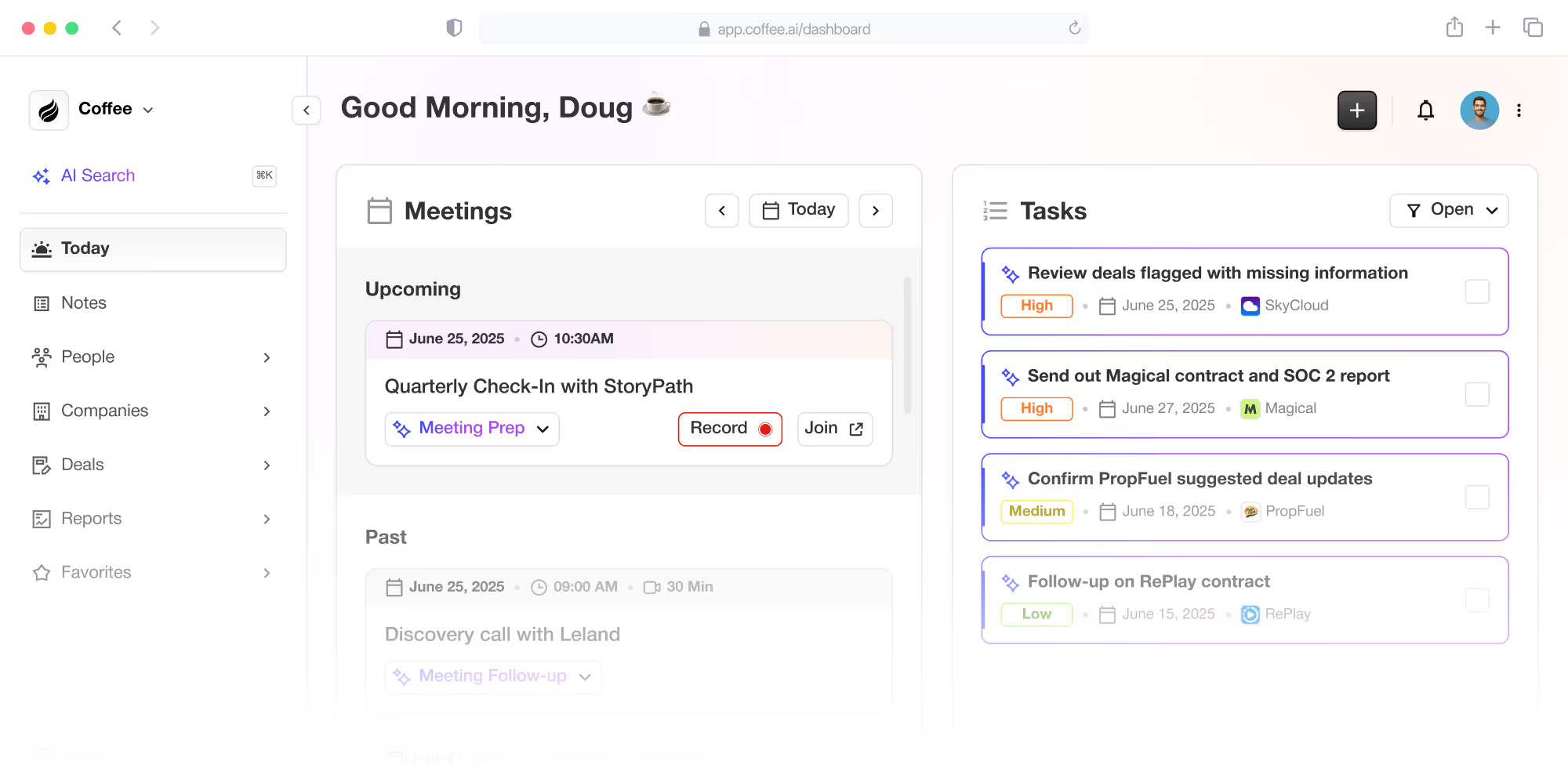
Coffee serves as an AI-driven companion app that integrates directly with your Salesforce environment. Instead of replacing your current system, it adds a layer of automation and intelligence, focusing on data capture and organization. By connecting with tools like email and calendars, Coffee pulls in customer information automatically, cutting down on manual entry and saving reps hours each week.
One of Coffee’s key strengths is processing both structured data, like contact details, and unstructured content, such as meeting transcripts. Its AI extracts relevant insights and organizes them within Salesforce, ensuring a more complete customer view. This app enhances your existing investment by maintaining Salesforce as the core system while adding efficiency through automation and actionable insights.
Getting Started with Coffee: What You Need
To use Coffee with Salesforce, start with an active Salesforce account, as Coffee builds on this foundation. You’ll also need a Coffee account or trial to access its AI features. Connecting Google Workspace or Microsoft 365 is necessary for automatic data capture from emails and calendars, ensuring comprehensive records in Salesforce. Ready to explore the benefits? Request access to Coffee and see how it can streamline your data management.
Practical Steps to Optimize Salesforce Data with Coffee
Step 1: Connect Coffee Securely to Salesforce
Begin by linking Coffee to your Salesforce account through a secure setup process. In Coffee’s integration settings, choose Salesforce as your CRM and authenticate using OAuth for a protected connection. This ensures data safety with compliance to standards like SOC 2, Type 2, and GDPR.
Once connected, Coffee enables two-way data flow, reading existing records for context and allowing you to sync back enriched insights. It aligns with your Salesforce structure, maintaining consistency with current workflows and preparing to automate repetitive tasks.
Step 2: Automate Data Capture from Emails and Calendars
Coffee pulls customer data automatically from Google Workspace or Microsoft 365, updating Salesforce without manual input. It scans emails to create or update contacts and logs interactions, while calendar events are recorded as activities tied to relevant records.
To keep data relevant, adjust Coffee’s settings to filter out internal communications, focusing only on customer-related information. This helps maintain clean, actionable records in Salesforce, free from unnecessary clutter.
Step 3: Use AI to Manage Call and Meeting Data
Coffee’s AI joins virtual meetings on platforms like Google Meet, Microsoft Teams, or Zoom, recording and transcribing discussions. It then creates summaries, identifies action items, and drafts follow-up emails based on the content, aligning with sales frameworks like BANT or MEDDIC.
Reps can review and send these follow-ups quickly after meetings, keeping momentum in deal progression. Using these AI tools right away ensures insights turn into actions without delay, enhancing customer engagement.
Step 4: Enrich Data Automatically with Real-Time Updates
Coffee enhances customer records with details like job titles, company size, and industry trends from reliable data sources. This added context helps reps tailor conversations and strategies, while automatic updates keep information current as roles or businesses change.
This process integrates directly into Salesforce, reducing the need for separate enrichment tools and keeping data management straightforward within your existing system.
Step 5: Sync Valuable Insights Back to Salesforce
Choose which AI-enriched data to write back to Salesforce, ensuring it aligns with your workflows and field mappings. Coffee offers control over this sync, respecting validation rules and flagging conflicts for review to maintain data accuracy.
Monitor this process regularly to prioritize the most useful insights for your team, optimizing how enriched data supports Salesforce reports and dashboards for better decision-making.
Evaluating the Benefits of AI-Enhanced Salesforce Data
Key Metrics to Track Progress
Measure the time saved by reps with Coffee’s automation, often reclaiming 8-12 hours weekly for customer-facing tasks. Track data completeness in Salesforce records, as enriched profiles provide more actionable information. Higher adoption rates among reps and improved activity logging also signal success, offering managers clearer insights into engagement patterns.
Tangible Business Results
Better data quality from Coffee can lead to more accurate pipeline forecasts, improving revenue planning. Reps focusing on sales rather than admin tasks may shorten sales cycles, while enriched customer insights support stronger conversations. Over time, these improvements can help scale revenue efforts while maintaining solid client relationships. See the impact for yourself—request access to Coffee today.
Advanced Tools for Sales Efficiency with Coffee
Pipeline Compare for Insightful Reviews
Coffee’s Pipeline Compare feature simplifies Salesforce reviews by showing week-over-week changes in deal status. It highlights new opportunities, progress, and stalled deals, helping managers spot trends and intervene early. This tool uses historical data for detailed analysis, making pipeline meetings more focused and strategic.
List Builder for Precise Prospecting
With Coffee’s List Builder, reps can use natural language to create targeted prospect lists in Salesforce, such as finding specific job titles in certain industries. This feature pulls from enriched data, ensuring lists are current and relevant, leading to more effective outreach compared to broad campaigns.
How Coffee Stacks Up Against Traditional Methods
|
Feature |
Coffee with Salesforce |
Manual Salesforce Entry |
Traditional CRM Add-ons |
|
Data Ingestion |
Automatic from emails, calls, calendars |
Manual after each interaction |
Partial automation, multiple tools needed |
|
Data Enrichment |
AI-driven updates |
Manual research required |
Separate paid tools often needed |
|
Meeting Management |
AI summaries, follow-up drafts |
Manual notes and emails |
Basic features, limited automation |
|
Pipeline Analysis |
Instant comparison reports |
Manual exports and setup |
Costly additional features |
Common Questions About Coffee and Salesforce
How Does Coffee Work with Salesforce?
Coffee connects to Salesforce through a secure OAuth process, enabling two-way data flow. It reads existing records for context and writes back AI-generated insights, aligning with your current field mappings and workflows for a smooth integration.
Does Coffee Replace My Salesforce System?
No, Coffee enhances your existing Salesforce setup. It acts as a supportive layer, automating data tasks and adding AI insights while keeping Salesforce as your primary record system, improving efficiency without disruption.
Is My Data Safe with Coffee?
Yes, Coffee adheres to strict security standards, including SOC 2, Type 2, and GDPR compliance. It uses enterprise-level protocols to protect data during integration with Salesforce, ensuring confidentiality throughout the process.
How Does Coffee Manage Unstructured Data?
Coffee’s AI analyzes unstructured content like emails and call transcripts, extracting key details and organizing them into Salesforce records. This provides a detailed history of customer interactions, accessible within your CRM.
What Returns Can I Expect from Coffee?
Time savings for reps can be significant, often freeing up several hours weekly from manual tasks. Improved data accuracy supports better forecasting, and consolidating tools into Coffee may reduce overall technology costs for your team.
Final Thoughts: Boost Salesforce Efficiency with Coffee
Managing data in Salesforce doesn’t have to be a struggle with scattered information and time-consuming tasks. Coffee, as part of the broader trend of AI-driven CRM solutions, offers a practical way to automate data handling, enrich insights, and free up reps for meaningful customer work. This approach not only addresses current pain points but also sets a foundation for scalable sales growth. Ready to simplify your Salesforce data management? Request access to Coffee and experience the benefits of AI integration.