
Sales teams today face a complex market landscape shaped by evolving customer expectations, rapid technological advancements, and increasing pressure to deliver results. The traditional tools meant to support these teams often fall short, rooted in designs from decades past that prioritize data storage over actionable support. Sales representatives spend countless hours on repetitive tasks like data entry and manual reporting, time that could be used to build relationships and close deals. This gap between potential and reality has driven interest in innovative solutions that rethink customer relationship management for the modern era.
AI-powered CRM platforms are at the forefront of this shift, automating routine tasks and providing insights that help sales professionals focus on what they do best: selling. Among these, Coffee stands out as a notable example of how technology can address persistent pain points while aligning with broader industry trends toward efficiency and data-driven decision-making. In this article, we’ll dive into the challenges of legacy systems, explore how AI CRM tools tackle these issues, and highlight specific benefits through platforms like Coffee.
Why Legacy CRMs Slow Down Your Sales Team with Admin Tasks and Poor Data
The Real Impact of Manual Data Entry
Manual data entry eats up valuable time for sales reps, who often spend hours logging calls, updating contacts, or noting interactions. This repetitive work not only cuts into selling time but also leads to incomplete or outdated records when rushed, directly impacting the effectiveness of future customer engagements.
This issue ripples across teams. Incomplete data in CRM systems reduces their value, causing sales reps to see the tool as a chore rather than an asset. As adoption drops, data quality worsens, creating a cycle that undermines the system’s purpose and overall team performance.
Yet, much of this effort is avoidable. Emails, meetings, and calls already contain the necessary data to keep records current. Modern technology can capture and organize this information automatically, a feature some older CRMs lack, leaving reps to handle tasks that could be streamlined.
Reporting Challenges Limit Pipeline Visibility
Traditional CRM systems often fail to meet the needs of today’s sales teams when it comes to pipeline management. Sales reps and managers need up-to-date visibility into deal progress to make informed choices. Instead, many rely on static reports that show past data without reflecting current trends or real-time changes.
Creating useful reports in these systems can demand manual effort and time-intensive analysis. This delays key activities like pipeline reviews and hinders accurate forecasting, as managers struggle to track deal movements. Customer interaction data from calls or emails often remains unstructured, further limiting the system’s ability to provide actionable insights.
Why Sales Teams Dodge Their CRM
Between manual data entry and clunky reporting, many sales teams avoid using their CRM altogether. This isn’t due to a dislike of technology but rather a reaction to tools that add workload instead of reducing it.
Reps often turn to alternatives like spreadsheets or apps such as Notion, creating separate systems where critical information lives. This scatters data across platforms, making collaboration and pipeline tracking nearly impossible. Organizations lose the chance to spot trends or improve processes because data isn’t centralized, perpetuating inefficiencies that hinder competitiveness.
Ready to free your sales team from administrative burdens? Request access to explore Coffee’s solution now.
How AI CRM Tools Improve Sales Productivity
AI-driven CRM platforms mark a significant change, moving from passive data storage to active sales support. Unlike older systems that depend on constant user input, these tools use automation to handle routine tasks, allowing sales teams to prioritize customer engagement and deal closure.
By pulling and organizing customer data from emails, calls, and calendars, AI CRMs address the core causes of productivity loss. They deliver real-time insights that enable quicker, better decisions, shifting focus from admin work to building relationships and driving revenue. This trend is reshaping how sales teams operate, with platforms like Coffee leading as practical examples of what’s possible.
Coffee: An AI-Driven CRM Focused on Sales Efficiency
Coffee represents a fresh approach to CRM, built with AI as its foundation. It operates on the idea that accurate data is essential for effective automation and insights, avoiding the pitfalls of incomplete records common in traditional systems.
Designed for today’s fast-paced sales environment, Coffee actively processes and enriches data to offer useful recommendations and automated workflows. It reduces manual tasks through two distinct offerings:
- A standalone AI-driven CRM for small to mid-sized businesses seeking a modern alternative to outdated systems or moving beyond basic solutions.
- A companion app that layers AI capabilities onto existing CRMs like Salesforce or HubSpot, enhancing functionality without requiring a full switch.
Coffee reshapes sales processes by cutting inefficiencies and boosting team output, creating a tool that reps actually want to use because it simplifies their work and supports their success.
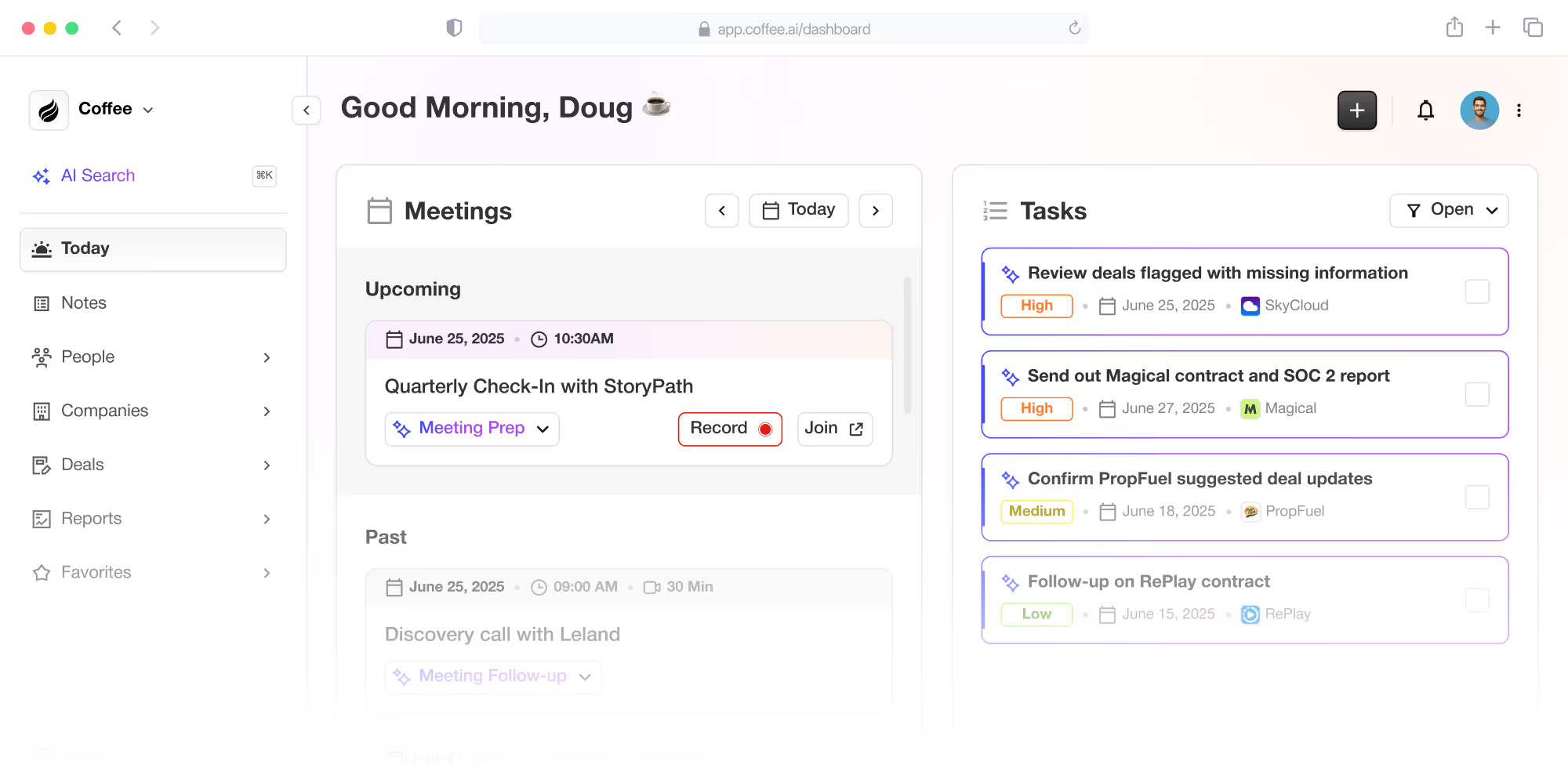
Key Ways Coffee’s AI CRM Enhances Sales Efficiency
Cut Manual Work to Focus on Selling
Coffee uses AI to eliminate manual data entry by scanning emails and calendar events to update contact details, company information, and activity histories. This keeps customer data accurate and current without any effort from the sales team, allowing more time for actual selling.
The platform automatically tracks recent and upcoming activities by syncing with email and calendar tools, ensuring deal updates happen in real time. Users report saving 8 to 12 hours weekly on data entry, redirecting that time to nurturing leads and advancing deals.
This automation also enhances data reliability. AI captures information consistently, providing a solid base for analyzing sales trends and making strategic decisions without the errors tied to manual input.
Gain Real-Time Insights for Better Decisions
With its Pipeline Compare feature, Coffee offers a clear view of week-over-week pipeline shifts. This tool helps teams spot changes in the sales funnel quickly, supporting effective reviews and precise forecasting without extra admin work.
An AI Meeting Bot further aids productivity by recording, transcribing, and summarizing customer calls. It identifies next steps and key points, ensuring no detail is missed. This gives managers visibility into deal status and equips reps with context for follow-ups, directly supporting smarter sales strategies.
Simplify Prospecting with Targeted Lists
Coffee’s List Builder streamlines prospecting by letting users build detailed lists through simple language requests, like identifying sales VPs at specific company sizes or funding levels. The system delivers enriched, ready-to-use lists for outreach.
This removes the hassle of complex searches, allowing reps to focus on defining their ideal targets. Built-in data accuracy ensures the lists support personalized communication, offering clear time savings over older, manual list-building methods.
Comparing Coffee to Traditional CRMs and Point Solutions
| Feature | Legacy CRMs | Multiple Point Solutions | Coffee (AI CRM) |
|---|---|---|---|
| Data Entry | Heavy manual input, prone to errors | Scattered across tools, inconsistent | Automated, AI-updated, real-time |
| Reporting | Static, outdated, often manual | Fragmented, needs integration | Real-time, pipeline trend insights |
| Tech Stack | Needs expensive extras | Complicated setups, costly | Unified, all-in-one system |
| User Experience | Feels like a burden, low usage | Switching between tools disrupts flow | Simple, supportive, widely used |
Want to see how Coffee can lift your team’s productivity? Request access to learn more.
Common Questions About AI CRM and Sales Productivity
How Does AI CRM Differ from Traditional Systems?
AI CRMs like Coffee focus on automating repetitive tasks and offering actionable insights through intelligent technology. Traditional CRMs often act as mere data repositories, requiring heavy manual input and providing limited, static reports, which discourages consistent use. Coffee prioritizes reducing workload to improve sales outcomes.
How Can AI CRM Free Up Time for Selling?
By handling tasks like updating contacts from emails or logging activities, Coffee cuts down on admin work. It also creates meeting summaries and draft follow-ups, saving reps 8 to 12 hours weekly that can be spent engaging clients and closing deals.
Does AI CRM Improve Data Accuracy for Reporting?
Yes, platforms like Coffee pull and organize data directly from communication tools, minimizing human error in record-keeping. Features like Pipeline Compare show historical and current pipeline data, enabling reliable forecasting and informed planning.
Is AI CRM Only for Large Sales Teams?
No, Coffee serves a range of businesses. Its standalone CRM suits smaller or growing companies moving beyond basic tools, while the companion app adds AI benefits to existing systems for larger teams, avoiding the need for a full replacement.
How Soon Can Teams Notice Productivity Gains with AI CRM?
Improvements often appear within days of using Coffee, starting with automated data entry. Deeper benefits, such as enhanced pipeline insights and meeting analysis, typically emerge within weeks as the system gathers and processes more information.
Conclusion: Elevate Your Sales Team with Coffee
Administrative overload and poor CRM usage remain significant hurdles for sales success, often tied to outdated systems unfit for current demands. Coffee counters these issues with AI-driven automation, instant pipeline visibility, and a design that prioritizes user needs, allowing teams to focus on selling. Its approach improves data accuracy and forecasting, positioning it as a strong option within the growing wave of AI CRM solutions.
Ready to enhance your sales performance with less admin work? Request access to Coffee and see how AI can reshape your sales process.