Written by: Doug Camplejohn, CEO & Co-Founder, Coffee | Last updated: June 17, 2026
Key Takeaways for Choosing an AI Sales Agent
- 71% of sales reps spend too much time on manual CRM data entry, which creates dirty pipeline data and cuts into selling time.
- Six AI sales agent tools are compared on automation depth, integration quality, and manual workarounds: Salesforce Agentforce, HubSpot Breeze, Clay, Gong, Zapier/Make, and Coffee.
- Coffee is the only tool that works as both a standalone CRM and a companion layer for Salesforce or HubSpot, with autonomous data entry from emails, calendars, and calls.
- Teams save 8–12 hours per week when CRM write-back covers contacts, enrichment, activities, transcripts, and summaries without manual work.
- Eliminate manual CRM data entry with Coffee and keep data clean for reliable insights.
What Counts as an Autonomous CRM Data Entry Agent in 2026
Not every product marketed as an “AI sales agent” actually automates CRM data entry. Generic AI SDR platforms generate outreach sequences. Basic Zapier workflows move data between fields on a trigger. These tools do not qualify as autonomous data-entry agents.
The tools in this comparison are evaluated on five criteria that separate true agents from partial automation: data-entry automation depth across email, calendar, call transcripts, and enrichment; native versus companion integration architecture; demonstrated time savings in the 8–12 hour per week range; Salesforce and HubSpot write-back fidelity; and fit for teams of 15–40 people. These criteria focus on end-to-end automation, because only broad coverage removes the data-entry burden instead of just reducing it.
Sales reps save 30–60 minutes daily on note-taking and data entry through AI-generated meeting and call summaries that sync directly to CRM records, and automated data entry via AI can save around 5 hours per week per rep on administrative tasks. This 8–12 hour threshold marks the difference between partial automation and comprehensive autonomous data entry. Tools that do not reach this level through autonomous write-back are treated as partial solutions in this guide.
Head-to-Head Comparison of Leading AI Sales Agents
Salesforce Agentforce executes autonomous tasks inside Salesforce and represents the 2026 shift from AI that suggests to AI that acts. It handles lead qualification and follow-up outreach natively. It requires an existing, well-maintained Salesforce org. It does not function as a standalone CRM and offers no companion layer for HubSpot.
HubSpot Breeze operates only within HubSpot. It automates contact enrichment and activity logging for HubSpot users. It cannot write back to Salesforce. Teams already on HubSpot benefit from its embedded position. Teams on Salesforce or without a CRM do not gain value.
Clay is a data enrichment and outbound workflow builder. It excels at building prospect lists and enriching records through waterfall enrichment. It does not log call transcripts, create CRM activities autonomously, or manage post-meeting follow-up. It serves as a prospecting tool rather than a data-entry agent.
Gong captures call and email intelligence and surfaces revenue insights. It writes call summaries to Salesforce and HubSpot. It still requires a separate CRM as the system of record. It does not auto-create contacts, enrich company records, or manage calendar-based activity logging outside call events.
Zapier/Make automates data movement between tools through trigger-action workflows. Surface-level integrations that only log call occurrence fail to read existing data or write structured updates during conversations. Zapier needs a human to design and maintain each workflow. It does not process unstructured data such as email text or call transcripts natively.
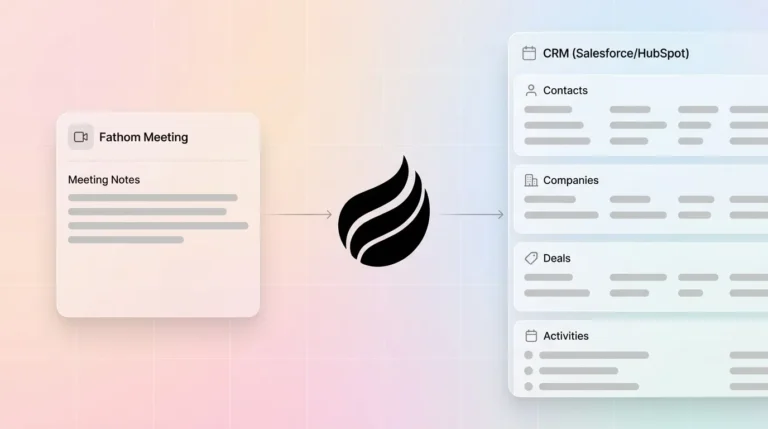
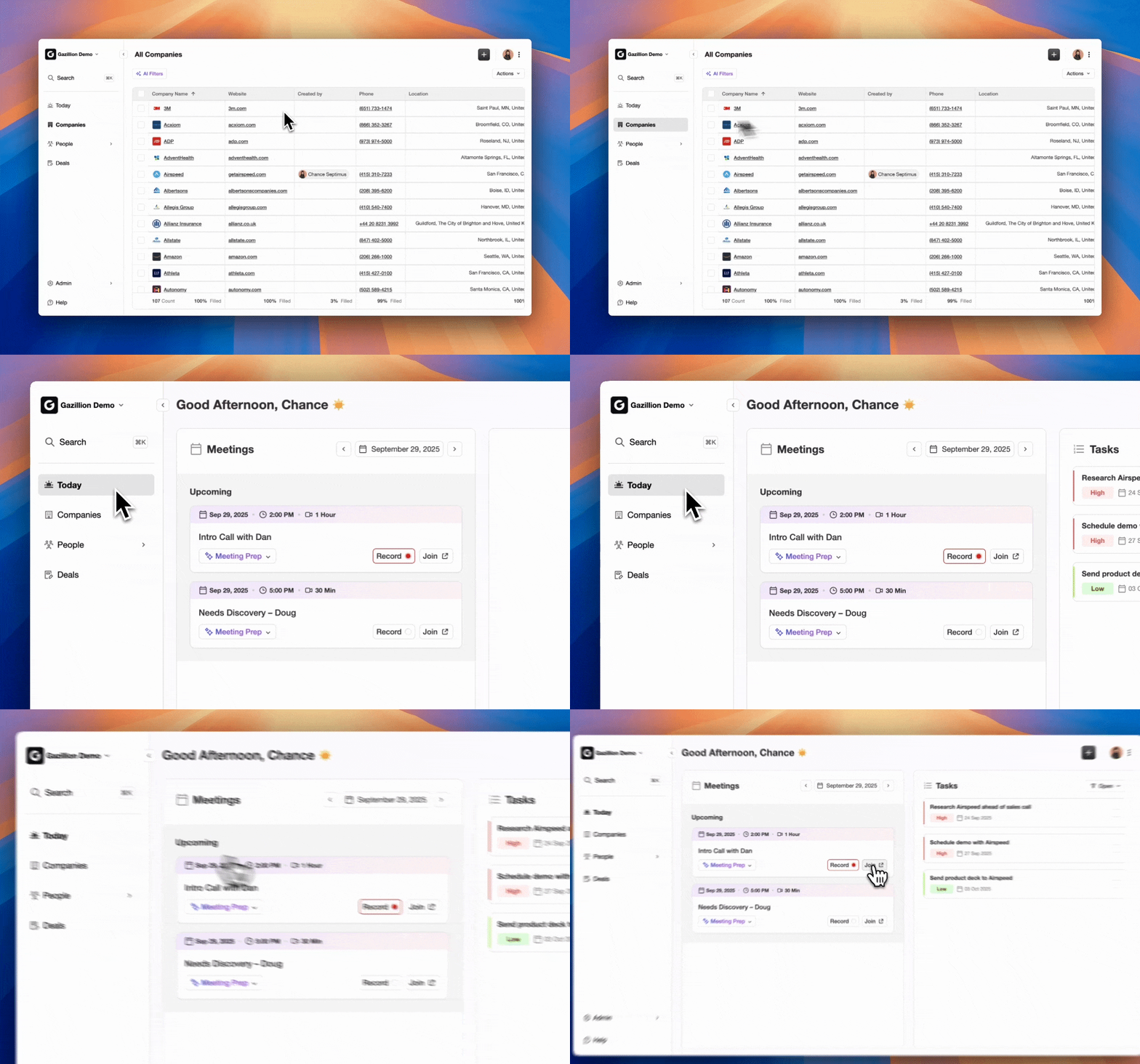
Coffee auto-creates contacts and companies from email and calendar connections, enriches records with job titles, funding data, and LinkedIn profiles, logs last and next activity autonomously, joins calls to record and transcribe, and writes structured summaries back to Coffee, HubSpot, or Salesforce. Coffee released improved summary templates in November 2025, customizable to match workflows and writable back to Coffee, HubSpot, or Salesforce, and launched Custom Meeting Briefings and Summaries in February 2026 enabling exact formats from high-level executive summaries to granular technical breakdowns.
| Tool | Standalone CRM | Companion Layer | CRM Write-Back Depth |
|---|---|---|---|
| Salesforce Agentforce | No | Salesforce only | High (Salesforce only) |
| HubSpot Breeze | No | HubSpot only | High (HubSpot only) |
| Clay | No | Partial (enrichment only) | Low (no transcript or activity logging) |
| Gong | No | Yes (call data only) | Medium (calls and emails, no contact creation) |
| Zapier/Make | No | Yes (trigger-based) | Low (structured fields only, no unstructured data) |
| Coffee | Yes | Yes (Salesforce + HubSpot) | High (contacts, enrichment, activities, transcripts, summaries) |
Start eliminating manual CRM data entry with Coffee today.
How These Tools Compare on Setup, Data, Adoption, and Cost
Setup complexity. Agentforce and Breeze need existing, well-configured CRM instances before autonomous features activate. Clay and Gong depend on additional CRM connections. Coffee connects through Google Workspace or Microsoft 365 authentication and starts populating records immediately, even when no CRM exists yet.
Data quality outcomes. Most AI CRM disappointments in 2026 stem from data quality issues, change management failures, and unclear goals rather than flaws in the algorithms themselves. 76% of CRM users say less than half of their organization's CRM data is accurate and complete. Tools that rely on reps to trigger logging inherit this problem. Coffee's agent captures data at the source through email, calendar, and calls before human neglect can degrade it.
User adoption impact. 55% of CRM implementations fail to meet objectives per the Johnny Grow 2025 report, with poor user adoption as the primary cause. Removing the entry burden directly addresses this adoption failure mode and increases the odds that reps trust and use the CRM.
Cost versus fragmented point solutions. A typical mid-market stack that combines a CRM, Gong, ZoomInfo, and a workflow tool carries high per-seat cost. Coffee consolidates enrichment, call recording, activity logging, and pipeline intelligence into a single seat-based price with no metering on agent usage.
Best-Fit Use Cases by Team Size and CRM Environment
Teams of 1–20 employees without an established CRM gain the most from Coffee's standalone model. The agent becomes the full system of record and removes the need to configure Salesforce or HubSpot before seeing value. Teams of 15–40 people already committed to Salesforce or HubSpot deploy Coffee as a companion layer. The agent writes enriched contacts, activity logs, and call summaries into the existing instance without replacing the system of record.

New CRM stacks with clean schemas work well for Agentforce or Breeze when the team is locked into a single platform. Established stacks with dirty data benefit more from Coffee's companion model, which enforces data quality at ingestion instead of relying on retroactive cleanup. Teams that need full call-to-CRUD automation, from transcript capture through structured field updates, require Coffee or a Gong-plus-CRM combination, with Coffee delivering this coverage in a single product.
Explore Coffee's standalone and companion deployment options.
Operational Guardrails: Where Human Review Still Matters
BCG's January 2026 analysis warns that hallucination and misinterpretation can produce plausible but incorrect outputs that affect CRM data logging and enrichment quality. Every tool in this comparison still needs human input for initial configuration of custom fields, sales stage definitions, and required-field mapping. AI phone agents require deep two-way CRM integration with custom field mapping, multi-object support, and real-time sync. This setup cost is a one-time investment that unlocks ongoing automation.
Post-call summaries across all platforms benefit from a brief human review before sending to prospects, especially for complex technical discussions. Speech recognition limitations including poor accent handling and industry terminology recognition can cause incomplete data capture. Teams should treat human review as a quality layer that protects data integrity rather than as a replacement for automation.

Risks and Misconceptions About AI Sales Agents
The most common misconception is that any tool with “AI” in its marketing copy automates CRM data entry. Clay automates prospecting list creation, not activity logging. Zapier automates field-to-field data movement, not unstructured data processing. Every AI sales application depends on CRM data quality; forecasting models built on poorly maintained pipeline data produce unreliable forecasts. Tools that add AI on top of a manual entry process do not solve the core problem.
Decision Framework for Selecting the Right Agent
The decision process starts with your primary CRM. If the team is 100% on Salesforce, the org is well-configured, and the need focuses on Salesforce-native task automation, Agentforce fits that environment. The same logic applies to Breeze for HubSpot-only teams that want native automation inside HubSpot.
Teams that prioritize call intelligence and revenue forecasting, while relying on a separate CRM for contact and activity management, align better with Gong. Teams where outbound prospecting list-building is the main bottleneck and CRM data entry is handled elsewhere can use Clay. Teams that only need simple field-to-field data movement between tools, with no unstructured data involved, can rely on Zapier or Make.
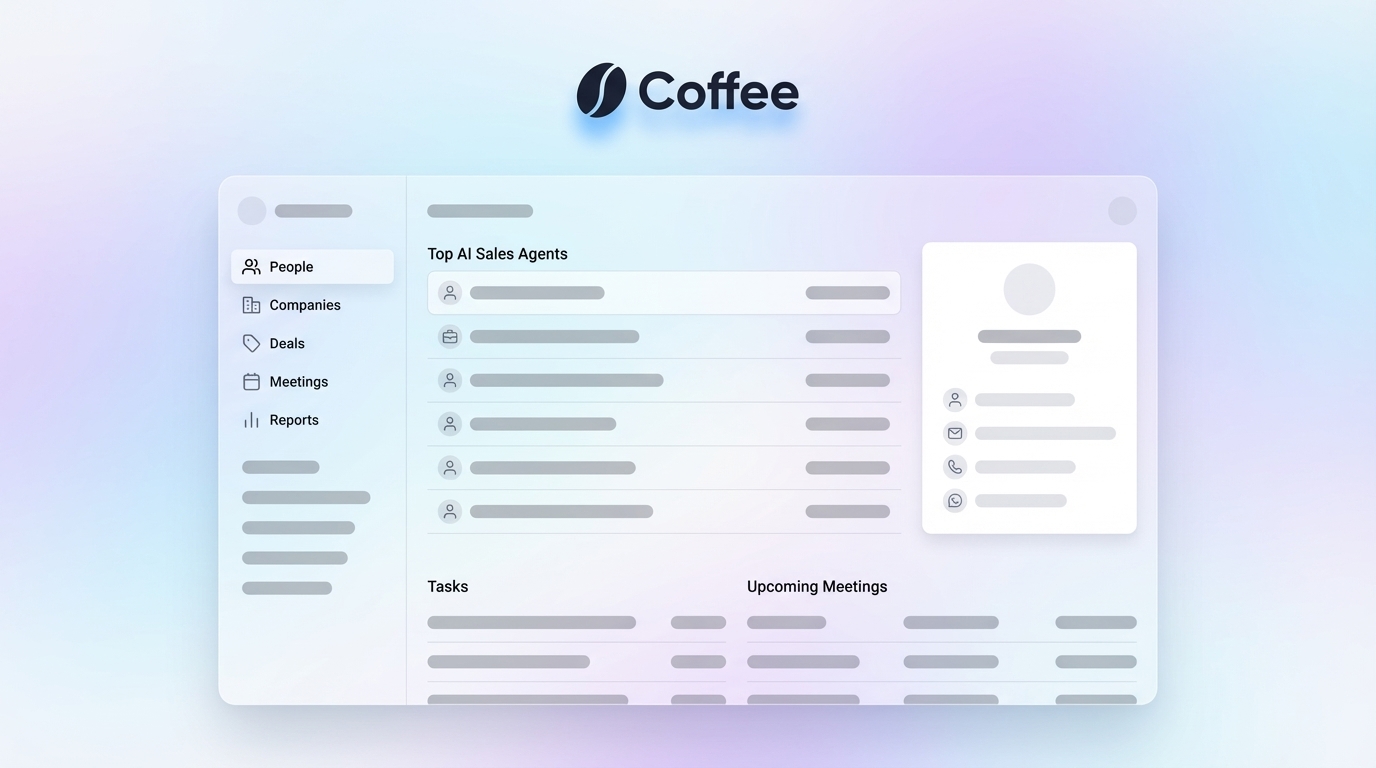
Teams that require autonomous end-to-end data entry across contacts, enrichment, activities, call transcripts, and summaries should select Coffee. Coffee supports both deployment models, as a system of record or as a companion layer on Salesforce or HubSpot, and processes structured and unstructured data into a single coherent CRM record.
Frequently Asked Questions
What is the best AI sales agent for Salesforce data entry?
The best AI sales agent for Salesforce data entry in 2026 depends on whether the team needs a native Salesforce tool or a companion layer. Salesforce Agentforce operates natively within Salesforce and handles task automation and follow-up outreach, but it requires a well-maintained org and does not process unstructured data like email threads or call transcripts into structured fields autonomously. Coffee's companion model connects to an existing Salesforce instance through simple authentication and writes enriched contacts, activity logs, call summaries, and next steps directly into Salesforce records without requiring reps to log anything manually. For teams where dirty data and low rep adoption are the core problems, Coffee's companion approach addresses the root cause instead of adding another layer on top of an already fragmented stack.
How does a HubSpot AI agent improve CRM hygiene?
HubSpot Breeze automates contact enrichment and activity logging within HubSpot natively, which improves hygiene for teams already on HubSpot with clean schemas. The limitation is that Breeze cannot process data from outside the HubSpot ecosystem or serve teams on Salesforce. Coffee's companion model improves HubSpot CRM hygiene by capturing data at the source through emails, calendar events, and call transcripts, then writing structured records back to HubSpot before human neglect can introduce gaps. Coffee also enforces consistent note formats using frameworks like BANT, MEDDIC, or SPICED, which standardizes qualification data across the team and makes pipeline reviews more reliable. HubSpot then functions as a system of accurate record rather than a system of aspirational record.
How does an AI agent compare to Zapier for CRM automation?
Zapier automates structured data movement between tools using trigger-action workflows. It moves a value from one field to another when a defined event occurs. It cannot read an email thread, extract a contact's job title, process a call transcript, or write a structured summary to a CRM record. An autonomous AI sales agent like Coffee processes unstructured data, including the content of emails, meetings, and calls, and converts it into structured CRM records without human configuration of individual triggers. Zapier requires a human to design and maintain each workflow and breaks when the upstream tool changes its data structure. Coffee's agent operates continuously on live data streams and handles edge cases that no Zapier workflow can anticipate. For teams whose CRM data problems stem from unstructured data going unlogged, Zapier does not replace an autonomous agent.
What is the best AI sales agent for mid-market CRM teams?
Mid-market teams of 15–40 people using Salesforce or HubSpot need an agent that delivers deep write-back without displacing the existing system of record or forcing a full CRM migration. Coffee's companion model is built for this scenario. It connects to Salesforce or HubSpot, auto-creates and enriches contacts, logs all email and calendar activity, joins calls to capture transcripts, and writes structured summaries back to the CRM. This approach saves reps 8–12 hours per week on administrative tasks. Unlike Gong, which covers call intelligence but not contact creation or calendar-based activity logging, Coffee handles the full data-entry surface area in a single product. Unlike Agentforce or Breeze, Coffee works across both platforms, which matters for mid-market teams that have mixed CRM environments or are considering a platform switch.
Conclusion: Pick an Agent That Truly Removes Data Entry
The 8–12 hours per week saved through autonomous data entry represents roughly half of the time sales reps currently spend on non-selling activities. That reduction turns directly into more time in front of prospects. The tools that achieve this capture data at the source and write structured records autonomously, instead of adding new forms for reps to fill out or workflows that need constant human tuning.
Coffee is the only solution in this comparison that operates as both a standalone CRM for teams starting fresh and a companion agent for teams committed to Salesforce or HubSpot. Its agent processes structured and unstructured data, enforces consistent record formats, and delivers pipeline intelligence that becomes possible only when the underlying data is clean. Only 38% of B2B companies use AI features within their CRM systems, yet using AI features differs from eliminating the data-entry burden. Coffee removes that burden.