
In today’s fast-paced business environment, sales teams face mounting pressure to close deals, build relationships, and meet aggressive targets. Yet, many find themselves bogged down by the very tools designed to support them: customer relationship management (CRM) systems. Originally introduced to organize data and streamline processes, traditional CRMs often come with steep learning curves, time-consuming manual tasks, and fragmented integrations that hinder rather than help. As a result, sales reps spend less time selling and more time navigating complex software, leading to frustration and missed opportunities.
The CRM market, valued at over $50 billion globally in recent years, reflects a crowded landscape of solutions promising efficiency. Despite this, adoption rates remain a persistent challenge, with studies indicating that up to 40% of sales professionals underutilize their CRM due to usability issues. This gap between expectation and reality has created a ripple effect, impacting data accuracy, forecasting, and revenue growth. Meanwhile, the rise of digital transformation has shifted buyer behavior, with prospects expecting personalized, timely interactions—something traditional CRMs often struggle to deliver at scale.
Against this backdrop, a new wave of AI-driven CRM platforms is emerging, offering a fresh approach to an old problem. These tools aim to simplify workflows by automating mundane tasks, providing actionable insights, and integrating seamlessly with existing systems. This article dives into the limitations of conventional CRM interfaces, explores how AI is reshaping the sales technology landscape, and highlights solutions like Coffee as part of a broader trend toward intelligent, user-focused tools that prioritize productivity.
Why Traditional CRM Interfaces Often Fall Short for Sales Teams
Low Adoption Rates Slow Down Sales Momentum
Many sales reps view traditional CRMs as more of a burden than a benefit. Even with polished designs, these systems often fail to align with a rep’s daily workflow, requiring significant training and effort to use effectively. When the tool feels like a chore, reps may revert to familiar methods like spreadsheets or personal notes, leading to inconsistent usage across teams.
This lack of adoption creates broader issues for organizations. Incomplete or outdated data affects forecasting accuracy and team coordination, ultimately impacting revenue. A system meant to centralize customer information instead becomes a patchwork of missing or irrelevant records, undermining its purpose.
Manual Data Entry Eats Up Valuable Selling Time
One of the biggest pain points in legacy CRMs is the expectation of manual data entry. Sales reps are often tasked with logging contacts, updating deal stages, and recording interactions, all of which take time away from engaging with prospects. Sales reps spend only about 34% of their time actually selling, with much of the rest consumed by administrative work.
This reliance on manual input also introduces errors and delays. Inaccurate data can skew reports, while outdated information means reps might miss critical follow-up opportunities. Over time, this creates a negative perception of the CRM as a time sink rather than a helpful resource.
The constant need to update records manually adds another layer of frustration. Instead of focusing on building relationships, reps are stuck performing repetitive tasks, which can lower morale and reduce overall effectiveness in closing deals.
Fragmented Tools Create Workflow Inefficiency
Modern sales teams often juggle multiple tools for prospecting, outreach, meetings, and data management. While each may function well on its own, the lack of integration leads to a disjointed experience. Reps must switch between platforms to piece together customer information, wasting time and increasing the risk of missing key details.
Additionally, many CRMs overwhelm users with excessive features and data points that aren’t immediately relevant. This information overload can hinder decision-making, as reps struggle to filter out noise and focus on what matters for their next interaction.
How AI-Driven CRMs Address Sales Team Challenges
Automation That Fits Into Natural Workflows
AI-powered CRMs go beyond surface-level design to focus on usability through automation. Instead of forcing sales reps to adapt to the software, these tools work around existing habits, capturing data and delivering insights without extra effort. This approach reduces friction and makes the system feel like a supportive assistant rather than a mandatory task.
By automating routine activities like data entry and follow-up reminders, AI allows reps to prioritize relationship-building and deal-closing. Such platforms integrate with communication tools like email and calendars, ensuring that customer interactions are logged automatically in real time.
Proactive Insights for Smarter Selling
Unlike traditional systems that require manual searches for data, AI CRMs anticipate needs and provide relevant information at the right moment. For example, before a meeting, these tools can compile summaries of past interactions, attendee details, and company background, preparing reps without any additional work on their part.
This proactive assistance extends to deal management as well. AI can analyze patterns in communication and pipeline progress to suggest next steps, helping reps focus on high-priority tasks. By guiding rather than reacting, these tools enhance decision-making and efficiency.
Coffee as a Leading Example of AI CRM Innovation
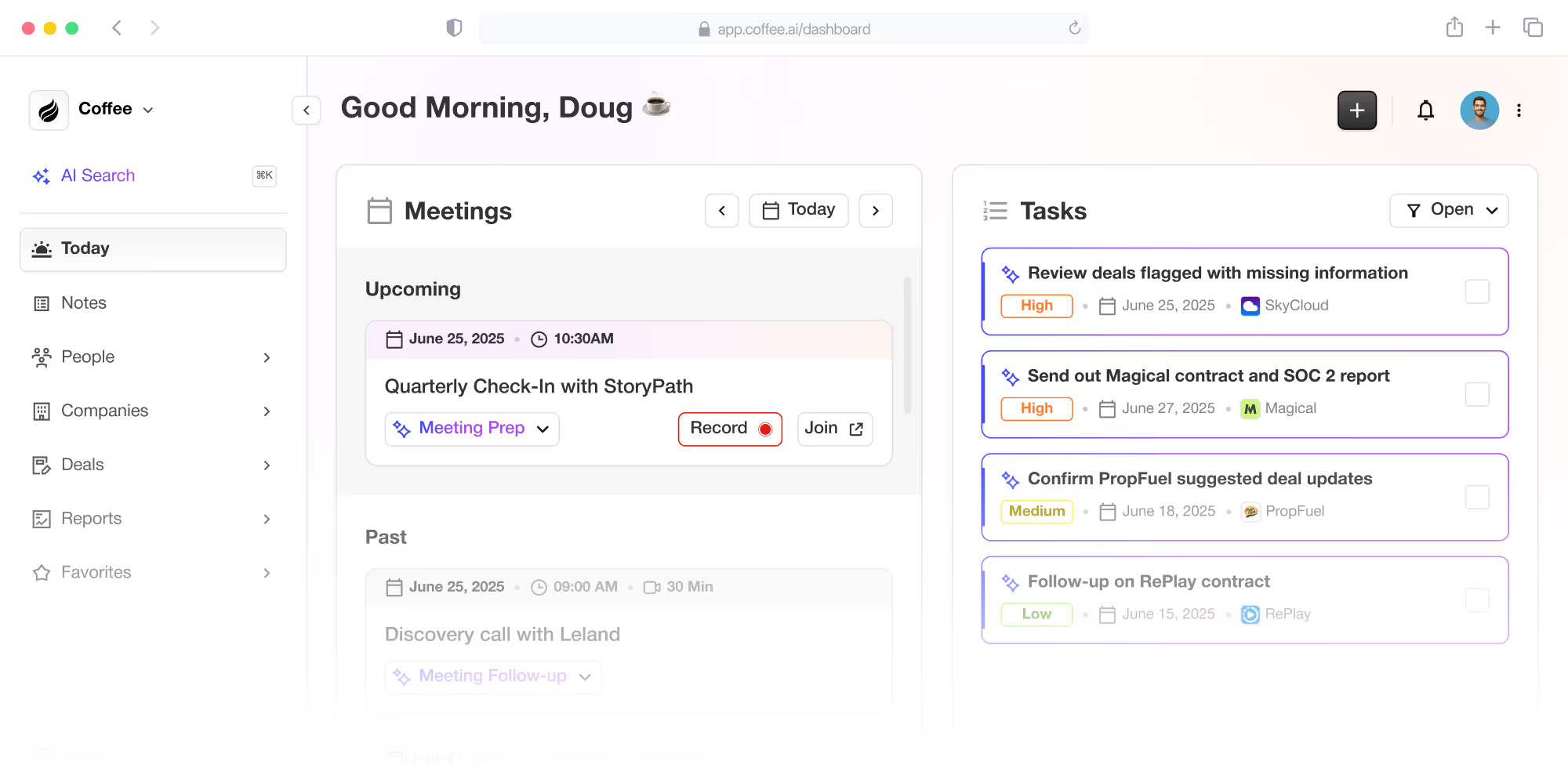
Among the growing field of AI-driven solutions, Coffee stands out by focusing on simplicity and productivity for sales teams. Built to integrate with daily workflows, Coffee automates data capture from emails and calendars, reducing manual input to almost zero. Its design ensures that reps spend less time managing the system and more time engaging with clients.
For organizations using established platforms like HubSpot or Salesforce, Coffee offers a companion app that adds a layer of intelligent automation. This means teams can enhance their current setup without the hassle of switching systems entirely, gaining immediate value from AI capabilities.
Coffee’s interface emphasizes clarity by presenting only the most relevant information for each task. Whether it’s a quick view of pipeline changes or a pre-meeting briefing, the platform cuts through clutter to deliver actionable insights, aligning with how sales reps naturally operate.
Interested in seeing how Coffee can improve your sales process? Request access to explore its features and integrations.
Key Benefits of Coffee for Sales Productivity
Save Time with Automatic Data Handling
Coffee pulls customer details directly from emails and calendar events, populating records without any manual input. It also enriches this data with details like job titles and company information, ensuring comprehensive profiles are always ready for use.
Streamline Meetings with AI Assistance
Before meetings, Coffee provides briefings with context about attendees and past interactions. During calls on platforms like Zoom or Microsoft Teams, its AI bot records and transcribes conversations. Afterward, it summarizes key points and drafts follow-up emails, cutting down on post-meeting admin work.
Gain Clear Pipeline Visibility
With a feature called Pipeline Compare, Coffee offers a week-over-week snapshot of deal progress, new opportunities, and stalled prospects. This simplifies pipeline reviews, letting managers and reps spot trends and act quickly without digging through complex reports.
Comparing AI Tools Like Coffee to Traditional CRMs
Automation vs. Manual Effort
Standard CRMs typically rely on users to input data and navigate features, while AI tools like Coffee handle these tasks automatically. This reduces errors and frees up time for selling, addressing a core frustration with older systems.
Insights vs. Information Overload
Where traditional platforms often drown users in data, AI CRMs filter and prioritize information. Coffee, for instance, delivers targeted recommendations and summaries, ensuring reps focus on what drives results rather than getting lost in menus and dashboards.
Integration vs. Fragmentation
Many legacy systems struggle to connect with other tools, creating workflow gaps. Coffee integrates with popular CRM platforms and communication apps, consolidating functions into a single hub that minimizes tool-switching.
| Feature | Traditional CRM | Coffee AI CRM |
|---|---|---|
| Data Entry | Requires manual updates | Automated from email/calendar |
| Meeting Support | Manual preparation needed | AI-generated briefings and summaries |
| Pipeline Review | Time-intensive reporting | One-click trend analysis |
Want to experience these differences for your team? Request access to Coffee and see how AI can simplify your sales workflow.
Boosting Returns with AI-Enhanced CRM Design
Encouraging Adoption with Immediate Value
A CRM is only as effective as its usage rate. Coffee focuses on delivering quick wins, like auto-populating contacts upon setup, so reps see benefits from day one. This builds a positive association, encouraging consistent engagement without heavy training or oversight.
Improving Data Accuracy Automatically
Manual data entry often leads to mistakes or gaps. Coffee captures information directly from communication channels, maintaining up-to-date, standardized records. This ensures reliable insights for forecasting and strategy, especially for teams using HubSpot or Salesforce.
Scaling Easily with Smart Features
As businesses grow, so does CRM complexity. Coffee uses AI to manage intricate tasks behind the scenes, keeping the user experience straightforward. Features like natural language search for prospects allow reps to find targeted leads without navigating complicated filters.
Common Questions About AI in CRM
Why Does Usability Matter So Much in CRM Tools?
Usability directly affects how often sales teams use a CRM. If the system is hard to navigate, reps may avoid it, leading to poor data and lower productivity. A tool like Coffee prioritizes ease of use, ensuring higher engagement and better outcomes, especially when layered over existing platforms.
How Does Coffee Improve Engagement Compared to Older Systems?
Coffee automates repetitive tasks and offers timely guidance, making the tool feel like a helper rather than a requirement. Reps engage more because each interaction with the system saves time and supports their goals directly.
Can Coffee Reduce Tool Overload for HubSpot or Salesforce Users?
Yes, Coffee combines multiple functions into one platform, cutting down on the need for separate apps. As a companion to HubSpot or Salesforce, it adds value through automation while maintaining a unified workflow for sales teams.
Conclusion: Embrace AI to Empower Your Sales Team
The limitations of traditional CRMs, from low adoption to manual workloads, no longer need to hold sales teams back. AI-driven platforms are paving the way for smarter, more intuitive tools that align with how reps work. Coffee exemplifies this shift, offering automation and insights that enhance productivity while integrating with systems already in place.
By adopting AI solutions, organizations can improve data quality, streamline processes, and ultimately drive better results. For sales teams ready to move beyond outdated interfaces, tools like Coffee represent a practical step forward in a wider trend of intelligent sales technology.
Curious about how AI can reshape your sales operations? Request access to Coffee today and discover a more efficient way to support your team.