
In today’s fast-paced sales environment, efficiency is critical, yet many teams struggle with administrative tasks that steal time from actual selling. Sales reps spend just 28% of their week on direct selling activities. The rest often goes to updating CRM records, entering data manually, and juggling disconnected tools. Salesforce, while a powerful platform, can contribute to this burden with its extensive data entry demands, leaving little room for building relationships or closing deals. This challenge reflects a broader trend in the industry, where technology, originally meant to simplify workflows, often adds complexity. As a result, sales professionals and organizations are seeking smarter solutions to reclaim their time. AI-powered tools like Coffee’s companion app are leading this shift, automating repetitive tasks and syncing data effectively to cut down on manual effort while maintaining accuracy. This guide offers practical steps to minimize data entry in Salesforce using AI, helping your team focus on what truly matters, selling.
Why Excessive Data Entry in Salesforce Hurts Sales Productivity
Data entry overload in Salesforce creates a real barrier to sales success. About 71% of sales reps say they spend too much time on these tasks, cutting into hours that could be used for engaging prospects or finalizing deals.
Several issues arise from this high data entry workload. First, the time investment is substantial. Reps often dedicate hours each day to updating contacts, logging interactions, and tracking deal progress, leaving less time for customer-facing activities.
Second, manual entry frequently results in inconsistent or incomplete data. Rushed updates or forgotten details lead to gaps in records, reducing the reliability of the CRM and making it harder for teams to trust the system.
Third, today’s sales tools are often fragmented. Reps switch between platforms for outreach, data enrichment, and meeting logs, each requiring separate inputs. This multiplies the workload and raises the chance of errors.
The broader impact hits organizational performance. Inaccurate or incomplete data costs companies an average of $15 million yearly through lost opportunities and flawed forecasting. When reps avoid using Salesforce due to its demands, managers lose insight into pipelines, hindering strategic decisions.
Finally, this burden often leads to “shadow CRMs.” Reps store critical info in personal spreadsheets or notes, fragmenting data and undermining the purpose of a centralized system. If you’re looking to address these challenges, tools like Coffee’s AI app can automate much of this process. Request access to see how it can help your team.
Key Steps to Prepare for AI Automation in Salesforce
Before adopting AI to cut down on data entry in Salesforce, setting up the right foundation is essential for a smooth rollout. A clear technical and organizational base ensures the tool delivers its full value.
Start with the technical needs. You’ll require an active Salesforce account with permissions for integration. Access to Google Workspace or Microsoft 365 is also necessary, as these platforms feed data like emails and calendars into AI automation.
On the process side, map out your current sales workflows. Identify which data entry tasks take the most time and pinpoint bottlenecks. Teams with documented processes tend to adopt automation more quickly.
Organizational buy-in matters. Leadership support helps reps see AI as a helper, not a burden. Managers should be ready to adjust workflows and reporting to capitalize on better data from automation.
Data quality is another factor. While AI will improve future records, existing inconsistencies in Salesforce might need addressing during setup. A full cleanup isn’t required upfront, but some attention helps.
Security and compliance can’t be overlooked. Confirm that any AI tool meets your standards, such as SOC 2 or GDPR, especially if you’re in a regulated industry. Understand how customer data is managed.
Set realistic timelines for implementation. AI reduces data entry, but initial setup and training take time. Plan a gradual rollout to allow for adjustments rather than expecting instant results.
Lastly, define success metrics. Track time saved per rep, data completeness, CRM usage rates, or forecast accuracy. Having baselines lets you measure the impact of automation clearly.
How to Automate Salesforce Data Entry with Coffee’s AI App: A Step-by-Step Guide
Cutting data entry in Salesforce with AI requires a structured approach. Coffee’s AI companion app offers a practical solution, working directly with your existing setup to lighten the administrative load.
Step 1: Connect Coffee to Salesforce Easily
Getting started with Coffee involves a simple connection to your Salesforce environment. The process is designed for quick setup.
From Coffee’s dashboard, select Salesforce as your CRM and authorize access through a secure login. This links the platforms, allowing data to flow between them.
After connection, Coffee syncs with your Salesforce structure. It pulls in existing data and lets you decide which automated updates or insights to push back, aligning with your specific setup.
You’ll likely notice early automation opportunities right after integration. Most teams see data starting to populate automatically within a short time.
A tip: Set this up during a regular business period, not during peak sales cycles. This helps the AI learn typical patterns for more accurate automation.
Step 2: Automate Contact and Company Updates
Once connected, Coffee’s AI takes over contact and company management. Link your Google Workspace or Microsoft 365 account, and it scans emails and calendars to detect new prospects or relationships.
The system creates contacts and companies automatically as you work. Each email or meeting ties to the correct records without manual input.
It also enriches data with details like job roles, company info, or LinkedIn profiles from trusted sources. This cuts out the need for separate research tools, keeping everything in one place.
Reps often save hours on contact tasks. Fields that are typically left empty due to time constraints get filled automatically with relevant information.
This unified approach combines creation, enrichment, and CRM updates into one flow, eliminating the need to juggle multiple tools or copy data manually.
Step 3: Log Activities Without Effort
Keeping activity logs up to date in Salesforce is vital but time-intensive. Coffee automates this by tracking emails and calendar events.
Whenever you send a message or schedule a call, the system records it in the relevant Salesforce entry. No manual updates are needed.
Managers gain better pipeline visibility with consistent, current data. Reps save time previously spent on logging after every interaction.
Real-time capture also preserves context. Details don’t get lost to memory lapses, ensuring records reflect accurate interaction histories.
Step 4: Simplify Meeting Prep and Follow-Up
Meetings consume significant time in preparation and follow-up. Coffee streamlines both, reducing the workload while boosting effectiveness.
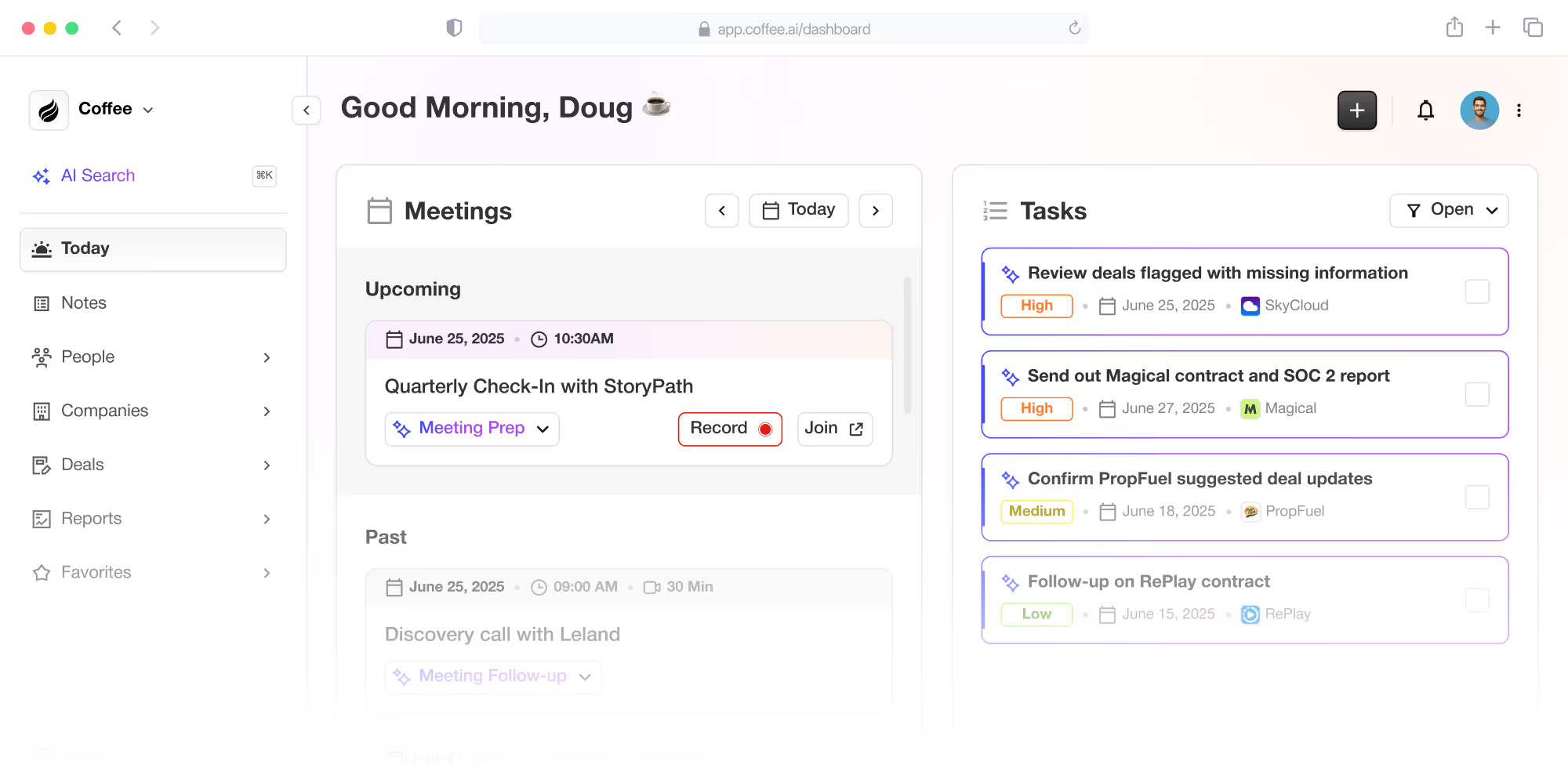
Before calls, Coffee’s “Today” page offers briefings with attendee details, roles, company data, and past interaction summaries, helping you prepare quickly.
During meetings on Google Meet, Microsoft Teams, or Zoom, Coffee’s AI bot records and transcribes. This frees you from note-taking, letting you focus on the conversation.
Afterward, it generates summaries, highlights action items, and drafts follow-up emails. Review and send these from Gmail with minimal edits, saving post-meeting time. Summaries can follow frameworks like BANT or MEDDIC for consistent deal tracking.
Teams report better call quality from briefings and fewer overlooked tasks due to automated summaries, cutting down on administrative follow-up.
Step 5: Track Pipeline Changes Automatically
Monitoring deal progress manually for reviews or updates is a drain. Coffee’s “Pipeline Compare” feature delivers insights without the effort.
Using historical data snapshots, it shows week-over-week pipeline changes. Spot progressed deals, new additions, or stalled opportunities with a single click.
Managers find review meetings more strategic, focusing on deal tactics rather than data collection. Reps save time on manual tracking.
To explore this feature, request access to Coffee and see how it simplifies pipeline oversight.
Clear Benefits of Cutting Data Entry with AI in Salesforce
Shifting to AI automation for data entry delivers measurable gains in sales performance. Tools like Coffee bring time savings, better data, and stronger results.
Reps using Coffee save an estimated 8 to 12 hours weekly on routine tasks. Automation handles contact setup, data updates, activity logs, and meeting follow-ups, freeing time for selling.
Data accuracy improves noticeably. Real-time updates and automatic enrichment reduce errors and gaps common in manual records.
CRM usage rises when Salesforce feels supportive rather than burdensome. Higher engagement means managers get clearer views of sales activities for better guidance.
Pipeline tracking becomes more reliable with updated data. Features like Pipeline Compare help managers plan strategically with a full picture of deal status.
| Feature | Manual Salesforce Effort | Coffee’s AI Solution | Time Savings |
|---|---|---|---|
| Contact/Company Setup | Heavy manual input | AI auto-creates and enriches | Substantial, varies by team |
| Data Updates | Separate tools, manual transfers | Built-in, automatic | Significant, based on usage |
| Activity Tracking | Manual post-interaction | Auto-logged via email/calendar | Notable, team-dependent |
| Meeting Follow-Ups | Manual notes and emails | AI summaries and drafts | Considerable, per meeting |
These gains compound. Better data fuels stronger sales efforts, improving outcomes across the board for reps, managers, and the organization.
Cost reductions are also possible. Coffee consolidates features like enrichment and pipeline tools, potentially lowering expenses on multiple standalone solutions.
Advanced Ways to Minimize Data Entry with AI in Salesforce
Once basic automation is in place, deeper strategies with Coffee’s features can further reduce data entry and build a proactive sales approach.
The List Builder tool supports precise prospecting. Use natural language to search for roles or companies matching specific criteria, tapping enriched data without manual uploads.
API options enable tailored integrations. One company used Coffee’s API to pull data for custom briefings and action plans, fitting their unique workflow.
Keep optimizing workflows. Regularly assess manual tasks to find new areas for Coffee’s automation to step in, trimming data entry further.
To dive into these capabilities, request access to Coffee and explore how AI can elevate your sales processes.
Common Questions About Reducing Salesforce Data Entry with AI
How Does Coffee Protect Data When Integrated with Salesforce?
Coffee adheres to strict security standards, including SOC 2 Type 2 and GDPR compliance, safeguarding your Salesforce data during integration and automation. Policies are in place to clarify data usage for AI training.
Does Coffee Replace My Current Salesforce Setup?
Coffee works alongside Salesforce, not as a replacement. It enhances your existing system by adding automation, reducing data entry while keeping Salesforce as your core record hub.
How Does Coffee’s Data Enrichment Stack Up Against Standalone Tools?
Coffee’s built-in enrichment meets most sales needs effectively. It updates records automatically upon creation and maintains them, cutting manual effort compared to separate tools.
What Time Savings Can My Team Expect with Coffee?
Teams using Coffee often save 8 to 12 hours per week on data entry and admin tasks. Gains come from automated contacts, updates, logs, and meeting workflows, with results visible early on.
Can Coffee Adapt to Complex Salesforce Configurations?
Coffee supports intricate sales processes and custom Salesforce setups. It works with unique fields, objects, and methodologies like BANT or MEDDIC. Complex setups may need extra configuration but still benefit from automation.
Wrapping Up: Boost Sales by Cutting Data Entry in Salesforce
Heavy data entry demands in Salesforce slow down sales teams, pulling focus from deal-closing to paperwork. Every hour spent on manual updates is an hour lost on revenue-generating work.
As part of a growing wave of AI solutions, Coffee’s companion app tackles this issue head-on. It automates contact setup, data updates, activity tracking, and meeting follow-ups, significantly reducing workload while keeping records accurate.
The payoff is clear: more selling time, sharper pipeline insights, and happier reps. Coffee fits into your current Salesforce system, turning a hurdle into an asset.
With sales tech evolving, adopting AI automation offers a competitive edge. Coffee stands out as a key player in this trend, helping teams make Salesforce a true enabler.
Don’t let data entry hold your team back. Take the first step to reclaim selling time. Request access to Coffee’s AI Companion App and see how it can improve your sales operations today.